Cross validated question
 Another problem generated by X’validated (on which I spent much too much time!): given an unbiased coin that produced M heads in the first M tosses, what is the expected number of additional tosses needed to get N (N>M) consecutive heads?
Consider the preliminary question of getting a sequence of N heads out of k tosses, with probability 1-p(N,k). The complementary probability is given by the recurrence formula
Indeed, my reasoning is that the event of no consecutive N heads out of k tosses can be decomposed according to the first occurrence of a tail out of the first N tosses. Conditioning on whether this first tail occurs at the first, second, …, nth draw leads to this recurrence relation. As I wanted to make sure, I rand the following R code

[sourcecode language=”r” gutter=”false”]
#no sequence of length N out of k draws
pnk=function(N,k){
if (k<N){
p=1}
else{
p=0
for (j in 1:N)
p=p+pnk(N,k-j)/2^j
}
return(p)
}
[/sourcecode]
and got the following check:
[sourcecode language=”r” gutter=”false”] > k=15
> #N=2
> 1-pnk(2,k)-sum(apply(vale[,-1]*vale[,-k],1,max))/10^6
[1] 6.442773e-05
> #N=3
> 1-pnk(3,k)-sum(apply(vale[,-(1:2)]*vale[,-c(1,k)]*vale[,-((k-1):k)],1,max))/10^6
[1] 0.0004090137
[/sourcecode]
Next, the probability of getting the first consecutive N heads in m≥ N tosses is
Both first cases are self-explanatory. the third case corresponds to a tail occurring at the m−N−1th draw, followed by N heads, and prohibiting N consecutive heads prior to the m−N−1th toss. When checking by

[sourcecode language=”r” gutter=”false”]
Tsim=10^7
S=sample(c(0,1),Tsim,rep=TRUE)
SS=S[-Tsim]*S[-1]
out=NULL
i=2
while (i<=length(SS)){
if ((SS[i]==1)&&(SS[i-1]==1)){
out=c(out,i);i=i+1}
i=i+1}
dif=diff((1:length(SS[-out]))[SS[-out]==1])
trobs=probs=tabulate(dif+(dif==1))/length(dif)[1:20]
for (t in 1:20) trobs[t]=qmn(2,t)
barplot(probs,col="orange2",ylim=c(-max(probs),max(probs)))
barplot(-trobs[1:20],col="wheat",add=TRUE)
[/sourcecode]
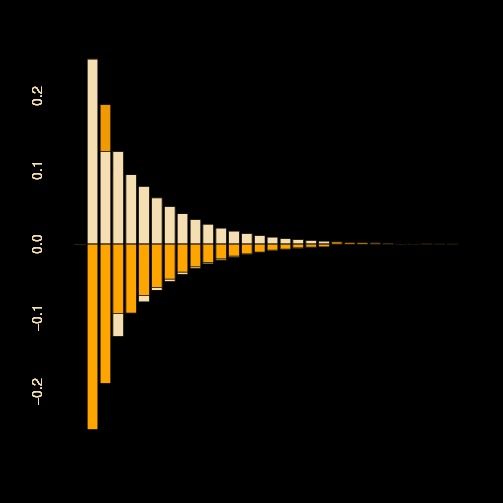
I however get a discrepancy shown in the above graph for the cases m=3,4, and N=2, which is due to the pseudo-clever way I compute the waiting times, removing the extra 1’s… Because the probabilities to wait 3 and 4 times for 2 heads should really be both equal to 1/2³. And things agree after that.
Now, the probability to get M heads first and N heads in m≥ N tosses (and no less) is

The third case is explained by the fact that completions of the first sequence of heads must stop (by a tail) before reaching N heads. Hence the conditional probability of waiting m tosses to get N consecutive heads given the first M consecutive heads is
The expected number can then be derived by


or

for the number of *additional* steps…
Checking for the smallest values of M and N, I got a reasonable agreement with the theoretical value of 2N+1-2M+1(established on Cross validated). (For larger values of M and N, I had to replace the recursive definition of pnk with a matrix computed once for all.)
October 24, 2016 at 7:27 am
Old thread, but I found myself reading (and actually noticing the xi’an username attached to) one of your cross-validated answers today. http://stats.stackexchange.com/questions/22879/linear-combination-of-two-dependent-multivariate-normal-random-variables
It was early in the morning.
October 25, 2016 at 7:49 am
You should not stay awake that late on my behalf, you know..!
February 23, 2012 at 5:53 am
[…] Xi’an’s Og studies a CrossValidated.SE question. […]
February 21, 2012 at 12:20 am
Is it possible with today’s manufacturing processes to produce a unbiased coin?
February 23, 2012 at 3:35 pm
Dear John, unfortunately your question is the wrong way round. Andrew Gelman and Deborah Nolan make the strong point that there actually is no such thing as a biased coin: http://www.stat.columbia.edu/~gelman/research/published/diceRev2.pdf