ABConic mean evidence approximation
 Following a question on X validated about evidence approximation in ABC settings, i.e., on returning an approximation of the evidence based on the outputs of parallel ABC runs for the models under comparison, I wondered at the relevance of an harmonic mean estimator in that context.
Rather than using the original ABC algorithm that proposes a model, a parameter from that model, and a simulated dataset from that model with that parameter, an alternate, cost-free, solution would be to run an ABC version of [harmonic mean evidence approximation à la Newton & Raftery (1994). Since
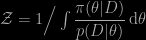
the evidence can formally be approximated by

and its ABC version is

where Kε(.) is the kernel used for the ABC acceptance/rejection step and d(.,.) is the distance used to measure the discrepancy between samples. Since the kernel values are already computed for evidence, the cost is null. Obviously, an indicator kernel does not return a useful estimate but something like a Cauchy kernel could do.
However, when toying with a normal-normal model and calibrating the Cauchy scale to fit the actual posterior as in the above graph, the estimated evidence 5 10⁻⁵ proved much smaller than the actual one, 8 10⁻².
Leave a Reply