
Archive for the Linux Category
the vim cheat sheet
Posted in Kids, Linux, R, University life, Wines with tags An Evil Guest, editor, unix, vim on March 18, 2015 by xi'an
Ubuntu issues
Posted in Kids, Linux with tags Bluetooth, Kubuntu, Linux, Ubuntu 14.04 on February 28, 2015 by xi'an It may be that weekends are the wrong time to tamper with computer OS… Last Sunday, I noticed my Bluetooth icon had a “turn off” option and since I only use Bluetooth for my remote keyboard and mouse when in Warwick, I turned it off, thinking I would turn it on again next week. This alas led to a series of problems, maybe as a coincidence since I also updated the Kubuntu 14.04 system over the weekend.
- I cannot turn Bluetooth on again! My keyboard and mouse are no longer recognised or detected. No Bluetooth adapter is found by the system setting. Similarly, sudo modprobe bluetooth shows nothing. I have installed a new interface called Blueman but to no avail. The fix suggested on forums to run rfkill unblock bluetooth does not work either… Actually rfkill list all only returns the wireless device. Which is working fine.
- My webcam vanished as well. It was working fine before the weekend.
- Accessing some webpages, including all New York Times articles, now takes forever on Firefox! If less on Chrome.
Is this a curse of sorts?!
As an aside, I also found this week that I cannot update Adobe reader from version 9 to version 11, as Adobe does not support Linux versions any more… Another bummer. If one wants to stick to acrobat.
Update [03/02]
Thanks to Ingmar and Thomas, I got both my problems solved! The Bluetooth restarted after I shut down my unplugged computer, in connection with an USB over-current protection. And Thomas figured out my keyboard had a key to turn the webcam off and on, key that I had pressed when trying to restart the Bluetooth device. Et voilà!
Glibc GHOST vulnerability
Posted in Linux with tags C, Glibc, Kubuntu 12.04, Linux, security vulnerability, Ubuntu 10.10 on January 28, 2015 by xi'anJust heard about a security vulnerability on Linux machines running Red Hat version 5 to 7, Ubuntu 10.04 and 12.04, Debian version 7, Fedora versions 19 and older, and SUSE versions 11 and older. The vulnerability occurs through a buffer overflow from some functions in the C library Glibc, which allows for a remote code to execute, and the fix to the problem is indicated on that NixCRaft webpage. (It is also possible to run the GHOST C code if you want to live dangerously!)
BibTool on the air
Posted in Books, Linux, Travel, University life with tags bash, BibTeX, BibTool, Birmingham, Charles de Gaulle, LaTeX, link, Linux, RER B, Roissy, University of Warwick on October 23, 2014 by xi'an Yesterday night, just before leaving for Coventry, I realised I had about 30 versions of my “mother of all .bib” bib file, spread over directories and with broken links with the original mother file… (I mean, I always create bib files in new directories by a hard link,
ln ~/mother.bib
but they eventually and inexplicably end up with a life of their own!) So I decided a Spring clean-up was in order and installed BibTool on my Linux machine to gather all those versions into a new encompassing all-inclusive bib reference. I did not take advantage of the many possibilities of the program, written by Gerd Neugebauer, but it certainly solved my problem: once I realised I had to set the variates
check.double = on
check.double.delete = on
pass.comments = off
all I had to do was to call
[sourcecode language=”bash” gutter=”false”]
bibtool -s -i ../*/*.bib -o mother.bib
bibtool -d -i mother.bib -o mother.bib
bibtool -s -i mother.bib -o mother.bib
[/sourcecode]
to merge all bib file and then to get rid of the duplicated entries in mother.bib (the -d option commented out the duplicates and the second call with -s removed them). And to remove the duplicated definitions in the preamble of the file. This took me very little time in the RER train from Paris-Dauphine (where I taught this morning, having a hard time to make the students envision the empirical cdf as an average of Dirac masses!) to Roissy airport, in contrast with my pedestrian replacement of all stray siblings of the mother bib into new proper hard links, one by one. I am sure there is a bash command that could have done it in one line, but I spent instead my flight to Birmingham switching all existing bib files, one by one…
how far can we go with Minard’s map?!
Posted in Books, Linux, pictures, Statistics, Travel with tags Berezina, book review, Grande Armée, Kraak, map, Minard, Napoléon, Patriotic war, Russian campaign, Russian winter, Tufte on October 13, 2014 by xi'an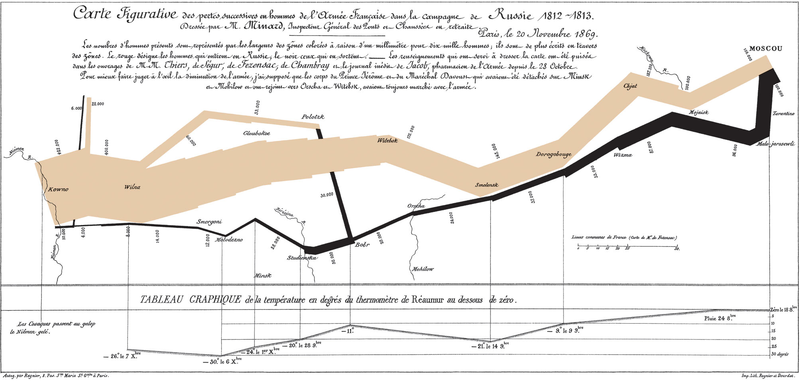 Like many others, I discovered Minard’s map of the catastrophic 1812 Russian campaign of Napoleon in Tufte’s book. And I consider it a masterpiece for its elegant way of summarising some many levels of information about this doomed invasion of Russia. So when I spotted
 Apart from the trivia about familial connection with the Russian campaign and the Berezina crossing which killed one of his direct ancestors, his great-great-grandfather, along with a few dozen thousand others (even though this was not the most lethal part of the campaign), he brings different perspectives on the meaning of
 a map and the quantity of information one could or should display. This is not unlike other attempts at competiting with Minard, including those listed on Michael Friendly’s page. Incl. the cleaner printing above. And the dumb pie-chart… A lot more can be done in 2013 than in 1869, indeed, including the use of animated videos, but I remain somewhat sceptical as to the whole purpose of the book. It is a beautiful object, with wide margins and nice colour reproductions, for sure, alas… I just do not see the added value in work. I would even go as far as thinking this is an a-statistical approach, namely that by trying to produce as much data as possible into the picture, he forgets the whole point of the drawing which is I think to show the awful death rate of the Grande Armée along this absurd trip to and from Moscow and the impact of temperature (although the rise that led to the thaw of the Berezina and the ensuing disaster does not seem correlated with the big gap at the crossing of the river). If more covariates were available, two further dimensions could be added: the proportions of deaths due to battle, guerilla, exhaustion, desertion, and the counterpart map of the Russian losses. In the end, when reading I learned more about the history surrounding this ill-planned military campaign than about the proper display of data towards informative and unbiased graphs.


