 Just received the good news that our paper Faster Hamiltonian Monte Carlo by Learning Leapfrog Scale by Wu Changye (吴昌烨), Pierre Pudlo, Julien Stoehr and myself, got accepted in Statistics & Computing! This is great in its own, but further concludes a story that started with Changye’s PhD thesis at Paris Dauphine in 2018, with a revision request from Statistics & Computing that stalled with Changye’s departing for industry in Shanghai and eventually resumed thanks to Julien’s massive investment in coding and improving the learning mechanism. It may also conclude my story with Statistics & Computing, where I am supposed to be the historically most prolific author (?), given the move by Springer to a cash-flow model on 01 January, 2027…
Archive for eHMC
faster HMC by learning
Posted in Books, Kids, Statistics, University life with tags algorithm, conformal Hamiltonian dynamics, eHMC, Hamiltonian Monte Carlo, HMC, leapfrog integrator, mirror descent, No-U-Turn sampler, NUTS, PhD thesis, population Monte Carlo, publication fees, revision, Scholarly Open Access, Shanghai, Springer Nature, Statistics & Computing, tempering, Università Ca' Foscari Venezia on September 23, 2026 by xi'anrevised empirical HMC
Posted in Statistics, University life with tags eHMC, github, Hamiltonian Monte Carlo, leapfrog integrator, NUTS, Rao-Blackwellisation, revision, scaling, STAN on March 12, 2019 by xi'anFollowing the informed and helpful comments from Matt Graham and Bob Carpenter on our eHMC paper [arXival] last month, we produced a revised and re-arXived version of the paper based on new experiments ran by Changye Wu and Julien Stoehr. Here are some quick replies to these comments, reproduced for convenience. (Warning: this is a loooong post, much longer than usual.) Continue reading
faster HMC [poster at CIRM]
Posted in Statistics with tags CIRM, eHMC, HMC, Jean Morlet Chair, Luminy, Monte Carlo Statistical Methods, NUTS, poster, Université Aix Marseille on November 26, 2018 by xi'anaccelerating HMC by learning the leapfrog scale
Posted in Books, Statistics with tags eHMC, ESJD, ESS, Hamiltonian Monte Carlo, HMC, leapfrog integrator, mixing speed, NUTS, stochastic volatility on October 12, 2018 by xi'an In this new arXiv submission that was part of Changye Wu’s thesis [defended last week], we try to reduce the high sensitivity of the HMC algorithm to its hand-tuned parameters, namely the step size ε of the discretisation scheme, the number of steps L of the integrator, and the covariance matrix of the auxiliary variables. By calibrating the number of steps of the Leapfrog integrator towards avoiding both slow mixing chains and wasteful computation costs. We do so by learning from the No-U-Turn Sampler (NUTS) of Hoffman and Gelman (2014) which already automatically tunes both the step size and the number of leapfrogs.
The core idea behind NUTS is to pick the step size via primal-dual averaging in a burn-in (warmup, Andrew would say) phase and to build at each iteration a proposal based on following a locally longest path on a level set of the Hamiltonian. This is achieved by a recursive algorithm that, at each call to the leapfrog integrator, requires to evaluate both the gradient of the target distribution and the Hamiltonianitself. Roughly speaking an iteration of NUTS costs twice as much as regular HMC with the same number of calls to the integrator. Our approach is to learn from NUTS the scale of the leapfrog length and use the resulting empirical distribution of the longest leapfrog path to randomly pick the value of L at each iteration of an HMC scheme. This obviously preserves the validity of the HMC algorithm.
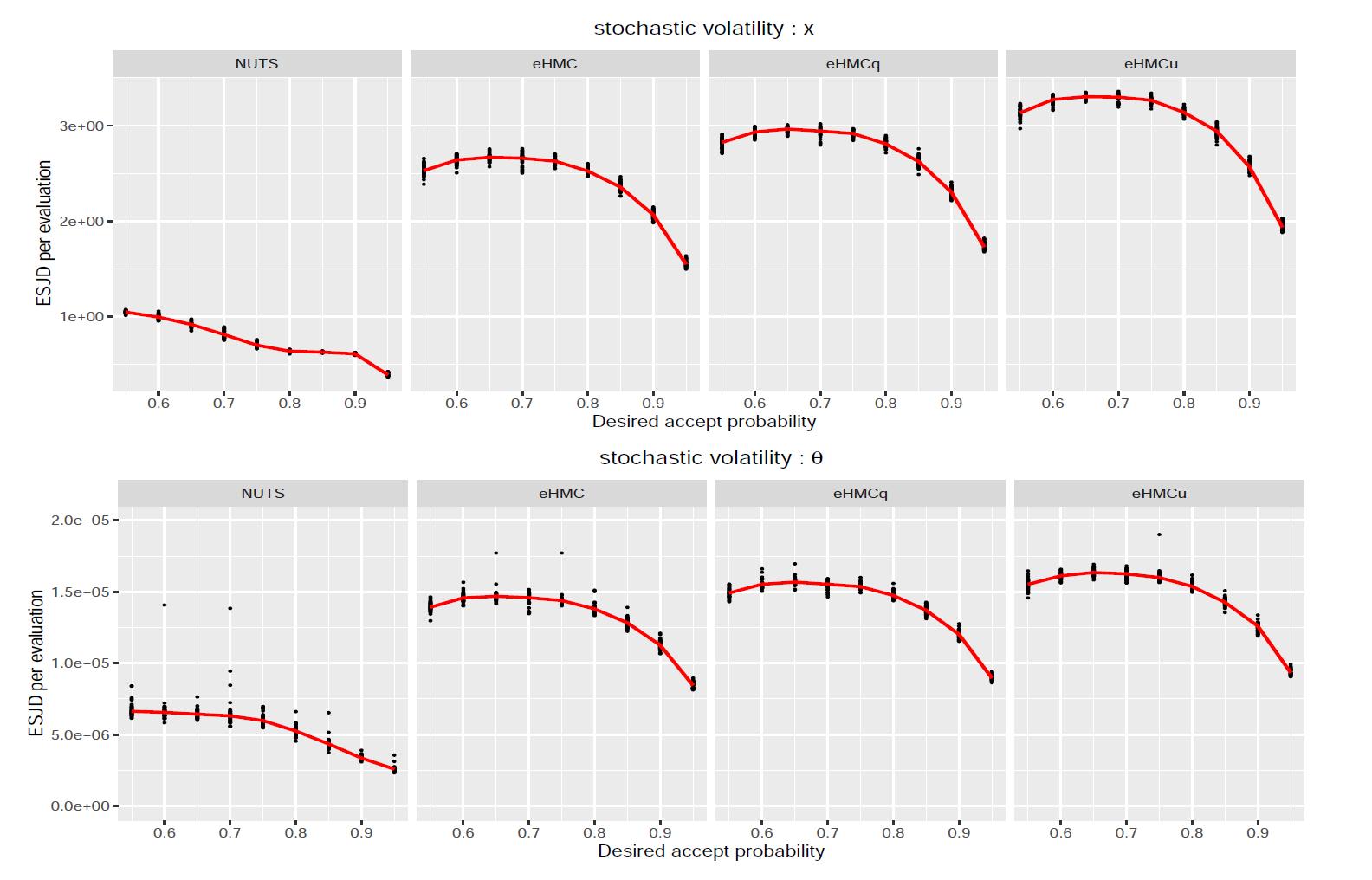 While a theoretical comparison of the convergence performances of NUTS and this eHMC proposal seem beyond our reach, we ran a series of experiments to evaluate these performances, using as a criterion an ESS value that is calibrated by the evaluation cost of the logarithm of target density function and of its gradient, as this is usually the most costly part of the algorithms. As well as a similarly calibrated expected square jumping distance. Above is one such illustration for a stochastic volatility model, the first axis representing the targeted acceptance probability in the Metropolis step. Some of the gains in either ESS or ESJD are by a factor of ten, which relates to our argument that NUTS somewhat wastes computation effort using a uniformly distributed proposal over the candidate set, instead of being close to its end-points, which automatically reduces the distance between the current position and the proposal.

