
Archive for completion
biXarre, biXarre
Posted in Books, Statistics with tags completion, cross validated, GARCH model, Gibbs sampler, latent data, Metropolis-Hastings algorithm on May 2, 2024 by xi'an
insufficient Gibbs sampling bridges as well!
Posted in Books, Kids, pictures, R, Statistics, University life with tags ABC, ABC model choice, Bayes factor, bridge sampling, completion, evidence, Gibbs sampling, insufficient statistic, latent variable, mad, median, model comparison, revision on March 3, 2024 by xi'an
Antoine Luciano, Robin Ryder and I posted a revised version of our insufficient Gibbs sampler on arXiv last week (along with three other revisions or new deposits of mine’s!), following comments and suggestions from referees. Thanks to this revision, we realised that the evidence based on an (insufficient) statistic was also available for approximation by a Monte Carlo estimate attached to the completed sample simulated by the insufficient sampler. Better, a bridge sampling estimator can be used in the same conditions as when the full data is available! In this new version, we thus revisited toy examples first explored in some of my ABC papers on testing (with insufficient statistics), as illustrated by both graphs on this post.

mostly MC[bruary]
Posted in Books, Kids, Statistics, University life with tags completion, contour algorithm, Gibbs sampling, insufficiency, IQR, mad, manifold, MCMC, median, Monte Carlo methods, Monte Carlo Statistical Methods, mostly Monte Carlo seminar, Paris, PariSanté campus, sample median, seminar, The Prairie Chair on February 18, 2024 by xi'an
truncated mixtures
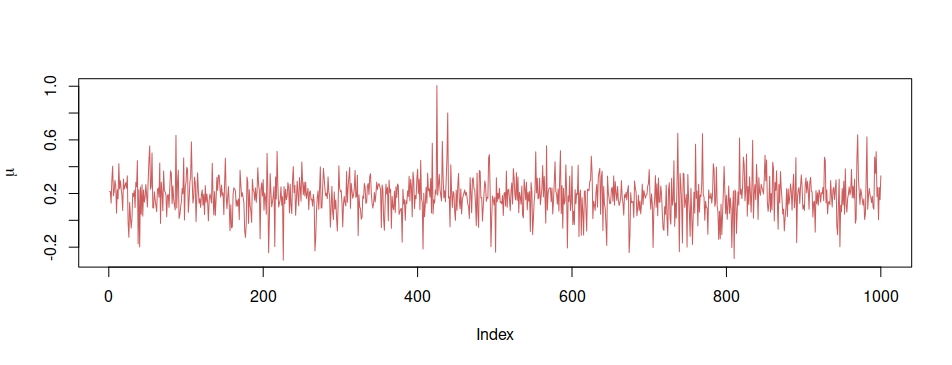
Posted in Books, pictures, R, Statistics with tags completion, cross validated, EM, expectation maximisation, Gibbs sampler, R on May 4, 2022 by xi'an A question on X validated about EM steps for a truncated Normal mixture led me to ponder whether or not a more ambitious completion [more ambitious than the standard component allocation] was appropriate. Namely, if the mixture is truncated to the interval (a,b), with an observed sample x of size n, this sample could be augmented into an untrucated sample y by latent samples over the complement of (a,b), with random sizes corresponding to the probabilities of falling within (-∞,a), (a,b), and (b,∞). In other words, y is made of three parts, including x, with sizes N¹, n, N³, respectively, the vector (N¹, n, N³) being a trinomial M(N⁺,p) random variable and N⁺ an extra unknown in the model. Assuming a (pseudo-) conjugate prior, an approximate Gibbs sampler can be run (by ignoring the dependence of p on the mixture parameters!). I did not go as far as implementing the idea for the mixture, but had a quick try for a simple truncated Normal. And did not spot any explosive behaviour in N⁺, which is what I was worried about. Of course, this is mostly anecdotal since the completion does not bring a significant improvement in coding or convergence (the plots corresponds to 10⁴ simulations, for a sample of size n=400).
Typo in MCSM
Posted in Books, Statistics with tags censored data, completion, EM algorithm, Monte Carlo Statistical Methods, typos on February 20, 2010 by xi'anI received the following email from Liaosa Xu this morning about Monte Carlo Statistical Methods:
I am reading your text to learn MCMC. However I feel confused for Example 5.14. I don’t understand how to derive Likelihood of y by the integration of product completed data’s likelihood and conditional density of z given y. Since conditional density of z is just f(z-theta)/(1-F(a-theta)), then we actually integrate f(z-a)^2 over [a, +infinity). How to finally get the likelihood of y? I feel confused about this problem. Could you help me out. Thanks a lot for your answer.
and there is indeed a mistake in the example. The integration of the complete likelihood is

where 


and

which is plain wrong, as pointed above by Liaosa Xu.
Ps-If you see the above LaTeX formula for the correct decomposition twice, it is because I wrote it twice in the HTML code. (If you don’t, forget about the following.) For some incomprehensible reason, including the first formula for the complete likelihood erases the two following lines, at least on my output. I tried to play with the entries in the LaTeX formula but did not find a clear culprit!


