Archive for pseudo-random generator

truly and uniquely pseudo-random?

Posted in Books, pictures, Statistics, Travel, University life with tags , , , , , , , , , , , , , on July 10, 2024 by xi'an

I came across a Web paper entitled The Impact of Google’s Random Number Generator on Accurate Results that I found most puzzling in failing to explain the specific nature of this random generator and that included gems as below

“PRNGs (…) outputs are inherently predictable given a specific seed value, thus deviating from true randomness”

or stating that linear congruential generators suffered from “discernible patterns”, or yet advancing a bonus in using Google’s generator for “leveraging Gaussian distributions”… Referring to a specific and possibly obscure arXival proposing to construct (yet) a PRNG by reinforced learning, with an objective function based on randomness tests reminded me of Marsaglia’s Die Hard. And to “true randomness”. Plus being repetitive and obsequious. Until I found the piece was “written” by Quthor with no typo, an AI “writer” powered by Quick Creator. I should have paid more attention to the level of nonsense…

On the same occurrence, I also read a recent Scientific American paper on randomness tests pseudo-random number generators by Christopher Lutsko. Which does not start that well, since it reproduces the Laplace démon’s argument that a die roll outcome is not random. Also repeating the above pleonasm that PRNGs are not random since they are deterministic. And failing to not mention lava generators! The core of the article is however about recent papers by the author and Niclas Technau of the only examples of sequences that prove passed extremely strong pseudorandom tests. They focus on tests based on gap distribution and pair correlation.

“The [gap distribution] measures the size of the gaps between the points, and the [pair correlation’ measures the clustering of the points—how much they group up or stay apart (…) If these agree with what we would expect from random data, we say that the gap distribution or pair correlation is “Poissonian”.”  Christopher Lutsko

Along with Athanasios Sourmelidis, they proved that exponential sequences {α exp(θ log[n]) mod 1} have Poissonian pair correlation when θ<⅓, for any value of α. And higher Poissonian correlations for θ “smaller and smaller“. (This does not come out of the blue, as the proof relates to Van der Corput’s method of exponential sums, with links to the leading Austrian random generator community.) This is definitely an achievement. However, when θ gets “smaller and smaller“, the terms in the sequence grow more and more slowly, which forces calling for larger and larger values of α to make the generator useful. And the pseudo-randomness test based on Poissonian correlations is only one of many from the toolbox, so the debate seems far from over.


[very] simple rejection Monte Carlo

Posted in Books, pictures, R, University life with tags , , , , , , , , on March 29, 2024 by xi'an

“In recent years, the Rejection Monte Carlo (RMC) algorithm has emerged sporadically in literature under alternative names such as screening sampling or reject-accept sampling algorithms”

First, I was intrigued enough by a new arXival spotted in the Thalys train from Brussels to take a deeper look at it, but soon realised there was nothing of substance in the paper. Which solely recalls the fundamental of (accept-)reject algorithms, invented in the early days of computer simulation by von Neumann (even though the preprint refers to much more recent publications).  Without providing the average acceptance probability as being equal to the inverse of the bounding constant [independently of the dimension of the random variable] and no mention of The Bible either… But with a standard depiction of accepted vs rejected points as uniformly dispersed on the subgraph of the proposal (as in the above taken from our very own Monte Carlo statistical Methods). Funnily enough, the most basic rejection algorithm, that is, the one based on a uniform sampling from a bounding (hyper)box is illustrated for a Normal target, although the latter has infinite support. And the paper seems to conclude on the appeal of using uniform proposals over bounding boxes, even though the increasing inefficiency against the dimension is well-known. A very simple rejection then, indeed!

simulating signed mixtures

Posted in Books, pictures, R, Statistics, University life with tags , , , , , , , , on February 2, 2024 by xi'an

While simulating from a mixture of standard densities is relatively straightforward, when the component densities are easily simulated, to the point that many simulation methods exploit an intermediary mixture construction to speed up the production of pseudo-random samples from more challenging distributions (see Devroye, 1986), things get surprisingly more complicated when the mixture weights can take negative values. For instance, the naïve solution consisting in first simulating from the associated mixture of positive weight components and then using an accept-reject step may prove highly inefficient since the overall probability of acceptance

{\displaystyle 1}\Big/{\displaystyle \sum_{k=1}^{P} \omega_k^+}

is the inverse of the sum of the positive weights and hence can be arbitrarily close to zero. The intuition for such inefficiency is that simulating from the positive weight components need not produce values within regions of high probability for the actual distribution

m = \sum_{k=1}^P \omega_k^+ f_k - \sum_{k=1}^N \omega_k^- g_k

since its negative weight components may remove most of the mass under the positive weight components. In other words, the negative weight components do not have a natural latent variable interpretation and the resulting mixture can be anything, as the above graph testifies.

Julien Stoehr (Paris Dauphine) and I started investigating this interesting challenge when the Master students who had been exposed to said challenge could not dent it in any meaningful way. We have now arXived a specific algorithm that proves superior to the naïve accept-reject algorithm, but also to the numerical cdf inversion (which happens to be available in this setting). Compared with the naïve version, we construct an alternative accept-reject scheme based on pairing positive and negative components as well as possible, partitioning the real line, and finding tighter upper and lower bounds on positive and negative components, respectively, towards yielding a higher acceptance rate on average. Designing a random generator of signed mixtures with enough variability and representativity proved a challenge in itself!

probabilistic numerics [book review]

Posted in Books, pictures, Statistics, Travel with tags , , , , , , , , , , , , , , , , , , , , on July 28, 2023 by xi'an

Probabilistic numerics: Computation as machine learning is a 2022 book by Philipp Henning, Michael Osborne, and Hans Kersting that was sent to me by CUP (upon my request and almost free of charge, as I had to pay custom charges, thanks to Brexit!). With the important message of bringing statistical tools to numerics. I remember Persi Diaconis calling for (such) actions in the 1980’s (and even reading a paper of his on the topic along with George Casella in Ithaca while waiting for his car to get serviced!).

From a purely aesthetic view point, the book reads well, offers a beautiful cover and sells for a quite reasonable price for an academic book. Plus it is associated with a website containing draft version of the book. Code, links to courses, research, conferences are also available there. Just a side remark that it enjoys very wide margins that may have encouraged an inflation of footnotes (but also exercises). Except when formulas get in the way (as e.g. on p.40).

The figure below is an excerpt from the introduction that sets the scene of probabilistic numerics involving algorithms as agents, gathering data and making decisions, with an obvious analogy with standard Bayesian decision theory. Modelling uncertainty missing from the picture (if not from the book, as explained later by the authors as an argument against attaching the label Bayesian to the field). Also referring to Henri Poincaré for the origination of the prior vs posterior uncertainty about a mathematical quantity. Followed by early works from the Russian school of probability, somewhat ignored until the machine-learning revolution and a 2012 NIPS workshop organised by the authors. (I participated to a follow-up workshop at NIPS 2015.)

In this nicely written section, I have an objection to the authors’ argument that a frequentist, as opposed to a Bayesian, “has the loss function in mind from the outset” (p.9), since the loss function is logically inseparable from the prior and considered from the onset. I also like very much the conclusion to that introduction, namely that the main messages (from the book) are that (verbatim)

  • classical methods are probabilist (p.10)
  • numerical methods are autonomous agents (p.11)
  • numerics should not be random (if not a rejection of the concept of Monte Carlo methods, p.1, but probabilistic numerics being opposed to stochastic numerics, p.67)
  • numerics must report calibrated uncertainty (p.12)
  • imprecise computation is to be embraced (p.12)
  • probabilistic numerics consolidates numerical computation and statistical inference (p.13)
  • probabilistic numerical algorithms are already adding value (p.13)
  • pipelines of computation demand harmonisation

“Is it still reasonable to labour under computational constraints conceived in the 1940s?” (p.113)

“rather than being equally good for any number of dimensions, Monte Carlo is perhaps better thought of as being equally bad” (p.110)

Chapter I is a 40p infodump (!) on mathematical concepts needed for the following parts. Chapter II is about integration, opposing again PN and Monte Carlo (with strange remark that MCMC does not achieve √N convergence rate, p.72). In the sense that the later is frequentist in that it does not use a prior [unless considering a limiting improper version as in Section 12.2, an intriguing concept in this setup as I wonder whether or not improper priors can at all be contemplated] on the object of interest and hence that the stochasticity does not reflect uncertainty but rather the impact of the simulated sample. Advocating Bayesian quadrature (with some weird convergence graphs exhibiting a high variability with the number of iterations that apparently is not discussed) and bringing in the fascinating perspective of model choice in that framework (leading to compute a posterior probability for each model!). Being evidently biased towards Monte Carlo, I find the opposition in Chapter 12 unnecessarily antagonistic, while presenting Monte Carlo methods as a form of minimax solution, the more because quasi-Monte Carlo methods are hardly discussed (or dismissed). As illustrated by the following picture (p.115) and the above quotes. (And I won’t even go into the absurdity of §12.3 trashing pseudo-random generators as “painfully dumb”.)

Chapter III is a sort of dual of Chapter II for linear algebra numerics, primarily solving linear equations by Gaussian solvers, which introduces new concepts like Krylov sequences, although it sounds quite specific (for an outsider like me). Chapters IV and V deal with the more ambitious prospect of optimisation. Reconsidering classics and expanding into Bayesian optimisation, using Gaussian process priors and defining specific loss functions. Bringing in a strong link with machine learning tools and goals. [citation typo on p.277]. Chapter VII addresses the resolution of ODEs by a Bayesian state space model representation and (again!) Gaussian processes. Reaching to mentioning inverse problems and offering a short finale on prospective steps for interested readers.

[Disclaimer about potential self-plagiarism: this post or an edited version will eventually appear in my Books Review section in CHANCE.]

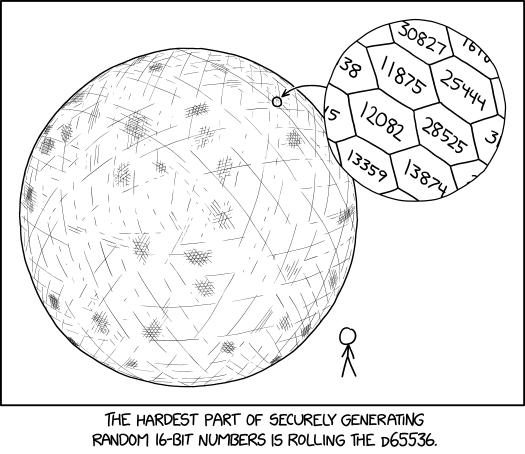
D65536 [xkcd]

Posted in Books, Kids with tags , , , on June 16, 2022 by xi'an