Archive for McGill University

the acceptance-complement method

Posted in Books, Statistics with tags , , , , , , on August 6, 2026 by xi'an

Last Saturday, while getting reacquainted with my home desk, I was delighted to spot a new arXival by Luc Devroye! Entitled the acceptance-complement method revisited, it discusses a variant of accept-reject method, where the target density f(·) is squeezed between two functions

0≤r(x)≤f(x)≤r(x)+q(x)

and can be simulated as the mixture

r(x)+(f(x)-r(x)),

assuming both r(·) and q(·) are proportional to densities that can easily be simulated. (With the additional constraint of q(·) having at most mass 1.) The nicest part is that the algorithm is always one-pass, as 

  1. generate Y~ q(y), U ~U(0,1)
  2. if Uq(Y)<f(Y)-r(Y), set X=Y
  3. else generate X~r(x)

with step 2 having two outcomes: either generate a realisation of [the density proportional to] f(·)-r(·) or generate an event of probability α when α is the mass [normalising constant] of r(·). This explains step 3 since the rejection of Y implies simulation from the second component of f(·). Brilliant! And Devroye derives a universal accept-complement algorithm for generic log-concave densities (that differs from Gilks & Wild, 1992.).

the privacy fallacy [book review]

Posted in Statistics with tags , , , , , , , , , , , , , , , , , , , , , , , , , , , , , on May 3, 2024 by xi'an

“The World changed significantly since 1973.” (p.10)

I read this book, The Privacy Fallacy: Harm and Power in the Information Economy, by Ignacio Cofone, upon my return from Warwick the past week. This is a Cambridge University Press 2023 book I had picked from their publication list after reviewing a book proposal for them. A selection made with our ERC OCEAN goals in mind, but without paying enough attention to the book table of contents, since it proved to be a Law book!

“People’s inability to assess privacy risks impact people’s behavior toward privacy because it turns the risks into uncertainty, a kind of risk that is impossible to estimate.” (p.31)

Still, this ended up being a fairly interesting read (for me) about the shortcomings of the current legal privacy laws (in various countries), since they are based on an obsolete perception that predates AIs and social media. Its main theme is that privacy is a social value that must be protected, regardless of whether or not its breach has tangible consequences. The author then argues that notions that support these laws such as the rationality of individual choices, the confusion between privacy and secrecy, the binary dichotomy between public and private, &tc., all are erroneous, hence the “fallacy” he denounces. One immediate argument for his position is the extreme imbalance of information between individuals and corporations, the former being unable to assess the whole impact of clicking on “I agree” when visiting a webpage or installing a new app. The more because the data thus gathered is pipelined to third parties. (“One’s efforts cannot scale to the number of corporations collecting and using one’s personal data”, p.93) For similar reasons, Cofone further states that the current principles based on contracts are inappropriate. Also because data harm can be collective and because companies have a strong incentive to data exploitation, hence a moral hazard.

“Inferences, relational data, and de-identified data aren’t captured by consent provisions.” (p.9)

“AI inferences worsen information overload (…) As [they] continue to grow, so will the insufficiency of our processing ability to estimate our losses.” (p.75)

As illustrated by the surrounding quotes, the statistical and machine-learning aspects of the book are few and vague, in that the additional level of privacy loss due to post-data processing is considered as a further argument for said loss to be impossible to quantify and assess, without a proper evaluation of the channels through which this can happen and without a reglementary proposal towards its control. This level of discourse makes AIs appear as omniscient methods, unfortunately.

“Inferences are invisible (…) Risks posed by inferences are impossible to anticipate because the information inferred is disproportionate to the sum of the information disclosed.” (p.49)

“The idea of probabilistic privacy loss is crucial in a world where entities (..) mostly affect our privacy by making inferences” (p.121)

The attempts at regulation such as opt-in and informed consent are then denounced as illusions—obviously so imho, even without considering the nuisance of having to click on “Reject” for each newly visited website!—. De- and re-identified data does not require anyone’s consent. Data protection rights, as of today, do not provide protection in most cases, the burden of proof residing on the privacy victims rather than the perpetrators. The book unsurprisingly offers no technical suggestion towards ensuring corporations and data brokers comply with this respect of privacy and on the opposite agrees that institutional attempts such as GDPR remain well-intended wishful thinking w/o imposing a hard-wired way of controlling the data flows, with the “need of an enforcement authority with investigating and sanctioning powers” (p.106) . The only in-depth proposal therein is pushing for stronger accountability of these corporations via a new type of liability, with a prospect of class actions (if only in countries with this judiciary possibility).

[Disclaimer about potential self-plagiarism: this post or an edited version will eventually appear in my Books Review section in CHANCE.]

non-uniform Laplace generation

Posted in Books, pictures, Statistics, University life with tags , , , , , , , , , on June 5, 2019 by xi'an

This year, the French Statistical Society (SFDS) Prix Laplace has been granted to Luc Devroye, author of the Non-Uniform Random Generation bible. among many achievements!, prize that he will receive during the 2019 meeting in Nancy, this very week.

a question from McGill about The Bayesian Choice

Posted in Books, pictures, Running, Statistics, Travel, University life with tags , , , , , , , on December 26, 2018 by xi'an

I received an email from a group of McGill students working on Bayesian statistics and using The Bayesian Choice (although the exercise pictured below is not in the book, the closest being exercise 1.53 inspired from Raiffa and Shlaiffer, 1961, and exercise 5.10 as mentioned in the email):

There was a question that some of us cannot seem to decide what is the correct answer. Here are the issues,

Some people believe that the answer to both is ½, while others believe it is 1. The reasoning for ½ is that since Beta is a continuous distribution, we never could have θ exactly equal to ½. Thus regardless of α, the probability that θ=½ in that case is 0. Hence it is ½. I found a related stack exchange question that seems to indicate this as well.

The other side is that by Markov property and mean of Beta(a,a), as α goes to infinity , we will approach ½ with probability 1. And hence the limit as α goes to infinity for both (a) and (b) is 1. I think this also could make sense in another context, as if you use the Bayes factor representation. This is similar I believe to the questions in the Bayesian Choice, 5.10, and 5.11.

As it happens, the answer is ½ in the first case (a) because π(H⁰) is ½ regardless of α and 1 in the second case (b) because the evidence against H⁰ goes to zero as α goes to zero (watch out!), along with the mass of the prior on any compact of (0,1) since Γ(2α)/Γ(α)². (The limit does not correspond to a proper prior and hence is somewhat meaningless.) However, when α goes to infinity, the evidence against H⁰ goes to infinity and the posterior probability of ½ goes to zero, despite the prior under the alternative being more and more concentrated around ½!

complexity of the von Neumann algorithm

Posted in Statistics with tags , , , , , , , , , on April 3, 2017 by xi'an

“Without the possibility of computing infimum and supremum of the density f over compact subintervals of the domain of f, sampling absolutely continuous distribution using the rejection method seems to be impossible in total generality.”

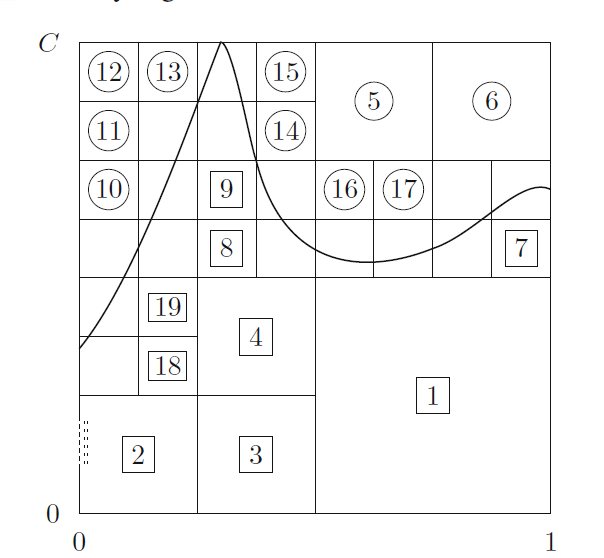
The von Neumann algorithm is another name for the rejection method introduced by von Neumann circa 1951. It was thus most exciting to spot a paper by Luc Devroye and Claude Gravel appearing in the latest Statistics and Computing. Assessing the method in terms of random bits and precision. Specifically, assuming that the only available random generator is one of random bits, which necessarily leads to an approximation when the target is a continuous density. The authors first propose a bisection algorithm for distributions defined on a compact interval, which compares random bits with recursive bisections of the unit interval and stops when the interval is small enough.

In higher dimension, for densities f over the unit hypercube, they recall that the original algorithm consisted in simulating uniforms x and u over the hypercube and [0,1], using the uniform as the proposal distribution and comparing the density at x, f(x), with the rescaled uniform. When using only random bits, the proposed method is based on a quadtree that subdivides the unit hypercube into smaller and smaller hypercubes until the selected hypercube is entirely above or below the density. And is small enough for the desired precision. This obviously requires for the computation of the upper and lower bound of the density over the hypercubes to be feasible, with Devroye and Gravel considering that this is a necessary property as shown by the above quote. Densities with non-compact support can be re-expressed as densities on the unit hypercube thanks to the cdf transform. (Actually, this is equivalent to the general accept-reject algorithm, based on the associated proposal.)

“With the oracles introduced in our modification of von Neumann’s method, we believe that it is impossible to design a rejection algorithm for densities that are not Riemann-integrable, so the question of the design of a universally valid rejection algorithm under the random bit model remains open.”

In conclusion, I enjoyed very much reading this paper, especially the reflection it proposes on the connection between Riemann integrability and rejection algorithms. (Actually, I cannot think straight away of a simulation algorithm that would handle non-Riemann-integrable densities, apart from nested sampling. Or of significant non-Riemann-integrable densities.)