Archive for dark matter

Nature tidbits [10 Sept 2026]

Posted in Books, pictures, Travel, University life with tags , , , , , , , , , , , , , , , , , , , , , , , , , , , , , , , , , , , , , , , , , , , , , , , , , , , , on October 21, 2026 by xi'an

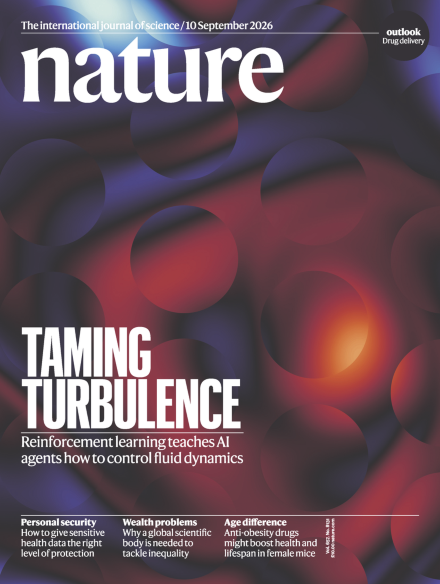
Having left my copy of the 10 September issue of Nature on a suburban train this afternoon (hopefully to the benefit of a fellow passenger!), I had to fall back on the online version. The cover story, Taming turbulence, is about HydroGym, a reinforcement-learning platform where AI agents learn to control turbulent flows. While this has practical consequences, it is also the harbinger of the resolution (?) of the Navier-Stoke Millennium Problem by OpenAI. Covered in the following issue.

Flotsam of interest for me:

  • reporting on a single data point exciting cosmologists (and beyond!), namely one unusual flash recorded in 2023 or 2024 by the LZ detector thru its 10 tonnes liquid xenon basin, which looks like what a weakly interacting massive particle (WIMP!) would produce. This would be a fist in experimentally supporting the dark matter theory. But without reproducibility, ’tis hard to jump to a conclusion. In correlation, a news article on the launch of the Nancy Grace Roman Space Telescope, with two World Views, one on Roman herself as “mother of Hubble”. Promising advances on far, far away celestial bodies thanks to the infrared abilities of said telescope. And again to cosmology.
  • a news feature on “the Einstein test”, checking whether language models trained only on pre-1905 data could rediscover relativity. This is a clever way to separate creativity from regurgitation, if the historical training corpus can indeed be kept clean. And faster than training monkeys to type…
  • an article combining climate and econometric modelling to assess how human-induced climate change has shifted, and will shift, the burden of childhood malaria in Africa. The attribution relies on counterfactual climate simulations, which makes me wonder about the propagation of uncertainty.
  • an article linking US mortgage records from around the Second World War to race and immigration status. It shows that New Deal programmes disproportionately excluded Black borrowers, a nice (if sad) record-linkage exercise.
  • a privacy feature on how UK Biobank was shut down after a data leak and is now imposing new safety measures. It raises the recurrent tension between protecting participants’ privacy and keeping data open to researchers, which connects once more with the membership-inference paper I discussed earlier.
  • an editorial praising the World Bank for publishing and verifying the raw data and code behind its reports. Other agencies should indeed follow suit!
  • a news item on the massive experience of mutating every DNA letter in a viral genome, whose effects the top AI models failed to predict (fail or pass the survival test!). A welcome reality check on AI in biology.

  • two militant comments on the economy, one by Joseph Stiglitz et al. calling for an IPCC-like International Panel on Inequality, and one on a call for measuring growth through all forms of capital, rather than GDP alone. And a great poster (reminding me of Indian movie posters) on the side!
  • an editorial on the comforting aspect of the Ig Nobel prizes, no matter how silly they sound.
  • a book review of The Winding Trail &tc. on the Principia Mathematica and Newton’s disdain for hypotheses (with his famous “hypotheses non fingo” that clashes with the modern scientific approach!), along with his habit of feuding over priority. What is amazing with Newton’s meteor trajectory is he only seriously engage into mathematics during his final undergraduate term at Cambridge, one year before the Great Plague and his revolutionary breakthroughs!

Nature tidbits [23 October 2025]

Posted in Books, Kids, pictures, Running, Travel, University life with tags , , , , , , , , , , , , , , , , , , , , , , , , , , , , , , , , , , , , , , , , , , , , , , on November 27, 2025 by xi'an

In this October issue of nature, plenty of the “usual” topics, namely AI and Trump.2.0 wrecking balls, along with two cosmology entries that related to my trip to the early universe last week, and a pros-and-cons opposition about animal testing,

a discussion on the nature of the “little red dots” that have been recently observed and whose nature remains open, the most popular explanation (I was given during lunch) being black holes surrounded by gas (even though I cannot understand why the gas is not attracted by the black hole!) [and would have produced a more exciting cover!]

a review of the recent book Discordance: The Troubled History of the Hubble Constant by Jim Baggott, entitled Why we still don’t understand the Universe — even after a century of dispute! A review that regrets that more time is spent on the Hubble “constant” (which varies with time!) rather than more controversial issues like dark matter and dark energy (And strangely bemoans that the book is focussed on scientific developments, missing sociological ones. Duh?! (Bonus for a picture of suit-and-tie Edwin Hubble sitting at the centre of a telescope),

two entries on the well-being [or lack thereof] of PhD students, with nothing particularly surprising (eg, inclusivity and respect help!), and Brazil, Australia and Italy ranking top locations but in a comparative study that does not mention France (as often in international comparisons found in Nature) despite the place being in the top 10 countries delivering PhD degrees, not that I believe PhD students are particularly well-treated in French academia!, the (unexplained) surprise being Italy ranking so high given the close resemblance between the two countries (low stipends, shortage of postdoc and permanent positions, high teaching loads for the advisor, limited travel budgets),

a conference (purposedly) made of AI-written papers reviewed by AI referees, Agents4Science 2025, how universities are rushed into adapting to AI-fluent students, whose skills are changing, and the rise in fake authors produced by paper mills, with a limited range of acceptable solutions,

why Trump 2.0‘s blackmail on pharmaceutical companies is counter-productive and likely to slow down progress, and why his massive increase of highly qualified scientists is shooting (or nuking) USelf in the foot, given the huge proportion) of im/emigrated Nobel prize winners (for physics, chemistry, and medicine), along the (post-) Nobel prize in economics is a direct or indirect reply to this regression by awarding the Prize to economists who worked on the importance of creativity and science on growth (not very surprising at first look!)

to the early Universe and back

Posted in Books, pictures, Statistics, Travel, University life with tags , , , , , , , , , , , , , , , , , , , on November 16, 2025 by xi'an

On 28 October, I spent the day at Institut d’Astrophysique de Paris (where I used to work on PMC for cosmology between 2005 and 2009), as a committee member for the habilitation defence of Florent Leclercq. Not only it was nice to be back in this unique institution (with vestiges from Laplace’s era), but this was a fantastic habilitation, with a superb thesis that beautifully gathered the different fields mastered by the candidate in a highly coherent discourse. And could serve as an introduction to cosmostatistics for many.

And provided the background to ten years (post-PhD) of research on forward modelling in cosmology and resulting Bayesian statistical analysis either by implicit likelihood (or likelihood-free) inference or by field-level inference. He describes the Simbelmynë software he developed to produce maps of the density field and analyse dark matter dynamics. Ẁhose name is borrowed from Tolkien (along with a quote from Guy Gavriel Kay!):

“How fair are the bright eyes in the grass! Evermind they are called, simbelmynë in this land of Men, for they blossom in all the seasons of the year, and grow where dead men rest.” — J.R.R. Tolkien, The Lord of the Ring

And the Bayesian computational and modelling tools he elaborated, like SELFI (Simulator expansion for likelihood-free inference, Leclercq et al., 2019), that relates to Michael Gutmann’s and Juka Corander’s BOLFI. (Obviously, I did not get every aspect right from just reading the thesis and attending the lecture, in particular the remarks on using SELFI to assess model misspecification. But I remain impressed by the scope of the work and its likely impact on the field!)

AI for the sciences [PhD funding]

Posted in Statistics with tags , , , , , , , , , on December 9, 2020 by xi'an

Our mega-university, PSL, is calling PhD candidates to apply for one of the 15 PhD scholarships supported to work on one of the 24 PhD topics proposed in the call. Deadline is 22 February 2021, the only constraint for applicants being that they must have stayed or studied less than 12 months in France, since 27 Feb 2018 … Here are some of the 24 topics:

trip to München

Posted in Mountains, Statistics, Travel, University life, Wines with tags , , , , , , , , , , , , , on October 19, 2015 by xi'an

While my train ride to the fabulous De Gaulle airport was so much delayed that I had less than ten minutes from jumping from the carriage to sitting in my plane seat, I handled the run through security and the endless corridors of the airport in the allotted time, and reached Munich in time for my afternoon seminar and several discussions that prolonged into a pleasant dinner of Wiener Schnitzel and Eisbier.  This was very exciting as I met physicists and astrophysicists involved in population Monte Carlo and parallel MCMC and manageable harmonic mean estimates and intractable ABC settings (because simulating the data takes eons!). I wish the afternoon could have been longer. And while this is the third time I come to Munich, I still have not managed to see the centre of town! Or even the nearby mountains. Maybe an unsuspected consequence of the Heisenberg principle…