Archive for intrinsic Bayes factor

deep Bayes factor

Posted in Books, pictures, Statistics, University life with tags , , , , , , , , , , , , , , , , on August 8, 2024 by xi'an

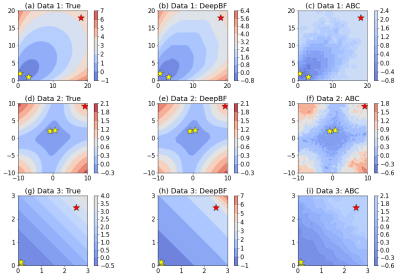
A recently arXived paper proposes an alternative approach to computing Bayes factors via deep learning, Deep Bayes Factors written by Jungeum Kim (presenting her work at JSM this very morning) and Veronika Ročková (whom I have known from her PhD years and whose COPSS Award we very gladly celebrated yesterday!). Which is obviously of interest to me, given my repeated visits to the challenge.

“we introduce Deep Bayes Factor (DeepBF), a neural classifier trained on simulated datasets to learn a mapping whose functional constitutes a Bayes factor estimator.”

Their approach is directly connected with various classification approaches to ABF, incl. the mythical inverse logistic version of Geyer (1994) and noise contrastive estimation of Gutmann and Hyvärinen (2010) (as well as our forested version). Which is called the likelihood-ratio trick here.

“Viewing the Bayes factor through the lens of binary classification aligns with Pudlo et al. (2016), who recast ABC model selection as a classification problem. They employ random forests to select a model by a majority vote. Instead, we focus on binary classification where the purpose is to learn marginal likelihood ratios.  Contrary to the method in Pudlo et al. (2016), our strategy circumvents a secondary learning phase for gauging model posterior estimates, delivering results in only one stage.”

The authors‘ solution stands with learning a classifier from simulated data from both models (and a basic log ratio utility), along iterations updating D from the gradient of the utility, the associated Bayes factor being the ratio D/(1-D) derived from the estimated classifier. There is a cost in producing new samples from the (same) predictives at each iteration (and I wonder if some recycling would be helpful, as well as reducing the sample size for the simpler model). In one of the remarks, the authors point out that “in the effort to see the best ABC performance, we intentionally use the full data Y as a summary statistic”, a remark that I find surprising given the overall consensus that the Bayes factor itself [when based on the full data] is close to optimal.

The method is overall consistent (in the data size n) under classical Bayesian asymptotics, sometimes even when the Bayes factor estimator is inconsistent, naturally expands to pseudo Bayes factors like intrinsic and fractional Bayes factors, also mileage varies in terms of numerical stability.

In the Bayesian model criticism section, the notion of opposing the actual dataset to a simulated one relates very much to Geyer’s (1994) solution. As well as to GANs, as noted in the paper. I did not look closely at the numerical comparisons in the experimental section, but they sound rich enough.

integral priors for multiple comparison

Posted in Books, Statistics, University life with tags , , , , , , , , , , , on June 24, 2024 by xi'an

Diego Salmerón and I just arXived a paper on integral priors for multiple model comparison, about deriving reference priors for multiple hypothesis testing. As (so-called) noninformative priors constructed for estimation purposes are usually not appropriate for model selection and testing due to their improperness, Jeffreys-Lindley paradoxes and the like, the methodology of integral priors was developed to get prior distributions for Bayesian model selection when comparing two models, modifying initial improper reference priors. This paper proposes a generalization of this methodology when than two models are to be compared. In order to avoid the above paradoxes and the associated possibility of producing a null recurrent or transient Markov chain, our approach adds an artificial copy of each model under comparison by compactifying the corresponding parametric space and creates an ergodic Markov chain exploring all models that returns the integral priors as marginals of the ergodic and stationary joint distribution. Besides the guarantee of existence of these integral priors and the disappearance of paradoxes that plague estimation reference priors, an additional perk of this methodology is that the simulation of this Markov chain is straightforward as it only requires simulations of imaginary training samples and from the corresponding posterior distributions, for all models, while producing Bayes factor approximations on the side. This renders its implementation automatic and generic, both in the nested and in the nonnested cases. We associated our late friend Juan Antonio Cano to this paper as he was instrumental in initiating both this collaboration and the methodology at its core.

prior sensitivity of the marginal likelihood

Posted in Books, pictures, Statistics, University life with tags , , , , , , , , , , , , , on June 27, 2022 by xi'an

Fernando Llorente and (Madrilene) coauthors have just arXived a paper on the safe use of prior densities for Bayesian model selection. Rather than blaming the Bayes factor, or excommunicating some improper priors, they consider in this survey solutions to design “objective” priors in model selection. (Writing this post made me realised I had forgotten to arXive a recent piece I wrote on the topic, based on short courses and blog pieces, for an incoming handbook on Bayesian advance(ment)s! Soon to be corrected.)

While intrinsically interested in the topic and hence with the study, I somewhat disagree with the perspective adopted by the authors. They for instance stick to the notion that a flat prior over the parameter space is appropriate as “the maximal expression of a non-informative prior” (despite depending on the parameterisation). Over bounded sets at least, while advocating priors “with great scale parameter” otherwise. They also refer to Jeffreys (1939) priors, by which they mean estimation priors rather than testing priors. As uncovered by Susie Bayarri and Gonzalo Garcia-Donato. Considering asymptotic consistency, they state that “in the asymptotic regime, Bayesian model selection is more sensitive to the sample size D than to the prior specifications”, which I find both imprecise and confusing,  as my feeling is that the prior specification remains overly influential as the sample size increases. (In my view, consistency is a minimalist requirement, rather than “comforting”.) The argument therein that a flat prior is informative for model choice stems from the fact that the marginal likelihood goes to zero as the support of the prior goes to infinity, which may have been an earlier argument of Jeffreys’ (1939), but does not carry much weight as the property is shared by many other priors (as remarked later). Somehow, the penalisation aspect of the marginal is not exploited more deeply in the paper. In the “objective” Bayes section, they adhere to the (convenient but weakly supported) choice of a common prior on the nuisance parameters (shared by different models). Their main argument is to develop (heretic!) “data-based priors”, from Aitkin (1991, not cited) double use of the data (or setting the likelihood to the power two), all the way to the intrinsic and fractional Bayes factors of Tony O’Hagan (1995), Jim Berger and Luis Pericchi (1996), and to the expected posterior priors of Pérez and Berger (2002) on which I worked with Juan Cano and Diego Salmeròn. (While the presentation is made against a flat prior, nothing prevents the use of another reference, improper, prior.) A short section also mentions the X-validation approach(es) of Aki Vehtari and co-authors.

marginal likelihood as exhaustive X validation

Posted in Statistics with tags , , , , , , , , on October 9, 2020 by xi'an

In the June issue of Biometrika (for which I am deputy editor) Edwin Fong and Chris Holmes have a short paper (that I did not process!) on the validation of the marginal likelihood as the unique coherent updating rule. Marginal in the general sense of Bissiri et al. (2016). Coherent in the sense of being invariant to the order of input of exchangeable data, if in a somewhat self-defining version (Definition 1). As a consequence, marginal likelihood arises as the unique prequential scoring rule under coherent belief updating in the Bayesian framework. (It is unique given the prior or its generalisation, obviously.)

“…we see that 10% of terms contributing to the marginal likelihood come from out-of-sample predictions, using on average less than 5% of the available training data.”

The paper also contains the interesting remark that the log marginal likelihood is the average leave-p-out X-validation score, across all values of p. Which shows that, provided the marginal can be approximated, the X validation assessment is feasible. Which leads to a highly relevant (imho) spotlight on how this expresses the (deadly) impact of the prior selection on the numerical value of the marginal likelihood. Leaving outsome of the least informative terms in the X-validation leads to exactly the log geometric intrinsic Bayes factor of Berger & Pericchi (1996). Most interesting connection with the Bayes factor community but one that depends on the choice of the dismissed fraction of p‘s.