Archive for econometrics

Nature tidbits [10 Sept 2026]

Posted in Books, pictures, Travel, University life with tags , , , , , , , , , , , , , , , , , , , , , , , , , , , , , , , , , , , , , , , , , , , , , , , , , , , , on October 21, 2026 by xi'an

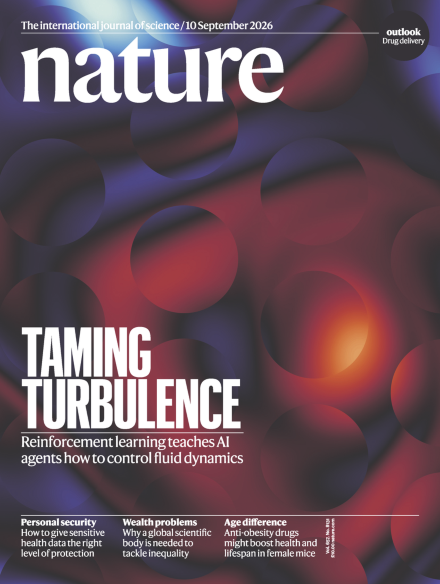
Having left my copy of the 10 September issue of Nature on a suburban train this afternoon (hopefully to the benefit of a fellow passenger!), I had to fall back on the online version. The cover story, Taming turbulence, is about HydroGym, a reinforcement-learning platform where AI agents learn to control turbulent flows. While this has practical consequences, it is also the harbinger of the resolution (?) of the Navier-Stoke Millennium Problem by OpenAI. Covered in the following issue.

Flotsam of interest for me:

  • reporting on a single data point exciting cosmologists (and beyond!), namely one unusual flash recorded in 2023 or 2024 by the LZ detector thru its 10 tonnes liquid xenon basin, which looks like what a weakly interacting massive particle (WIMP!) would produce. This would be a fist in experimentally supporting the dark matter theory. But without reproducibility, ’tis hard to jump to a conclusion. In correlation, a news article on the launch of the Nancy Grace Roman Space Telescope, with two World Views, one on Roman herself as “mother of Hubble”. Promising advances on far, far away celestial bodies thanks to the infrared abilities of said telescope. And again to cosmology.
  • a news feature on “the Einstein test”, checking whether language models trained only on pre-1905 data could rediscover relativity. This is a clever way to separate creativity from regurgitation, if the historical training corpus can indeed be kept clean. And faster than training monkeys to type…
  • an article combining climate and econometric modelling to assess how human-induced climate change has shifted, and will shift, the burden of childhood malaria in Africa. The attribution relies on counterfactual climate simulations, which makes me wonder about the propagation of uncertainty.
  • an article linking US mortgage records from around the Second World War to race and immigration status. It shows that New Deal programmes disproportionately excluded Black borrowers, a nice (if sad) record-linkage exercise.
  • a privacy feature on how UK Biobank was shut down after a data leak and is now imposing new safety measures. It raises the recurrent tension between protecting participants’ privacy and keeping data open to researchers, which connects once more with the membership-inference paper I discussed earlier.
  • an editorial praising the World Bank for publishing and verifying the raw data and code behind its reports. Other agencies should indeed follow suit!
  • a news item on the massive experience of mutating every DNA letter in a viral genome, whose effects the top AI models failed to predict (fail or pass the survival test!). A welcome reality check on AI in biology.

  • two militant comments on the economy, one by Joseph Stiglitz et al. calling for an IPCC-like International Panel on Inequality, and one on a call for measuring growth through all forms of capital, rather than GDP alone. And a great poster (reminding me of Indian movie posters) on the side!
  • an editorial on the comforting aspect of the Ig Nobel prizes, no matter how silly they sound.
  • a book review of The Winding Trail &tc. on the Principia Mathematica and Newton’s disdain for hypotheses (with his famous “hypotheses non fingo” that clashes with the modern scientific approach!), along with his habit of feuding over priority. What is amazing with Newton’s meteor trajectory is he only seriously engage into mathematics during his final undergraduate term at Cambridge, one year before the Great Plague and his revolutionary breakthroughs!

all of regression

Posted in Books, Statistics, University life with tags , , , , , , , , , , , , , , , , , , , , , , , , , , , , , , on October 16, 2026 by xi'an

My friends Isabella Verdinelli and Larry Wasserman published recently a new book with CUP in the spirit of the lean, terse, All of Statistics and All of Non-parametric Statistics (hilariously immodest titles!). This new volume is All of Regression, with expedited treatment of linear regression and hardly anything about machine learning (not even a mention in the index!). Time series barely escape oblivion within the final two pages!

(Our mutual friend) Ed George’s endorsement of All of Regression is worth quoting:

“Remarkable in scope and clarity, this book masterfully traces the evolution of regression from classical linear modeling to its many modern descendants. Each chapter offers a lucid introduction to a distinct methodology, explained with precision and insight from a contemporary perspective. Complete with exercises and datasets, it will serve equally well as a textbook and an indispensable research resource.”

The linear regression chapter shuns most of the linear algebra machinery swamping regression classics (except in its appendix), but it finds space to cover misspecified models, bootstrap, and model choice. The next and minuscule chapter is centred on X-validation for evaluating prediction error, while its follower is (barely) broaching on high-dimensional linear regression with a brief (and un-Bayesian) intuition on the Lasso. A few more words on logistic and Poisson regressions, and we are already landing at non-parametric regression.

The pace does not abate in any manner, though, since the univariate NP chapter covers kernels, local polynomials, k-nearest neighbours, and RKHS with a similar terseness (and no mention of Gaussian processes). Moving to multivariate regression zips thru trees and random forests, without severe consequences. Quantile regression is given the alm of a few pages (which imho may indeed be all it deserves!)

We are now already past the middle of the book, fighting for breath!, and classification then comes, mostly presented as an adaptation of earlier techniques to discrete outcome (which I find mildly objectionable for categorical data). With mentions of boosting (if not bagging) and SVMs. And no time for the ambiguity of the notion (which is at least as evil as mixtures, as earlier posted by Larry!) Of clear interest to the authors, the modern theory of conformal prediction gets its own, cosy, chapter, albeit somewhat misleadingly making it sound a very simple exercise.  And no machine learning link. Next comes the equally modern and central notion of causality. With the (predictable) causal graphs, confounding variables, and instrumental variables (which have been a mystery to me since my first econometrics class). The final chapter is acknowledged as being made of parts each deserving an entire book, still getting a few pages at best. Empirical Bayes is restrained to linear regression, deep learning is questioned about being useful in statistical problems, and survival analysis mostly summarises as the Kaplan-Meier estimator.

Having gone through the book in a single rush (while on a train to Normandy), I felt more exhausted than at the finish line of a successful half-marathon (with a similar race time). It is great to see most fundamental notions linked with regression covered in such a minimalist way. With mathematical justifications whenever manageable in the alloted space. Albeit not expecting them (!), I regret Bayesian approaches to regression and classification not being mentioned. (No BART!) The computational aspects are not covered, hence readers may face a steep cliff when moving to actual problems but this is the theme for another course.

One funny typo: the bibliography (or reference list) is ordered by the first name, except for a misclassified Nicolai Meinshausen!, which presumes some first-hand knowledge of the entire community! And the inevitable “the the” makes its first (?) appearance on p12.

[The usual disclaimer applies, namely that this review is likely to appear later in CHANCE, in my book reviews column.]

Venice time series workshop

Posted in pictures, Statistics, Travel, University life with tags , , , , , , , , , , , , on May 25, 2026 by xi'an

Blackwell-Rosenbluth Award 2025 [call]

Posted in Books, Kids, pictures, Travel, University life with tags , , , , , , , , , , , , on July 3, 2025 by xi'an

[Reposted:] The Blackwell-Rosenbluth Award by j-ISBA ia a recently established award for junior researchers in different areas of Bayesian statistics. The award aims at recognizing outstanding junior Bayesian researchers based on their overall contribution to the field and to the community. There will be six winners in total who will be invited to present their work in two special events of the Junior Bayes Beyond the Borders (JB³) webinar series and receive three years of free ISBA and j-ISBA membership.

ISBA proudly has a wide geographical diversity among its members. To encourage scientific exchange and strengthen research connections between geographies, three prizes will be awarded to researchers based in time zones UTC+0 to UTC+13 [e.g. Africa + Asia + Europe + Oceania] and three to those based in UTC-12 to UTC-1 [e.g. North America + South America].

We welcome nominations of junior researchers working in the broad spectrum of topics in Bayesian statistics, including but not limited to methods, theory, computation, machine learning, data science, biostatistics, econometrics, industrial statistics, environmental science, and software. The deadline is 15 July 2025.

Seminal ideas and controversies in Statistics [book review]

Posted in Books, Mountains, pictures, Statistics, Travel, University life with tags , , , , , , , , , , , , , , , , , , , , , , , , , , , , , , , , , , , , , , , , , , , , , , , , , , , , , , , , , , , , , , , , on May 24, 2025 by xi'an

CRC Press sent CHANCE this book for review. Since the topic was of clear interest to me, with an author who significantly contributed to the field—my only recollection meeting Roderick Little was during the Australian Statistical Conference in Adelaïde, in 2012, at the start of my Oz 2012 Tour!—, I took the opportunity of the nearest weekend to browse through Seminal ideas and controversies in Statistics. I like very much the idea of selecting a dozen key papers in the history of Statistics and of discussing why. In fact, this reminded me of my classics seminar, which lasted the few years I was 100% in charge of the Master program in Dauphine (and which I hope I could restart!). Checking the list of the papers I then suggested my students, I see some overlap with 9 papers out of the 15 groups. (I also remember Steve Fienberg making suggestions for that list, while he was spending a sabbatical in Paris at CREST.) Given that community of focus and purpose, and contrary to my wont, I have really very little of substance to criticize or wish about the book. The less when reading the following

“On a personal note, I met Yates [author of a 1984 paper on tests for 2×2 contingency tables discussing the relevance of conditioning on one or both margins], a charming man, when I was a young graduate student who knew next to nothing about statistics; we discussed the joys of traversing the Cuillin Ridge in Skye.”

since completing that ridge remains high in my mountain-climbing bucket-list! (Possibly next year, since we are running an ICMS workshop on the Island.)

The first paper in the series is more than a foundational paper since (The) Fisher’s 1922 paper is about creating (almost) ex nihilo the field of (modern) mathematical statistics. I don’t know if there is any equivalence in other scientific disciplines of such an impact (and of such a man)… Roderick Little manages to convincingly engage with Fisher’s dismissive views on (not yet called) Bayesian analysis, although, to the latter’s defence, the formalisation of Bayesian inference at that time had not yet emerged. The second chapter is discussing Yates’ 1984 paper on tests for 2×2 contingency tables that he wrote 50 years after writing the original one in the first volume of JRSS. Roderick Little adds a detailed Bayesian analysis with the three standard reference priors, Jeffreys’ version proving quite close to Fisher’s exact test (conditional on both margins). The third chapter is aiming at the generic challenge of hypothesis testing, from the well-known opposition between Fisher and Neyman (both on the cover), to questioning the sanity of hard-set thresholds (with a mention of our American Statistician call to abandon (shi)p!). The later (thus) refers to the recent literature on the replicability crisis and the now famous ASA statement on p-values by Ron Wasserstein and Nicole Lazar, analysed in the chapter. But I would have like to read another full section on alternatives to hypothesis testing. While now a niche interest (imho), Fisher’s attempt at creating a posterior distribution without a prior, aka fiducial inference, is discussed in Chapter 4 with the Behrens-Fisher problem as the illustrating example. The chapter feels rather anticlimactic, with the comparison relying on the (Malay) Ghosh and Kim (2001) simulation results.

Birnbaum’s (1962) likelihood principle is the topic of Chapter 5 (and I cannot remember any of my students choosing this paper over the years, although there was at least one). Roderick Little recalls some sentences from the JASA discussion as an appetiser, a reminder of the time when these discussions could turn in scathing attacks. The chapter contains excerpts from Berger and Wolpert (1988)—which they were writing while I was spending a year at Purdue and which I have always recommended to my PhD students, albeit not for the classic seminar. It then moves to the controversies that surround this principle since its inception, in particular those accumulated by Deborah Mayo (also on the cover) as reported on the ‘Og. In the recent years, I have become less excited about the LP, in part due to the imprecision in its statement, which opens the door to conflicting interpretations. And in part due to the scarcity of models with non-trivial sufficient statistics. (I am also wondering if the sufficiency issue we highlighted in our ABC model choice criticism does relate to the mixture example at the end of the chapter.)

The next chapter is one all for compromise, through the calibrated Bayes perspective that credible statements should be close to confidence statements in the long run. Which I remember him presenting at ASC 2012. The concept is found in the very 1984 paper by Don Rubin (also on the cover) that contains the concept behind Approximate Bayesian Computation (ABC). And the chapter proceeds by listing strengths and weaknesses of frequentist and Bayesian perspectives, towards a fusion of both., e.g. though posterior predictive checks.

While the choice of a (general public) paper from Scientific American may sound surprising in Chapter 7, with Efron’s (on the cover) and Morris’ 1977 Stein’s paradox, I cannot but applaud, the more because this was the first paper I read when starting my PhD on the James-Stein estimators. Although this may sound like happening eons ago, the James and Stein (1961) paper—which is my age!—”created a considerable backlash” by toppling unbiasedness from its pedestal and exhibiting a paradox that 1+1+1≠3… Which Little reinterprets via a random effect (or Bayesian hierarchical) model. (And a chapter where I learned that Little’s father was a journalist, a characteristic he shared with Bruce Lindsay, as I found at Blonde, Glasgow, during an ICMS workshop). Relatedly, the next chapter is about the “57 varieties [of regression] paper” by Demptster, Schatzoff and Wermuth (1977). Apparently connected with Heinz 57 varieties of pickles. The paper considers Stein and ridge and variable selections versions for variable selection. The chapter also covers (Bayesian) Lasso and BART, as well as a brief all too brief mention of Spike & Slab priors—with my friend Veronika Ročková missing from the authors’ index!—,  but I was expecting from the title other, robust, forms of regression like L¹ regression and econometrics digressions. Chapter 10 can however been seen as a proxy since covering generalized estimating equations from a 1986 Biometrika paper of Liang and Zeger, with no Bayesian aspect (and an expected appearance of Communications in Statistics B).

Chapter 9 covers the almost immediately classic 1995 paper of Benjamini and Hochbeg on multiple regressions (that Series B turned into a discussion paper ten years later!). Although it spends more time on Berry’s (2012) recommendations than on FDR. The computational Chapter 11 brings together Efron’s (1979) bootstrap [with his picture on the cover] and MCMC, represented by the founding paper of Gelfand and Smith (1990, if mistakenly set in 1988 on p140). A bit of a strange mix imho as the former is more inferential than computational. And not giving the EM algorithm that much space. And not questioning MCMC methods as a good proxy to posterior distributions. Tukey’s Future of Data Analysis (as founding exploratory data analysis) and Breiman’s Two cultures (as launching statistical machine learning) meet in Chapter 12. (With a reminder that the latter invokes Occam’s razor—which may not be that appropriate for hugely overparameterised machine learning black boxes—and…the Rashomon principle! Meaning that distinct models may all fit the same data. Let me nitpickingly add the reference to Ryûnosuke Akutagawa as the author of Rashômon and other stories that Kurosawa adapted in his splendid movie). The chapter contains critical remarks from David Cox, Brad Efron, David Bickel, and Andrew Gelman, with a further section on Little’s view on modelling.

The last three chapters are on design and sampling, in connection with Little’s (and Rubin’s) works in the area. With a 1934 paper of Neyman (whose picture on the cover could have been chosen differently, albeit no fault of Neyman [or of Little!] that his toothbrush style of moustache dramatically got out of fashion!). With a return to calibrated Bayes and a reminiscence of Little’s time at the World Fertility Survey but (apparently) no mention of the probabilistic aspects of modern censuses (that saw my friends Steve Fienberg on the one side and Larry Brown and Marty Wells on the other side argue for and against it!), again relating to the reliance on statistical models. Chapter 14 relates randomized clinical trials to causality, which makes a (worthy) appearance there. Roderick Little also makes a clear case there against the retracted study linking vaccines and autism, a call that will unlikely not reach the current Trump administration and its Secretary of Health.

The book concludes with a list of twenty style and grammar suggestions for improved writing.

As should be crystal-clear from the above, I quite enjoyed the book and would definitely use its reading list in a graduate course whenever the opportunity arises. Once again, some choices are more personal to the author than others, and I would have place more emphasis on the fantastic Dawid, Stone and Zidek (1973)—with Jim Zidek also missing from the author index—, but all make sense in a walk through statistical classics. Let me however regret the absence therein of major actors like, e.g., D. Blackwell, C.R. Rao,  or G. Wahba (except in a stylistic example p199), two of whom were awarded the International Prize in Statistics.

[Disclaimer about potential self-plagiarism: this post or an edited version will eventually appear in my Books Review section in CHANCE.]