Archive for INSEE

Nature likes official statistics

Posted in Books, Statistics, University life with tags , , , , , , , , , , , , , , , , , on April 5, 2026 by xi'an

Nature is (rightly!) concerned about official statistics around the World and ran a feature article on the topic in its issue of 12 March 2026. It stresses the multiple reasons for supporting a sound, independent, trustworthy national statistic office. The article explores the issues with four national statistic bureaux, for the US, the UK, India, and Argentina. (As my whole career has been associated with the French official statistics institute, INSEE, first as a student, then as a researcher, I would have liked to hear some external views on this institute, albei methinks the situation is not as dire here, despite a permanent reduction in staff over the past decade, to the point the landmark INSEE building in Malakoff has now been dismantled.)

The issue with the US system is predictably mixing political interference à la Trump and budget cuts again à la Trump. Referring to a 2025 ASA report. Longitudinal surveys have been terminated after running 30 years. While preserving its famous independence, the UK Office for National Statistics is facing mistrust from the public that in turn reduces the reliability of its labour survey, with a response rate of 13% in 2023! The UK Government has responded by creating a  National Statistician…. Concerning India, well-known for its love of official statistics, the concern is again with the government interventions against NSC, and Argentina suffers from the same woes, Milei refusing an update of the way inflation is calculated by the national institute NDEC, leading to the departure of the current director (whose remote predecessor was put on trial by an earlier government!)

“Decisions based on incomplete or incorrect knowledge are invariably bad, even harmful. That is why the statistics that governments collect need to be as accurate and as verifiable as possible.”

In what appears (now?) as a common trend in Nature, a tribune on the same topic appeared in the following edition of 19 March 2026. With the call to “fix surveys”, in part battered by systemic underfunding and sapped by low answer rates. And the somewhat paradoxical complaint that private philanthropies like the Gates Foundation is supporting less worldwide surveys like the Demographic and Health Survey Program, which should be the responsibility of governments.

stranger things

Posted in pictures, Travel with tags , , , , , , , , , , on April 16, 2024 by xi'an

A rather strange incident occurred to me this morn as I was optimising my backpack for my trip to Bristol. I found inside a stash of credit card receipts along with a booklet of down-town Paris metro tickets. As I hardly ever keep credit card receipts, I was rather surprised at it and, looking through them, the more because I could not place these purchases, although they mostly were spent in the neighbourhood of the former INSEE building in Malakoff. Checking further at the end digits of the credit card, I realised these were not agreeing with mine and thus that they had mysteriously ended up in my bag. The receipts covered the period from 21 January till 26 January and did not reveal much more than a rather regular pattern with a visit to a local bakery in the morning, sometimes followed by a coffee, then a modest lunch in one fast food joint or another in Issy (not far from my PariSanté Campus office) or Massy, and an usually more substantial diner back in Malakoff. Including one in the iconic Timbre-Poste pub! And one late-nighter in Résidence de la Tour (de Malakoff) where some of my visitors of yore stayed. I still cannot fathom how these receipts came into my possession and find it rather uncanny that they connect to my past life in Malakoff…

to be demolished!

Posted in Books, pictures, University life with tags , , , , , , , , , on May 8, 2022 by xi'an

how to count excess deaths?

Posted in Books, Kids, pictures, Statistics with tags , , , , , , , , , , , , , , , on February 17, 2022 by xi'an

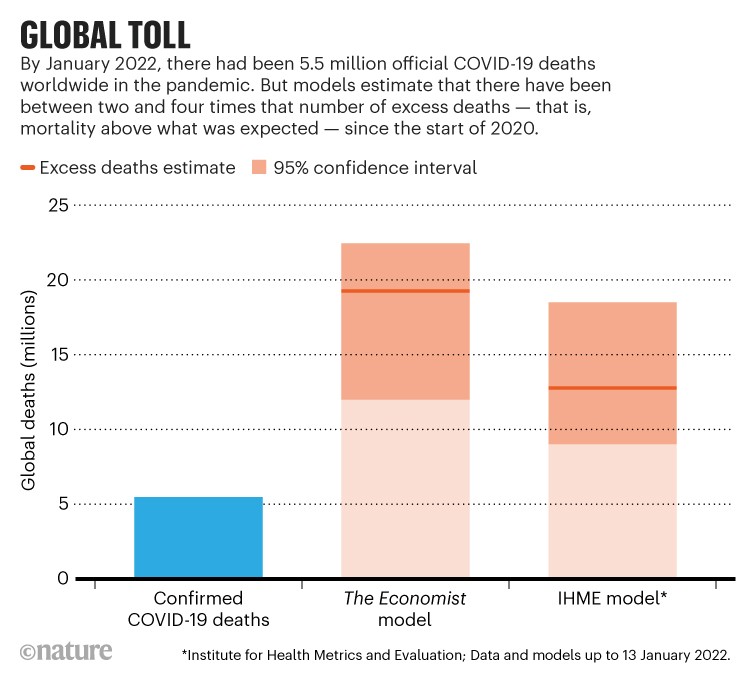
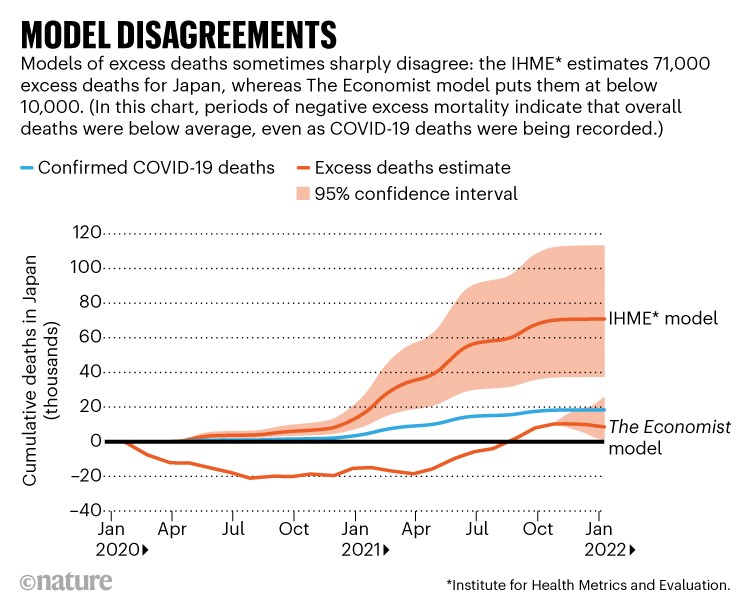
Another terrible graph from Nature… With vertical bars meaning nothing. Nothing more than the list of three values and both confidence intervals. But the associated article is quite interesting in investigating the difficulties in assessing the number of deaths due to COVID-19, when official death statistics are (almost) as shaky as the official COVID-19 deaths. Even in countries with sound mortality statistics and trustworthy official statistics institutes. This article opposes prediction models run by the Institute for Health Metrics and Evaluation and The Economist. The later being a machine-learning prediction procedure based on a large number of covariates. Without looking under the hood, it is unclear to me how poor entries across the array of covariates can be corrected to return a meaningful prediction. It is also striking that the model predicts much less excess deaths than those due to COVID-19 in a developed country like Japan. Survey methods are briefly mentioned at the end of the article, with interesting attempts to use satellite images of burial grounds, but no further techniques like capture-recapture or record linkage and entity resolution.

democracy suffers when government statistics fail [review of a book review]

Posted in Books, Statistics, Travel with tags , , , , , , , , , , on October 13, 2020 by xi'an

This week, rather extraordinarily!, Nature book review was about official statistics, with a review of Julia Lane’s Democratizing our Data. (The democratizing in the title is painful to watch, though!) The reviewer is Beth Simone Noveck, who was deputy chief technology officer under Barack Obama and a major researcher in digital democracy, excusez du peu! (By comparison, Trump’s deputy chief technology officer had a B.A. in politics and no other qualification for the job, but got nonetheless promoted to chief…)

“Lane asserts that the United States is failing to adequately track its population, economy and society. Agencies are stagnating. The census dramatically undercounts people from minority racial groups. There is no complete national list of households. The data are made available two years after the count, making them out of date as the basis for effective policy making.” B.S. Noveck

The debate raised by the book on the ability of official statistics to keep track of people in a timely manner is most interesting. And not limited to the USA, even though it seems to fit in a Hell of its own:

“In the United States, there is no single national statistical agency. The process of gathering and publishing public data is fragmented across multiple departments and agencies, making it difficult to introduce new ideas across the whole enterprise. Each agency is funded by, and accountable to, a different congressional committee. Congress once sued the commerce department for attempting to introduce modern techniques of statistical sampling to shore up a flawed census process that involves counting every person by hand.” B.S. Noveck

This remark brings back to (my) mind the titanesque debates of the 1990s when Republicans attacked sampling techniques and statisticians like Steve Fienberg rose to their defence. (Although others like David Freedman opposed the move, paradoxically mistrusting statistics!) The French official statistic institute, INSEE, has been running sampled census(es) for decades now, without the national representation going up in arms. I am certainly being partial, having been associated with INSEE, its statistics school ENSAE and its research branch CREST since 1982, but it seems to me that the hiring of highly skilled and thoroughly trained civil servants by this institute helps in making the statistics it produces more trustworthy and efficient, including measuring the impact of public policies. (Even though accusations of delay and bias show up regularly.) And in making the institute more prone to adopt new methods, thanks to the rotation of its agents. (B.S. Noveck notices and deplores the absence of reference to foreign agencies in the book.)

“By contrast, the best private-sector companies produce data that are in real time, comprehensive, relevant, accessible and meaningful.”  B.S. Noveck

However, the notion in the review (and the book?) that private companies are necessarily doing better is harder to buy, if an easy jab at a public institution. Indeed, public official statistic institutes are the only one to have access to data covering the entire population, either directly or through other public institutes, like the IRS or social security claims. And trusting the few companies with a similar reach is beyond naïve (even though a company like Amazon has almost an instantaneous and highly local sensor of economic and social conditions!). And at odds for the call of democratizing, as shown by the impact of some of these companies on the US elections.