
Archive for graphic novel
(almost) everything you need understand about AI [book review]
Posted in Books, Kids, pictures, Statistics, Uncategorized with tags AI, artificial intelligence, book review, Centre National de la Recherche Scientifique, ChatGPT, CNRS, French universities, graphic novel, IA, infographics, Paris Sciences et Lettres, popular science, PSL on May 3, 2025 by xi'an
Corto à Beaubourg [cover]
Posted in Books, Kids, pictures, Travel with tags art exhibit, bande dessinée, BD, Beaubourg, Centre George Pompidou, comics, Corto Maltese, cover, graphic novel, Hugo Pratt, Libé, Paris on June 18, 2024 by xi'an
The Road [book review]
Posted in Statistics with tags BD, Cormac McCarthy, Dargaud, graphic novel, La Route, The Road on May 29, 2024 by xi'an
Rashomon, plus 47 ronins, plus…
Posted in Books, Kids, pictures, Travel with tags Akira Kurosawa, Bayesian graphical model, 羅生門, Dashiell Hammett, detective story, Edo era, graphic novel, Japan, Konjaku Monogatarishū, Kyoto, Rashomon, the 47 rônins on January 26, 2020 by xi'an
 Another chance encounter (on Amazon) led me to read a graphical novel entitled Rashōmon, by Victor Santos. Which uses the same short stories from Ryūnosuke Akutagawa as Akira Kurosawa in his superlative film, if not with the same intensity. (The very first sentences are inspired from the first pages of the book, though.) And in a second part builds upon the tale of the 47 rônins which I read last summer in Koyasan. Plus a possible appearance of , the great 17th Century swordsman (depicted in two wonderful novels by Eiji Yoshikawa). While this is historically impossible, since Rashōmon takes place in the 12th Century and the 47 rônins acted in 1702, the theme cementing the story is the presence of a detective named Heigo Kobayashi, who “solves” both crimes but is nonetheless outsmarted by the novel “femme fatale”… Without a clear explanation as to how she did it.
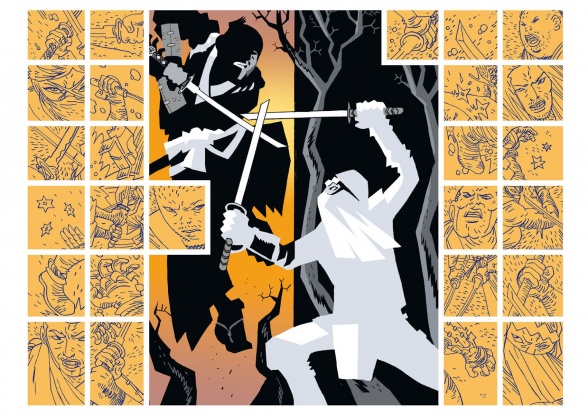 While I found the rendering rather entertaining, with an original if convoluted drawing style, I was rather disappointed at the simplistic and Westernised adaptation of the subtle stories into a detective story. Calling upon (anachronic) ninjas as if the historical setting per se was not exotic enough. And the oddly modified role of the main female character into an Hammet-like heroin kills the ambivalence that is central to both Akutagawa’s and Kurosawa’s versions.
prime suspects [book review]
Posted in Books, Kids, University life with tags Alexandre Grothendieck, book review, CHANCE, comics, François Schuiten, Gödel Escher and Bach, graphic novel, Jacques Tardi, José Muñoz, Kingman's coalescent, logicomix, NCIS, Nicolas Bourbaki, Persi Diaconis, Princeton University Press on August 6, 2019 by xi'an
I was contacted by Princeton University Press to comment on the comic book/graphic novel Prime Suspects (The Anatomy of Integers and Permutations), by Andrew Granville (mathematician) & Jennifer Granville (writer), and Robert Lewis (illustrator), and they sent me the book. I am not a big fan of graphic book entries to mathematical even less than to statistical notions (Logicomix being sort of an exception for its historical perspective and nice drawing style) and this book did nothing to change my perspective on the subject. First, the plot is mostly a pretense at introducing number theory concepts and I found it hard to follow it for more than a few pages. The [noires maths] story is that “forensic maths” detectives are looking at murders that connects prime integers and permutations… The ensuing NCIS-style investigation gives the authors the opportunity to skim through the whole cenacle of number theorists, plus a few other mathematicians, who appear as more or less central characters. Even illusory ones like Nicolas Bourbaki. And Alexander Grothendieck as a recluse and clairvoyant hermit [who in real life did not live in a Pyrénées cavern!!!]. Second, I [and nor is Andrew who was in my office when the book arrived!] am not particularly enjoying the drawings or the page composition or the colours of this graphic novel, especially because I find the characters drawn quite inconsistently from one strip to the next, to the point of being unrecognisable, and, if it matters, hardly resembling their real-world equivalent (as seen in the portrait of Persi Diaconis). To be completely honest, the drawings look both ugly and very conventional to me, in that I do not find much of a characteristic style to them. To contemplate what Jacques Tardi, François Schuiten or José Muñoz could have achieved with the same material… (Or even Edmond Baudoin, who drew the strips for the graphic novels he coauthored with Cédric Villani.) The graphic novel (with a prime 181 pages) is postfaced with explanations about the true persons behind the characters, from Carl Friedriech Gauß to Terry Tao, and of course on the mathematical theory for the analogies between the prime and cycles frequencies behind the story. Which I find much more interesting and readable, obviously. (With a surprise appearance of Kingman’s coalescent!) But also somewhat self-defeating in that so much has to be explained on the side for the links between the story, the characters and the background heavily loaded with “obscure references” to make sense to more than a few mathematician readers. Who may prove to be the core readership of this book.
There is also a bit of a Gödel-Escher-and-Bach flavour in that a piece by Robert Schneider called Réverie in Prime Time Signature is included, while an Escher’s infinite stairway appears in one page, not far from what looks like Milano Vittorio Emmanuelle gallery (On the side, I am puzzled by the footnote on p.208 that “I should clarify that selecting a random permutation and a random prime, as described, can be done easily, quickly, and correctly”. This may be connected to the fact that the description of Bach’s algorithm provided therein is incomplete.)
[Disclaimer about potential self-plagiarism: this post or an edited version will eventually appear in my Books Review section in CHANCE. As appropriate for a book about Chance!]


