
Archive for reproducibility

Nature tidbits [10 Sept 2026]

Posted in Books, pictures, Travel, University life with tags , , , , , , , , , , , , , , , , , , , , , , , , , , , , , , , , , , , , , , , , , , , , , , , , , , , , on October 21, 2026 by xi'an

Having left my copy of the 10 September issue of Nature on a suburban train this afternoon (hopefully to the benefit of a fellow passenger!), I had to fall back on the online version. The cover story, Taming turbulence, is about HydroGym, a reinforcement-learning platform where AI agents learn to control turbulent flows. While this has practical consequences, it is also the harbinger of the resolution (?) of the Navier-Stoke Millennium Problem by OpenAI. Covered in the following issue.

Flotsam of interest for me:

  • reporting on a single data point exciting cosmologists (and beyond!), namely one unusual flash recorded in 2023 or 2024 by the LZ detector thru its 10 tonnes liquid xenon basin, which looks like what a weakly interacting massive particle (WIMP!) would produce. This would be a fist in experimentally supporting the dark matter theory. But without reproducibility, ’tis hard to jump to a conclusion. In correlation, a news article on the launch of the Nancy Grace Roman Space Telescope, with two World Views, one on Roman herself as “mother of Hubble”. Promising advances on far, far away celestial bodies thanks to the infrared abilities of said telescope. And again to cosmology.
  • a news feature on “the Einstein test”, checking whether language models trained only on pre-1905 data could rediscover relativity. This is a clever way to separate creativity from regurgitation, if the historical training corpus can indeed be kept clean. And faster than training monkeys to type…
  • an article combining climate and econometric modelling to assess how human-induced climate change has shifted, and will shift, the burden of childhood malaria in Africa. The attribution relies on counterfactual climate simulations, which makes me wonder about the propagation of uncertainty.
  • an article linking US mortgage records from around the Second World War to race and immigration status. It shows that New Deal programmes disproportionately excluded Black borrowers, a nice (if sad) record-linkage exercise.
  • a privacy feature on how UK Biobank was shut down after a data leak and is now imposing new safety measures. It raises the recurrent tension between protecting participants’ privacy and keeping data open to researchers, which connects once more with the membership-inference paper I discussed earlier.
  • an editorial praising the World Bank for publishing and verifying the raw data and code behind its reports. Other agencies should indeed follow suit!
  • a news item on the massive experience of mutating every DNA letter in a viral genome, whose effects the top AI models failed to predict (fail or pass the survival test!). A welcome reality check on AI in biology.

  • two militant comments on the economy, one by Joseph Stiglitz et al. calling for an IPCC-like International Panel on Inequality, and one on a call for measuring growth through all forms of capital, rather than GDP alone. And a great poster (reminding me of Indian movie posters) on the side!
  • an editorial on the comforting aspect of the Ig Nobel prizes, no matter how silly they sound.
  • a book review of The Winding Trail &tc. on the Principia Mathematica and Newton’s disdain for hypotheses (with his famous “hypotheses non fingo” that clashes with the modern scientific approach!), along with his habit of feuding over priority. What is amazing with Newton’s meteor trajectory is he only seriously engage into mathematics during his final undergraduate term at Cambridge, one year before the Great Plague and his revolutionary breakthroughs!

safe Bayes & e-values & least favourable priors

Posted in Books, pictures, Statistics, University life with tags , , , , , , , , , , , , , , , , , , , , , , on March 2, 2024 by xi'an

The paper by Peter Grünwald, Rianne de Heide and Wouter Koolen on safe testing was read before The Royal Statistical Society at a meeting organized by the Research Section on Wednesday, 24th January, 2024, after many years in the making, to the point that several papers based on this initial one have appeared in the meanwhile, incl. some submissions to Biometrika. Like this one in the current issue of Statistical Science dedicated to reproducibility and replicability. Joshua Bon and I wrote a discussion that synthesised the following and sometimes rambling remarks.

Overall, this is a mind-challenging paper with definitely original style and contents for which the authors are to be congratulated!

“…p-values are interpreted as indicating amounts of evidence against the null, and their definition does not need to refer to any specific alternative H¹. Exactly the same holds for e-values: the basic interpretation ‘a large e-value provides evidence against H⁰’ holds no matter how the e-variable is defined, as long as it satisfies (1). If they are defined relative to H¹ that is close to the actual process generating the data they will grow fast and provide a lot of evidence, but the basic interpretation holds regardless.”

About the entry section, one may ask why would a Bayesian want to test the veracity of a null hypothesis. The debate has been raging since the early days, although Jeffreys spent two chapters of his book on the topic of testing. (While appearing in Example 5 p.14 for his point estimation prior.) From an opposite viewpoint, the construction of e-values and such in the paper is highly model dependent, but all models are wrong! and more to the point both hypotheses may turn out to be wrong for misspecified cases. The notion thus seems on the opposite to be very M-close, with no idea of what is happening under misspecified models or why is rejecting H⁰ the ultimate argument.

When introducing e-values, (1) is not a definition per se, since otherwise E≡1 would be an e-value. This is unfortunate as the topic is already confusing enough. E[E] must be larger than 1 under H¹, otherwise product of e-values would always degenerate to zero (?)

The points

  1. behaviour under optional continuation [by a martingale reasoning]
  2. interpretation as ‘evidence against the null’ as gambling [unethical!]
  3. in all cases preserving frequentist Type I error guarantees
  4. e-variables turn out to be Bayes factors based on the right Haar prior [rather than sometimes with highly unusual (e.g. degenerate) priors? p.4]
  5. e-variables need more extreme data than p-values in order to reject the null

are rather worthwhile, even though 2. is vague and 3. is firmly frequentist. Any theory involving Haar priors (and even better amenability) cannot be all wrong, though, even considering that Haar priors are improper. The optional continuation in 1. is a nice argument from a Bayesian viewpoint since it has also been used to defend the Bayesian approach. Point 4. brings a formal way to define least favourable priors in the testing sense. One may then wonder at the connection with the solution of Bayarri and Garcia-Donato (Biometrika, 2007). The perspective adopted therein is somehow an inverse of the more common stance when the prior on H⁰ is the starting point [and obviously known]. So, is there any dual version of e-values where this would happen, i.e. leading to deriving the optimal prior on H¹ for a given prior on H⁰? (Which would further offer a maximin interpretation.) Theorem 1 indeed sounds like the minimax=maximin result for test settings. (In Corollary 2, why is (10) necessarily a Bayes factor, given the two models?)

While I first thought that the approach leads to finding a proper prior, the “Almost Bayesian Case” [p.17] (ABC!!) comes to justify the use of a “common” improper prior over nuisance parameters under both hypotheses, which while more justifiable than in the original objective Bayes literature, remains unsatisfactory to me. But I like the notion in 2.2 [p.10] that a prior chosen on H¹ forces one to adopt a particular corresponding prior on H⁰, as it defines a form of automated projection that we also considered in Goutis [RIP] and Robert (Biometrika, 1998). Corollary 2 is most interesting as well. However, taking the toy example of H⁰ being a normal mean standing in (-a,a) seems to lead to the optimal prior on H⁰ being a point mass at +/- a for any marginal m(y) centred at zero. Which is a disappointing outcome when compared with the point mass situation. It is another disappointment that the Bayes Factor cannot be an e-value since (6) fails to hold, but (1) is not (6) and one could argue that the BF is an e-value when integrating under the marginals!

As a marginalia, the paper made me learn about the term (and theme) tragedy of the commons, a concept developed by [the neomalthusian and eugenist] Garett Hardin.

In conclusion, we congratulate the authors on this endeavour but it remains unclear to us (as Bayesians) (i) how to construct the least favourable prior on H0 on a general basis, especially from a computational viewpoint, and, more importantly, (ii) whether it is at all of inferential interest [i.e., whether it degenerates into a point mass]. With respect to the sequential directions of the paper, we also wonder at the potential connections with sequential Monte Carlo, for instance, towards conducting sequential model choice by constructing efficiently an amalgamated evidence value when the product of Bayes factors is not a Bayes factor (see Buchholz et al., 2023).

Bayesian sampling without tears

Posted in Books, Kids, R, Statistics with tags , , , , , , , , , , , , on May 24, 2022 by xi'an

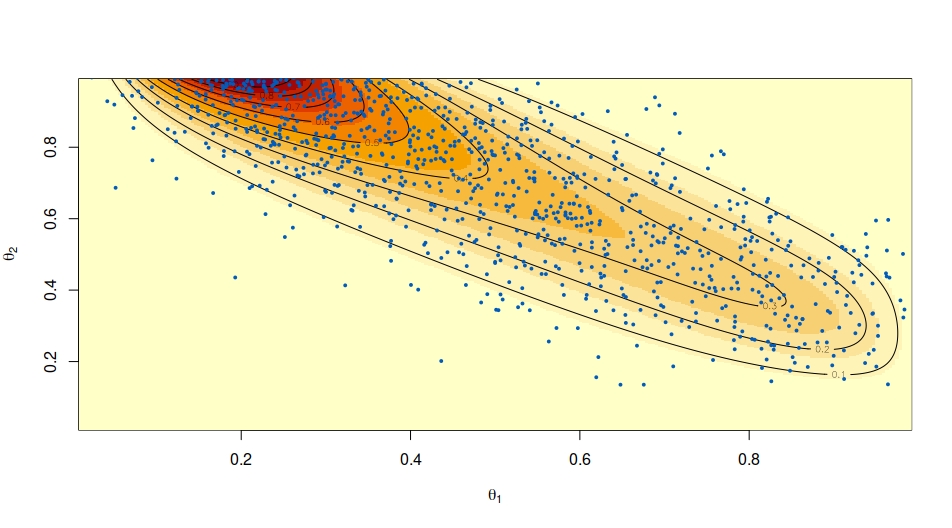
Following a question on Stack Overflow trying to replicate a figure from the paper written by Alan Gelfand and Adrian Smith (1990) for The American Statistician, Bayesian sampling without tears, which precedes their historical MCMC papers, I looked at the R code produced by the OP and could not spot an issue as to why their simulation did not fit the posterior produced in the paper. Which proposes acceptance-rejection and sampling-importance-resampling as two solutions to approximately simulate from the posterior. The later being illustrated by simulations from the prior being weighted by the likelihood… The illustration is made of 3 observations from the sum of two Binomials with different success probabilities, θ¹ and θ². With a Uniform prior on both.

for (i in 1:N)
  for (k in 1:3){
    llh<-0
    for (j in max(0,n2[k]-y[k]):min(y[k],n1[k]))
      llh<-llh+choose(n1[k],j)*choose(n2[k],y[k]-j)*
         theta[i,1]^j*(1-theta[i,1])^(n1[k]-j)*theta[i,2]^(y[k]-j)*
         (1-theta[i,2])^(n2[k]-y[k]+j)
    l[i]=l[i]*llh}

To double-check, I also wrote a Gibbs version:

theta=matrix(runif(2),nrow=T,ncol=2)
x1=rep(NA,3)
for(t in 1:(T-1)){
   for(j in 1:3){
     a<-max(0,n2[j]-y[j]):min(y[j],n1[j])
     x1[j]=sample(a,1,
        prob=choose(n1[j],a)*choose(n2[j],y[j]-a)*
           theta[t,1]^a*(1-theta[t,1])^(n1[j]-a)*
           theta[t,2]^(y[j]-a)*(1-theta[t,2])^(n2[j]-y[j]+a)
           )}
      theta[t+1,1]=rbeta(1,sum(x1)+1,sum(n1)-sum(x1)+1)
      theta[t+1,2]=rbeta(1,sum(y)-sum(x1)+1,sum(n2)-sum(y)+sum(x1)+1)}

which did not show any difference with the above. Nor with the likelihood surface.

reproducibility check [Nature]

Posted in Statistics with tags , , , , , , , , on September 1, 2021 by xi'an

While reading the Nature article Swarm Learning, by Warnat-Herresthal et [many] al., which goes beyond federated learning by removing the need for a central coordinator, [if resorting to naïve averaging of the neural network parameters] I came across this reporting summary on the statistics checks made by the authors. With a specific box on Bayesian analysis and MCMC implementation!