
Archive for Académie des Sciences
Stéphane Mallat awarded CNRS Gold Medal
Posted in Books, pictures, Statistics, University life with tags 1530, Académie des Sciences, awards, École Normale Supérieure, Centre National de la Recherche Scientifique, CNRS, CNRS Gold Medal, Collège de France, France, neural networks and learning machines, Paris, signal processing, Stéphane Mallat, wavelets on September 12, 2025 by xi'an
Borel and Langevin jailed [in 1941]
Posted in Books, Kids, pictures, Statistics, University life with tags Abwehr, Académie des Sciences, anti-fascism, Camille Marbo, collaboration, Collège de France, Emile Borel, French Navy, French resistance, IHP, Institut Henri Poincaré, Jacques Solomon, Lucien Le Cam, Nazi occupation, Paul Langevin, Pétain, Vichy régime, WW II on December 1, 2024 by xi'an

When attending the Le Cam 100th anniversary day at IHP, I learned from Laurent Mazliak’s talk that Émile Borel Borel (then in his 70’s and a member of the French Académie des Sciences) was arrested and jailed for a few weeks in 1941, as well as Paul Langevin (both in 1940 and 1941), for political (left-wing) reasons (?), by German security services (Abwehr), with no involvement of the French collaborationist authorities who rather intervened towards their release (along with the German Navy!, unlikely connected with Borel being the minister of the French Navy in 1924!!). Possibly from denunciations sent to German forces. Possibly as a show of power by the occupying forces towards the Vichy government and Philippe Pétain. The fact that Borel and his wife, Camille Marbo, were actually engaged in the French Resistance at least from 1942 fortunately did not come to the knowledge of French police or German security. (Langevin was one of the founders of the 1934 Comité de vigilance des intellectuels antifascistes. In 1941, his son-in-law, Jacques Solomon, a physicist, got arrested and executed for founding a clandestine newspaper, l’Université libre. His daughter Hélène Solomon-Langevin got deported but survived several deportation camps.)
my neighbour who invented the gradient descent from the top of his hill
Posted in Books, pictures, University life with tags Académie des Sciences, Augustin Cauchy, Comptes Rendus de l'Académie des Sciences, CRAS, gradient descent, Marie Curie, Sceaux on September 6, 2024 by xi'an
“It will suffice therefore, either to resolved this last equation, or at least to attribute to θ a sufficiently small value, in order to obtain a new value of u inferior to u. If the new value of u is not a minimum, one will be able to deduce, by operating always in the same manner, a third still smaller value; and, by continuing thus, one will find successively some values of u more and more small, which will converge toward a minimum value of u. If the function u, which is supposed not at all to admit negative values, offers some null values, there will be able always to be determined by the preceding method, provided that one chooses conveniently the values of x, y, z, …” Augustin Cauchy, CRAS, 25, 536–538, 1847 [translation of Richard J. Pulskamp, 2010]
Surprisingly, I was not aware till a few days ago that Augustin Cauchy had made the first proposal of the gradient method to solve a minimisation problem. Which he published in a fairly vague(witness the above quote) paper in the Comptes Rendus de l’Académie des Sciences. Cauchy lived most of his (adult) life in my town of Sceaux, with his house still standing near the town centre, and now part of the nearby Marie Curie high school (named after another famous resident!).
extinction minus one
Posted in Books, Kids, pictures, R, Statistics, University life with tags Académie des Sciences, Bienaymé, Francis Galton, Galton-Watson extinction, Henry William Watson, Images des Mathématiques, logarithmic periodicity, order statistics, Pierre Simon Laplace, R, riddle, simulation, Société Mathématique de France, Stiegler's Law, The Riddler, Venezia on March 14, 2022 by xi'an
The riddle from The Riddler of 19 Feb. is about the Bernoulli Galton-Watson process, where each individual in the population has one or zero descendant with equal probabilities: Starting with a large population os size N, what is the probability that the size of the population on the brink of extinction is equal to one? While it is easy to show that the probability the n-th generation is extinct is

I could not find a way to express the probability to hit one and resorted to brute force simulation, easily coded
for(t in 1:(T<-1e8)){N=Z=1e4
while(Z>1)Z=rbinom(1,Z,.5)
F=F+Z}
F/T
which produces an approximate probability of 0.7213 or 0.714. The impact of N is quickly vanishing, as expected when the probability to reach 1 in one generation is negligible…
However, when returning to Dauphine after a two-week absence, I presented the problem with my probabilist neighbour François Simenhaus, who immediately pointed out that this probability was more simply seen as the probability that the maximum of N independent geometric rv’s was achieved by a single one among the N. Searching later a reference for that probability, I came across the 1990 paper of Bruss and O’Cinneide, which shows that the probability of uniqueness of the maximum does not converge as N goes to infinity, but rather fluctuates around 0.72135 with logarithmic periodicity. It is only when N=2^n that the sequence converges to 0.721521… This probability actually writes down in closed form as

(which is obvious in retrospect!, albeit containing a typo in the original paper which is missing a ½ factor in equation (17)) and its asymptotic behaviour is not obvious either, as noted by the authors.
On the historical side, and in accordance with Stiegler’s law, the Galton-Watson process should have been called the Bienaymé process! (Bienaymé was a student of Laplace, who successively lost positions for his political idea, before eventually joining Académie des Sciences, and later founding the Société Mathématique de France.)
The [errors in the] error of truth [book review]
Posted in Books, Statistics, University life with tags Abraham De Moivre, Académie des Sciences, book review, Carl Friedrich Gauss, central limit theorem, CHANCE, Edward Simpson, Enlightenment, eugenism, French Revolution, guillotine, Jakob Bernoulli, Karol Wojtyła, Law of Large Numbers, Margaret Thatcher, Marie Curie, Maximilien Robespierre, Ottoman Empire, OUP, Pierre Simon Laplace, Richard Price, Ronald Reagan, St Petersburg, The Bell Curve, Thomas Bayes, typos, Victorian society, Voltaire, wikipedia on August 10, 2021 by xi'an OUP sent me this book, The error of truth by Steven Osterling, for review. It is a story about the “astonishing” development of quantitative thinking in the past two centuries. Unfortunately, I found it to be one of the worst books I have read on the history of sciences…
To start with the rather obvious part, I find the scholarship behind the book quite shoddy as the author continuously brings in items of historical tidbits to support his overall narrative and sometimes fills gaps on his own. It often feels like the material comes from Wikipedia, despite expressing a critical view of the on-line encyclopedia. The [long] quote below is presumably the most shocking historical blunder, as the terror era marks the climax of the French Revolution, rather than the last fight of the French monarchy. Robespierre was the head of the Jacobins, the most radical revolutionaries at the time, and one of the Assembly members who voted for the execution of Louis XIV, which took place before the Terror. And later started to eliminate his political opponents, until he found himself on the guillotine!
“The monarchy fought back with almost unimaginable savagery. They ordered French troops to carry out a bloody campaign in which many thousands of protesters were killed. Any peasant even remotely suspected of not supporting the government was brutally killed by the soldiers; many were shot at point-blank range. The crackdown’s most intense period was a horrific ten-month Reign of Terror (“la Terreur”) during which the government guillotined untold masses (some estimates are as high as 5,000) of its own citizens as a means to control them. One of the architects of the Reign of Terror was Maximilien Robespierre, a French nobleman and lifelong politician. He explained the government’s slaughter in unbelievable terms, as “justified terror . . . [and] an emanation of virtue” (quoted in Linton 2006). Slowly, however, over the next few years, the people gained control. In the end, many nobles, including King Louis XVI and his wife Marie-Antoinette, were themselves executed by guillotining”
Obviously, this absolute misinterpretation does not matter (very) much for the (hi)story of quantification (and uncertainty assessment), but it demonstrates a lack of expertise of the author. And sap whatever trust one could have in new details he brings to light (life?). As for instance when stating
“Bayes did a lot of his developmental work while tutoring students in local pubs. He was a respected teacher. Taking advantage of his immediate resources (in his circumstance, a billiard table), he taught his theorem to many.”
which does not sound very plausible. I never heard that Bayes had students or went to pubs or exposed his result to many before its posthumous publication… Or when Voltaire (who died in 1778) is considered as seventeenth-century precursor of the Enlightenment. Or when John Graunt, true member of the Royal Society, is given as a member of the Académie des Sciences. Or when Quetelet is presented as French and as a student of Laplace.
The maths explanations are also puzzling, from the law of large numbers illustrated by six observations, and wrongly expressed (p.54) as

to the Saint-Petersbourg paradox being seen as inverse probability, to a botched description of the central limit theorem (p.59), including the meaningless equation (p.60)

to de Moivre‘s theorem being given as Taylor’s expansion

and as his derivation of the concept of variance, to another botched depiction of the difference between Bayesian and frequentist statistics, incl. the usual horror

to independence being presented as a non-linear relation (p.111), to the conspicuous absence of Pythagoras in the regression chapter, to attributing to Gauss the concept of a probability density (when Simpson, Bayes, Laplace used it as well), to another highly confusing verbal explanation of densities, including a potential confusion between different representations of a distribution (Fig. 9.6) and the existence of distributions other than the Gaussian distribution, to another error in writing the Gaussian pdf (p.157),
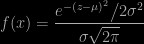
to yet another error in the item response probability (p.301), and.. to completely missing the distinction between the map and the territory, i.e., the probabilistic model and the real world (“Truth”), which may be the most important shortcoming of the book.
The style is somewhat heavy, with many repetitions about the greatness of the characters involved in the story, and some degree of license in bringing them within the narrative of the book. The historical determinism of this narrative is indeed strong, with a tendency to link characters more than they were, and to make them greater than life. Which is a usual drawback of such books, along with the profuse apologies for presenting a few mathematical formulas!
The overall presentation further has a Victorian and conservative flavour in its adoration of great names, an almost exclusive centering on Western Europe, a patriarchal tone (“It was common for them to assist their husbands in some way or another”, p.44; Marie Curie “agreed to the marriage, believing it would help her keep her laboratory position”, p.283), a defense of the empowerment allowed by the Industrial Revolution and of the positive sides of colonialism and of the Western expansion of the USA, including the invention of Coca Cola as a landmark in the march to Progress!, to the fall of the (communist) Eastern Block being attributed to Ronald Reagan, Karol Wojtyła, and Margaret Thatcher, to the Bell Curve being written by respected professors with solid scholarship, if controversial, to missing the Ottoman Enlightenment and being particularly disparaging about the Middle East, to dismissing Galton’s eugenism as a later year misguided enthusiasm (and side-stepping the issue of Pearson’s and Fisher’s eugenic views),
Another recurrent if minor problem is the poor recording of dates and years when introducing an event or a new character. And the quotes referring to the current edition or translation instead of the original year as, e.g., Bernoulli (1954). Or even better!, Bayes and Price (1963).
[Disclaimer about potential self-plagiarism: this post or an edited version will eventually appear in my Book Review section in CHANCE.]

