Archive for qubit

JSM 2024, Portland, Day 1

Posted in pictures, Running, Statistics, Travel, University life with tags , , , , , , , , , , , , , , , , , , , , , , , , , , on August 6, 2024 by xi'an

Strolling through the Oregon Conference Centre on 5 Aug, I am as always amazed at how the JSM conference centres have the ability to swallow in thousands of participants without giving an impression of overcrowding! (And appreciating the moderate air conditioning, which for once does not require wearing a fleece indoors!), I must admit that my first impressions of the city itself have been rather poor, as I was (unsuccessfully) seeking an after-hour grocery near the conference centre, I walked through run-down areas and kept passing homeless people, most in a sorry state. And hearing throughout the night, And again this morning in the warehouse maze I jogged through  before hitting the Willamette River path, which goes uninterrupted for miles. And showed me an unexpected spot, the Kevin Duckworth dock, where swimming the Willamette is feasible. Hopefully attempting a morn swim before I leave Portland.

I attended the quantum computing session, with a rather light introduction without bringing much light on the nature of qubits for storage and computing. In particular, the role of the complex coefficients of the 0 and 1 states. Then my friend Brani Vidakovic gave us an hand-on demonstration (almost hand-on as the conference facilities were unable to let a code run live!, eons away from quantum performances!!). Using Qiskit and Anaconda. He pointed out that measuring a qubit is destroying its quantum nature, the very equivalent of Schrôdinger’s cat. But does not make it clear whether or not the qubit later returns to a random entity, since frequency stabilisation is assumed, witness the histograms displayed by Brani. or a Nature paper of last year.

Went to a (poorly attended) privacy panel session next. With a defence of the value of differential privacy (Jordan Awan, Purdue) somewhat connected with our own (Ocean) work, although utility not understood in a decision-theoretic sense. And privacy remaining in an one-suits-all sense. With Michael Hawes from the US Census Bureau introducing more dimensions than mere DP (coarsening, suppression, swapping, &tc.), with legal aspects (Title 13) of disclosure risk. With the positive (for me) notion of providing a meaningful assessment of disclosure, with some records being more vulnerable than others. And another one on the cumulative disclosure risk over time. If short in quantitative entries. With Valbona Bejleri (USDA NASS, with a Census of their own) on cell suppressions and metrics for assessing disclosure, eg Shannon’s information entropy. And with Gary Howarth (Privacy Engineering Program, NIST). whose point remained rather unclear to me, like the apparently obvious point that adding features increase dispersion between populations. Although presenting tools for convincing experts and actors of the efficiency of privacy protection techniques.

Which continued (sort of) on the afternoon with a synthetic data for preserving privacy panel session. With Bradley Malin (Vanderbilt U) on the dangers of (Nature Communication paper of 2022). And Harrison Quick using a posterior predictive to achieve differential privacy, albeit considering the posterior predictive as the statistical analysis outcome does not seem the right focus (and recoup my earlier criticism of differential privacy requiring bending one’s prior beliefs). Indeed, as a Bayesian aiming at inference rather than merely at not releasing raw data, I would use synthetic data generated from that posterior predictive to return a posterior on the parameters of interest. And Joshua Snoke (RAND) with cautionary warnings. Like producing “invalid” inference because the reliance on a specific model (but isn’t that the case for most of statistics?). And Roee Gutman (Brown U), discussing the special case of record linkage. More into the difficulties in creating synthetic data. (Like the issue with missingness.) Somehow disappointing in not reaching a more statistical and quantitative perspective, eg by sticking to a Bayesian perspective the whole way.

On a non-technical side, I am surprised at hardly anyone adopting the bring-your-own-container policy in the OCC cafés, or outside, given the large number of attendees carrying one or several liquid containers.
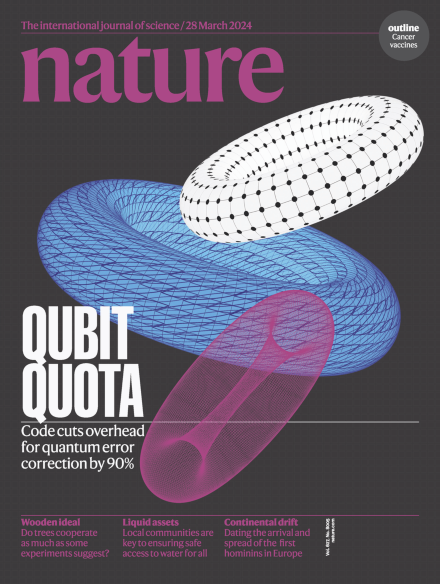
Nature tidbits

Posted in Books, Kids, Statistics, Travel, University life with tags , , , , , , , , , , , , , , , , , , , , , , , , , , , , , , , , , on June 10, 2024 by xi'an

I was quite glad to have taken this 28 March issue of Nature for the train ride to Marseille earlier this month, as it proved full of great entries. Starting with a tribune from a PhD candidate from Ghana unable to speak at a tropical ecology conference in Lisbon for being denied a Schengen visa by the Dutch embassy in Accra, despite providing a serious amount of supporting material. This is a general issue related to international conferences that I plan to include in my presentation in a round table about the future of conference at the ISBA 2024 conference next month. Researchers and students from low-income countries are regularly victims of arbitrary rejections by consular and embassy officers, with little leeway from inviting universities and academic societies for counteracting such arbitrariness. An example came last year when, as part of our Data Science for Social Good program at Warwick, one computer student from Pakistan got denied a visa, while another one with an almost identical profile did receive her visa.

In News in focus, the development of a revolutionary (CAR-T) cancer therapy by  a Munbai company at 1/10 the cost of similar products in the US, with several impressive innovations (and a clinical trial over 33 people). The coverage of Michel Talagrand’s 2024 Abel prize, the deteriorating state of scientific research in Russia, a review on how the Big Bang got its name (hint: it was on BBC 3), and remembering India’s Chipko tree-hugging women of Western Himalayas of 50 years ago. The development of signs for scientific terms to add to the Indian and American sign languages.

There is also an almost sleuthing story on the debates in the ecology community about the theory of “Mother Tree”, introduced by Suzanne Simard, about trees communicating among themselves by underground fungal networks, and thus creating a “wood wide web“.  With mature trees favouring their own kin, a theory that critics in the field deem incompatible with evolutionary theory and more crucially missing supporting evidence. (Arguments from Simard that “the European male society hates the mother tree” concept do not help towards a rational denate. The Guardian now has a podcast about this debate.)

And another story on the (racial and gender) bias of AI image generators. With the conclusion that removing such biases goes through open sourcing. And regulation like the EU’s AI Act. that requires technical documentation on the training datasets. Plus a retrospective on the theory of bird-flight origins, with John Ostrom proposing in 1974 that the evolution to flight was ground-up rather than tree-down.

A cover-paper on IBM error correcting code for quantum computing that only requires each qubit to connect with six others (just like birds in murmuration only keep track of seven neighbours) for an error threshold less than 1%. (With the property that 12 logical qubits can be preserved for 10⁶ cyclces using 288 qubits in total.)

quantum simulation or supremacy?

Posted in Books, Statistics, University life with tags , , , , , on November 11, 2019 by xi'an

d41586-019-03167-2_17301142Nature this week contains a prominent paper by Arute et al. reporting an experiment on a quantum computer running a simulation on a state-space of dimension 253 (which is the number of qubits in their machine, plus one dedicated to error correction if I get it right). With a million simulation of the computer state requiring 200 seconds. Which they claim would take 10,000 years (3 10¹¹ seconds) to run on a classical super-computer. And which could be used towards producing certified random numbers, an impressive claim given the intrinsic issue of qubit errors. (This part is not developed in the paper but I wonder how a random generator could handle such errors.)

“…a “challenger” generates a random quantum circuit C (i.e., a random sequence of 1-qubit and nearest-neighbor 2-qubit gates, of depth perhaps 20, acting on a 2D grid of n = 50 to 60 qubits). The challenger then sends C to the quantum computer, and asks it apply C to the all-0 initial state, measure the result in the {0,1} basis, send back whatever n-bit string was observed, and repeat some thousands or millions of times. Finally, using its knowledge of C, the classical challenger applies a statistical test to check whether the outputs are consistent with the QC having done this.” The blog of Scott Aaronson

I have tried reading the Nature paper but had trouble grasping the formidable nature of the simulation they were discussing, as it seems to be the reproduction by a simulation of a large quantum circuit of depth 20, as helpfully explained in the above quote. And checking the (non-uniform) distribution of the random simulation is the one expected. Which is the hard part and requires a classical (super-)computer to determine the theoretical distribution. And the News & Views entry in the same issue of Nature. According to Wikipedia, “the best known algorithm for simulating an arbitrary random quantum circuit requires an amount of time that scales exponentially with the number of qubits“. However, IBM (a competitor of Google in the quantum computer race) counter-claims that the simulation of the circuit takes only 2.5 days on a classical computer with optimised coding. (And this should be old news by the time this blog post comes out, since even a US candidate for the presidency has warned about it!)