Archive for Google Scholar

Nature (statistical) tidbits

Posted in Statistics with tags , , , , , , , , , , , , , , , , , , , , , , , , , , on January 3, 2025 by xi'an

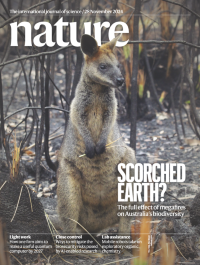
In the 28 November issue of Nature, with this black wallaby left with little to survive after the massive wildfires of 2020, which I read on my way to Nice, several entries related with statistics at large:

Bayesian differential privacy for free?

Posted in Books, pictures, Statistics with tags , , , , , , , , , , , , on September 24, 2023 by xi'an

“We are interested in the question of how we can build differentially-private algorithms within the Bayesian framework. More precisely, we examine when the choice of prior is sufficient to guarantee differential privacy for decisions that are derived from the posterior distribution (…) we show that the Bayesian statistician’s choice of prior distribution ensures a base level of data privacy through the posterior distribution; the statistician can safely respond to external queries using samples from the posterior.”

Recently I came across this 2016 JMLR paper of Christos Dimitrakakis et al. on “how Bayesian inference itself can be used directly to provide private access to data, with no modification.” Which comes as a surprise since it implies that Bayesian sampling would be enough, per se, to keep both the data private and the information it conveys available. The main assumption on which this result is based is one of Lipschitz continuity of the model density, namely that, for a specific (pseudo-)distance ρ

|\log f(x|\theta)-\log f(y|\theta)|\le L\rho(x,y)

uniformly in θ over a set Θ with enough prior mass

\pi(\Theta)\ge 1-e^{-\epsilon}

for an ε>0. In this case, the Kullback-Leibler divergence between the posteriors π(θ|x) and π(θ|y) is bounded by a constant times ρ(x,y). (The constant being 2L when Θ is the entire parameter space.) This condition ensures differential privacy on the posterior distribution (and even more on the associated MCMC sample). More precisely, (2L,0)-differentially private in the case Θ is the entire parameter space. While there is an efficiency issue linked with the result since the bound L being set by the model and hence immovable, this remains a fundamental result for the field (as shown by its high number of citations).

Google scholar error 403

Posted in Statistics with tags , , , on September 10, 2021 by xi'an

fake application

Posted in Books, University life with tags , , , , on August 2, 2021 by xi'an

A while ago, I was part of a hiring committee for a university abroad and among the applications we found one that was so blatantly fake as to wonder what was the purpose of the person (persons?) behind it. From a massive vita including all rewards in the field, incl. a COPSS presidential award, to publications in all top journals and conferences, with the applicant name added to the list of real authors, to fake affiliations, to a completely fake Google Scholar page, &tc. I was surprised at the possibility to include papers on one’s Scholar profile without appearing among the authors but this is apparently possible. And I wonder at the attempt itself since the application is screaming “fake”! A very weird form of performance art?! After searching a wee bit more, I found that some of my French colleagues had opened a webpage to warn about the activities of this individual (?). Including plagiarised papers or books still for sale on Amazon.

Microsoft wrote me an email

Posted in University life with tags , , , on November 23, 2011 by xi'an

I received the following and unsolicited email today from Microsoft Research:

Dear Christian,
Microsoft Research would like to tell you about Microsoft Academic Search (MAS) a search engine to explore publications, authors, conferences, journals and their relationships. Based on our data mining algorithm and data on the web, MAS has aggregated some of your information here.
This is our initial coverage into such academic area, we understand that our coverage is very limited, therefore the aggregated information might not be 100% correct or complete. We are working on finding and processing more data, better name disambiguation, and other enhancements. While you’re here, please check out interactive features like relationship path, and public APIs if you’re interested in using our data set in your research work.
We would love to hear your thoughts about how MAS can help your research and work. It would be great if you can take some time to fill out this short anonymous survey.
Best regards,
Microsoft Academic Search Team

which I find rather astounding. In the sense that the MAS team is basically asking me to correct the inaccuracies in a bibliometric tool I am not interested in! (The link to the survey was not working, not that I was particularly excited in answering! And there is no direct way to correct the information contained in the file, as opposed to google scholar citations…)