Archive for Banff International Research Station for Mathematical Innovation

Contextual Integrity for Differential Privacy #4 [23w5106]

Posted in Books, Mountains, pictures, Running, Statistics, Travel, University life, Wines with tags , , , , , , , , , , , , , , , , , , , , , , , , , , on August 5, 2023 by xi'an

Mostly short talks. First talk by Thomas Seinke (Google) on interpreting ε, with a side wondering of mine on the relation between exp(ε) and the uncertainty that comes with Monte Carlo outcome. Which may relate to this 2022 paper by Ruobin Gong. Second talk by Gautam Kamath (U Waterloo) on large language models under privacy with “public” data. Questioning the appropriateness of ML benchmarks in terms of privacy. Third talk by Mark Bun (Boston U) on replicability, privacy and adaptive generalisation in machine learning, with a strange criticism of confidence intervals on the same parameter not intersecting for two independent studies. And proposing high probability replicable algorithms that can be put in duality with differentially private algorithms at the cost of lowering precision and effective sample size. We also had another group discussion on how to reach out about privacy guarantees, which made me realise there were GDPR compliance software available.

In the afternoon session, Shlomi Hod (Boston U) presented a practical case of designing a privacy preserving protocol for the Israeli birth record. With a strong opposition from stakeholders to use synthetic data, due to a semantic drift from synthetic to manipulated to fake, to lying. Wanrong Zhang did not talk about her stunning recent ICML paper but instead of another practical case connected with mobile based Covid case predictions, by adding minimal noise to mobility data. Nidhi Hegde (U Alberta) gave up talking on Thomson sampling with privacy protection, to focus on an ongoing health application for Alberta as more suited for the workshop. And Ria Safavi-Naini (U Calgary) drew a parallel between information theory and DP versus CI.

While the workshop was scheduled till Friday noon, in usual BIRS habits (!), the morning session was cancelled for most people leaving Kelowna in the morning.

Contextual Integrity for Differential Privacy #3 [23w5106]

Posted in Books, Mountains, pictures, Running, Statistics, Travel, University life, Wines with tags , , , , , , , , , , , , , , , , , , , , , , , , , , , , on August 4, 2023 by xi'an

Morning of diverse short talks. First talk by Bei Jiang (Edmonton) on locally processed privacy for quantile estimation, which relates very much to our ongoing research with Stan, who is starting his ERC funded PhD on privacy. Randomised response, in having a positive probability of replacing indicators in the empirical cdf by a random or perturbed version whose bias can be corrected. I may have overdone the similarity though in confusing users with agents. Followed by a hacking foray by Joel Reardon (Calgary) into how much information is transmitted by apps on completely unrelated phone activity. (Moral: Never send a bug report.)

The afternoon break saw us visiting the Frind Estate winery on the other side of the lake. Meaning not only wine tasting (great Syrah!), and discovering an hybrid grape called Maréchal Foch, but also entering the lab with its mass spectrometer. (But no glimpse of the winemaking process per se…)

Contextual Integrity for Differential Privacy #2 [23w5106]

Posted in Books, Mountains, pictures, Running, Statistics, Travel, University life, Wines with tags , , , , , , , , , , , , , , , , , , , , , , , on August 3, 2023 by xi'an

Morning of diverse short talks. First one on What are the chances? Explaining ε towards endusers by presenting odds and illustrating the impact of including one potential user’s data. Then one on re-placing DP within CI in terms of causality. And multi-agent models, illustrated by the Cambridge Analytics scandal. I am still not getting the point of the CI perspective which sounds to me like an impossibility theorem. A bit as if Statistics had stopped at “All models are wrong” (as Keynes did, in a way). And a talk on Uses & misuses of DP inference, with nice drawings explaining that publicly available information (eg, smoking causes cancer) may create breaches of privacy (Alice may have cancer). Last talk of the morning on framing effects as privileging data processors and overly technical? Fundamental law of information privacy? Got me wondering about the lack (?) of dynamic perspective so far, in the (simplistic?) sense that DP does not seem to account for potential breaches were a secondary dataset to become available with shared subjects and record linkage. (A bit of a go at GDPR, for the second time within a week.)

Before, I had a rather nice early morning in woods on top of Okanagan Lake, crossing many white tailed deer, hopefully no ticks!, as well as No trespassing signs. And a quick and c…ool swim in the Lake 20⁰ waters. No sign of the large wildfires raging south in Osoyoos or north in Kalmoops. We had a fantastic lunch break at the nearby Arrowleaf Cellars winery, with a stellar pinot noir, although this rather made the following working session harder to engage with (not mentioning the lingering jetlag)!
Contextual Integrity for Differential Privacy #1 [23w5106]

Posted in Books, Mountains, pictures, Statistics, University life with tags , , , , , , , , , , , , , , , on August 2, 2023 by xi'an


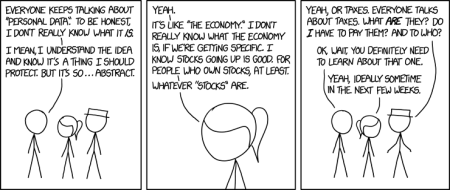
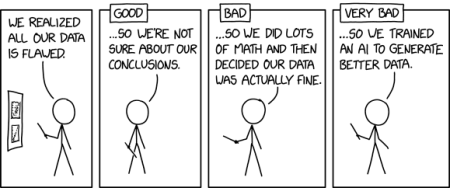
Very relaxed beginning to the workshop, with [xkcd illustrated] tutorials on CI and DP, plus informal discussions to find a common ground over the week. Helped by the beautiful surroundings of the UBC Okanagan campus. Tutorial on the fundamentals of differential privacy, with a long room discussion on the meaning(s) of the definition, for instance exhibiting the minimax nature of the thing, placing all bad events at the same level. Any Bayesian version? Still unclear [to me] how one can inverse-engineer (ε,δ) into the probability of identifying one data entry. More questions about the nature of noise in DP algorithms. Again lacking [for me] the impact on identifying one data entry. Plus notions like Laplace privacy-accuracy sound parameterisation dependent. Exponential mechanism, that involves a score function (protecting privacy?) that ends up resembling a Gibbs posterior in the “safe Bayes” perspective. Interesting distinction about which agent provides randomness as impacting the privacy.

As for contextual integrity, presented by Helen Nissenbaum at the origin of the concept, it is complicated by a strongly subjective handling of notions, first and foremost privacy, as inevitably the case in philosophy and ethics.

Contextual Integrity for Differential Privacy #0 [23w5106]

Posted in Statistics with tags , , , , , , , on July 31, 2023 by xi'an

The Banff International Research Station will host the “Contextual Integrity for Differential Privacy” workshop at the UBC Okanagan campus in Kelowna, B.C., from July 30 to August 4, 2023.

Privacy concerns are becoming a major obstacle to using data, and it is often unclear how current regulations should translate into technology. Over the last decade, differential privacy has emerged as the de facto algorithmic gold-standard in privacy-preserving data analysis, enabling analysis of sensitive data with rigorous privacy guarantees. It is a parameterized privacy notion, and tuning this privacy parameter allows an analyst to smoothly tradeoff between privacy to the individual with accuracy of the analysis. Much of the theoretical work on differential privacy has purposely left this parameter as a free variable that should be chosen based upon the context of data use.

Contextual integrity is a framework for formalizing context of data use, and offers a descriptive categorization of information flows as either appropriate or inappropriate based upon the context and cultural norms. This workshop will combine tools from differential privacy and contextual integrity to develop context-based prescriptions for the use and implementation of differential privacy. It will bring together a multi-disciplinary team of privacy researchers from computer science, information science, statistics, business, law, and public policy to address this multifaceted challenge.