Archive for California
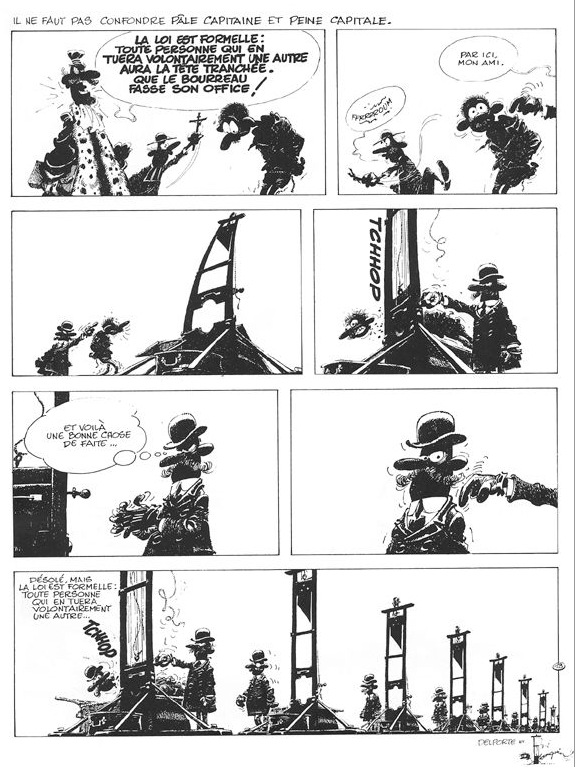
[u]sliding into barbarity
Posted in Books, pictures, Travel with tags Amnesty International, anticlericalism, broadcasing, California, death penalty, Franquin, guillotine, Idées noires, Pentagon, political cartoon, terrorism, Trump 2.0, Trump administration, UN Human Rights Office, US politics, US society on November 7, 2026 by xi'an
Nature tidbits [14 May 2026]
Posted in Books, pictures, Statistics, Travel, University life with tags academic freedom, AI, AI coding, anthropology, antibiotics, apes, Asilomar conference centre, biohazards, bioweapon, book review, California, Canada, coding, David Hume, EU, European Union, Fukushima Daïshi, Fukushima region, Iran, Islamic Republic of Iran, John Locke, LLMs, Middle East, Nature, nuclear disaster, programming, rationalism, sleep patern, US wars on June 21, 2026 by xi'an
The same issue covers the opening of a radiation observation centre in Fukushima, where an area of 300 km² remains off limit. While the remainder of the Fukushima region is declared as safe as the whole of Japan, very few people have returned. One of the goals of the institute (F-REI) is to induce more confidence in the scientific validity of the above declaration, but it remains to be seen how effective it will prove. (I intended to hike nearby this summer but plans have changed!)
Still in the 14 May volume, a longer “feature” article on the dangers of AI-based bioweapons. Which seem real but also difficult to counteract. Especially if rogue states are involved and can create AI-controlled robotic labs for the production. The common recommendation that scientists should create adequate guardrails sounds naïve, at best, since generic LLMs are not designed with such guardrails. (It seems to me each article on the topic reaches the Asilomar trigger at some point!) Followed by a less doom-laden article on the use of AI “vibe coding” by scientists, if not of lesser interest. Which relates to the explosive call to LLMs to design or improve codes. (Also impacting our students and courses in a massive way.) The gains are mostly appreciable for those in the know, since newcomers without coding experience are unlikely to spot subtle errors. (Of course, we a.s. faced pre-AI codes with a subtle error that took ages to detect. Or may even still be there!) The issue also contains an “outlook” leaflet [supported by external sources, who assumedly do not influence the contents!] on antimicrobial (incl. antibiotic) resistance. Among the causes are the default use of antibiotics in farming, which again reflect on the difficulty of controlling such practice (banned in the EU, except in some imports!) and the urge to reduce faster meat consumption. And a book review of Canadian anthropologist Samson’s The Sleepless Ape, which offers an interesting theory of evolution thru sleep deprivation! (“The philosophers John Locke and David Hume thought that sleep hindered rationalism and the pursuit of knowledge.”)
class action, really?!
Posted in Books, Travel, University life with tags Anthropic, book publishing, California, class action, copyright, copyright infringement, CRC Press, Judge Alsup, lawsuit, Library Genesis, Pirate Library Mirror, pirates, Springer-Verlag, Taylor and Francis, US District Court, US justice on January 13, 2026 by xi'an
The letter from the US I found in my (home) mailbox last week sounded like a spam building on copyright violations, if an elaborate one, with promises of huge settlement benefits ($3000 per work, for a total of $1.5 billion!) and a California judge authorization stamped on the envelope… However, after being contacted by a co-author and checking on Internet about the existence of a class action against Anthropic and its pirated libraries, I realised this was not (a spam) and checked that the database of the works concerned by this settlement included eight of my books. (Incl. second editions.) Although I do not expect much return (if any!) once the costs and fees and publishers’ share are subtracted, and the remainder split between 7M books!, this is a first instance of getting back at the providers of pirated copies that are everywhere (since publishers came up with the brilliant scheme of provided access to pdf versions!)
“The lawsuit alleges that Anthropic infringed copyrights by downloading datasets containing copyrighted books in violation of the federal Copyright Act. Anthropic denies all the allegations and denies that it did anything wrong. Anthropic argues that its use of the downloaded datasets was fair use. You can get more information about the lawsuit and view related court documents (…) . Copying a work without permission is not copyright infringement if a defendant can show the copying was fair use. If the use is determined to be infringement, the Copyright Act provides for statutory damages of between $200 and $150,000 per work, depending on factors including the harm that was actually caused by the infringement, and whether the alleged infringer reasonably believed its use was fair or instead acted wilfully. If the use was fair (or there was no copying), the defendant owes $0 (…) The resulting Settlement is the largest copyright class action settlement in history. It provides approximately $3,000 per work (not per Class Member), plus interest earned on the Settlement fund, less the Court-approved costs and fees taken out“
a journal of the [end of the] chaos year
Posted in Books, Kids, Mountains, pictures, Running, Travel, Wines with tags Agatha Christie, BBC Radio n4, Berlin, Black Plague, book reviews, California, Cambodia, COVID-19, crow, cuisine, Daniel Defoe, detective stories, fantasy, Frankenstein, horror, horror story, Indian food, Japan, Japanese cinema, Jotunheimen, Journal of the Plague Year, King Olaf, Kumano Kodō, Lancashire, Lenin, melodrama, North Korea, Norway, NSF, olive tree, restaurant, Russian invasion, Scandinavian Mountains, short stories, South Korea, Tokyo, Trondheim, Ukraine, Yatagarasu, Yorkshire on December 31, 2025 by xi'an  Read the delightful Barrowbreck by Andrew M Hurley, a great collection of short stories is made coherent by its unity of place, a lost, dark, valley between Lancashire and Yorkshire. The stories unfold from the Bronze ages till a near and disastrous future. While the book is often presented as horror fiction, I rather see it as an exploration of an alternate reality, a fantasy just outside our own world. Not inducing dread or unease in the reader. The author demonstrates great skill in setting substantial characters and situations within a few pages, in translating the inner feelings of highly diverse people and, above all, in refraining from providing a definite conclusion to his stories. Some of them are striking enough to remain in my memories for a while!


Apart from an Indian-style vegetable six dishes feast, did not experiment much in the kitchen, in part due to my travelling one week out of two between November and December. But harvested and prepared my olives after collecting about 3 litters of them. (I also tasted a Banh Chhev (in Petit Cambodge, Paris but it failed short from my expectation, neither crispy nor sizzling. And cold.)
Watched As You Stood By, a Korean drama about domestic violence. And then Last Samurai Standing. Adapted from the novel of the same name written by Shogo Imamura. And the rather hilarious movie Good News, a South Korean disaster black comedy film playing a similar trick to Good bye Lenin. Gave up watching an unlucky series of terrible films and TV series. From the cheezy A Man on the Inside (which surely makes Agatha Christie cringe in her grave), to Ichikei’s Crow (a highly unrealistic sequence of near-judicial errors in a Tokyo tribunal, with the redeeming feature of a three-leg crow logo, Yatagarasu, also a guardian on the Kumanokodo), to the pretentious Frankenstein by Guillermo del Toro (where over-prefect Victorian tableaux and crepuscular lighting games kill the scenario even before it is brought to life by Dr. Frankenstein’s steampunk apparatus, aka, the mélo chokes the drama!), to Troll 2, even worse than Troll, pulling on the very same strings as the first film, with the very same house eviscerated again by another strolling troll!, as well as a complete disregard for archaeological dig rules and with the ultimate lame resort to holy water! Catching a few views of the Jotunheimen peaks, though (which we hiked 35 years ago).
for a symmetric Asilomar?
Posted in Books, Kids, University life with tags amino acids, Asilomar conference centre, bioengineering, California, chiral interactions, chirality, DNA, ecosystem invasion, homochirality, immune evasion, immunity, live cell therapeutics, Louis Pasteur, mirror bacteria, mirror life, Nobel Prize, nucleotides, precautionary principle, proteins, RNA, Science on March 29, 2025 by xi'an


