Archive for official statistics

Trump goes to war against… randomization!

Posted in Kids, Statistics, University life with tags , , , , , , , , , , on July 11, 2026 by xi'an

The US Department of Commerce, through its Office of Privacy and Open Government, has posted an order for federal statistical agencies to stop using randomization as a (worthwhile!) mean of protecting confidential data. Another instance of going against scientific arguments and validated procedures, and of dismantling decade long expertises, and of stopping a long series of observations, and of destasbilising federal agencies, from the Trump administration. To wit:

b.     Statistical Policy Directive No. 1, codified at 44 U.S.C. § 3563, requires each statistical agency, as enabled by the head of the parent agency, to adopt policies, best practices, and appropriate procedures to ensure the confidentiality, accuracy, and objectivity of its statistical activities and to disseminate timely and relevant statistical products.

SECTION 5. POLICY.

.01    Ensuring the Accuracy, Confidentiality, Objectivity, and Relevance of Statistical Products

a.     The Department shall, as a primary objective, aim to fulfill its statistical obligations by providing the public with accurate and objective information.

b.     The Department is firmly committed to striking a balance of accuracy, confidentiality, objectivity, and relevance for each statistical product that is consistent with its statistical obligations and the applicable legal requirements.

c.     Any use of noise infusion is inconsistent with the Department’s policies.

.02   The Census Bureau and the Bureau of Economic Analysis shall adhere to the following order of priority when considering and applying Disclosure Avoidance:

a.     Coarsening shall be the preferred category of Disclosure Avoidance methods for all statistical products.

b.     Suppression shall be permitted as a last resort, only to be used when coarsening is prohibited by law or would substantially defeat the accuracy or usability of a statistical product.

c.     Noise infusion shall not be used for any statistical product.

.03   This policy shall not be interpreted to conflict with any constitutional, statutory, regulatory, or other legal provision.

So here go (to the drain) differential privacy, enforced by the Census Bureau under the direction of John Abowd, as well as synthetic data, subsampling, et cetera! This will directly impact the coming 2030 census. With the asinine arguments by Commerce Department Kristen Eichamer that this is done to “maintain public confidence in our data while upholding our duty to safeguard the privacy of those who provide information” and that “indiscriminate use of noise infusion—even when not mandated by law—ultimately undermined confidence in the department’s products and cast doubt on their integrity.” NPR relates this order to the introduction of differentially private measures around the 2020 census and irrational Republican attacks on the procedure. Which reminds me of an earlier opposition to random sampling instead of “exhaustive enumeration” to correct for undercounts, which brought statisticians from both sides almost to blows! (With a defence of the correction procedure by my later friend Steve Fienberg.)

Nature likes official statistics

Posted in Books, Statistics, University life with tags , , , , , , , , , , , , , , , , , on April 5, 2026 by xi'an

Nature is (rightly!) concerned about official statistics around the World and ran a feature article on the topic in its issue of 12 March 2026. It stresses the multiple reasons for supporting a sound, independent, trustworthy national statistic office. The article explores the issues with four national statistic bureaux, for the US, the UK, India, and Argentina. (As my whole career has been associated with the French official statistics institute, INSEE, first as a student, then as a researcher, I would have liked to hear some external views on this institute, albei methinks the situation is not as dire here, despite a permanent reduction in staff over the past decade, to the point the landmark INSEE building in Malakoff has now been dismantled.)

The issue with the US system is predictably mixing political interference à la Trump and budget cuts again à la Trump. Referring to a 2025 ASA report. Longitudinal surveys have been terminated after running 30 years. While preserving its famous independence, the UK Office for National Statistics is facing mistrust from the public that in turn reduces the reliability of its labour survey, with a response rate of 13% in 2023! The UK Government has responded by creating a  National Statistician…. Concerning India, well-known for its love of official statistics, the concern is again with the government interventions against NSC, and Argentina suffers from the same woes, Milei refusing an update of the way inflation is calculated by the national institute NDEC, leading to the departure of the current director (whose remote predecessor was put on trial by an earlier government!)

“Decisions based on incomplete or incorrect knowledge are invariably bad, even harmful. That is why the statistics that governments collect need to be as accurate and as verifiable as possible.”

In what appears (now?) as a common trend in Nature, a tribune on the same topic appeared in the following edition of 19 March 2026. With the call to “fix surveys”, in part battered by systemic underfunding and sapped by low answer rates. And the somewhat paradoxical complaint that private philanthropies like the Gates Foundation is supporting less worldwide surveys like the Demographic and Health Survey Program, which should be the responsibility of governments.

A statement from the Royal Statistical Society on the dismissal of the Commissioner of Labor Statistics, Dr Erika McEntarfer

Posted in Books, Statistics, University life, Wines with tags , , , , , , , , , , , , , on August 7, 2025 by xi'an

“The Royal Statistical Society (RSS) notes with concern the dismissal of Erika McEntarfer as Commissioner of Labor Statistics by US President, Donald Trump, at a time when the global economy is experiencing significant disturbance.

The United Nations’ Fundamental Principles of Official Statistics establishes international professional and scientific standards for the production of official statistics. The RSS, as one of the world’s leading statistical societies and with a membership that includes official statisticians from many countries, is keenly interested in the adherence to these standards across the world to ensure quality and integrity.

Any concerns regarding data or methodology should be independently evaluated to ensure credibility is maintained. The dismissal undermines international trust in US statistics, which has ramifications well beyond policy decisions within the US, with impacts on global confidence in the world economy.

The RSS is against all forms of political interference in the production of official statistics and urges President Trump to ensure that the nonpartisan integrity of the position is retained. Furthermore, reassurance is needed to ensure that statisticians working for federal agencies have confidence to continue producing the objective statistical information that enables those in power to gain the trust of their communities.

These actions are essential to ensure a healthy democracy in the US, and to maintain international credibility in its statistics.”

shoot the messenger & cook the books

Posted in Books, Statistics with tags , , , , , , , , , , , , , , , , , , , , , on August 2, 2025 by xi'an

Heads of Official Statistics Bureaux has been subjected to suspicion and sometimes prosecution from their governments in the recent past, the most notable cases being Agentina with Graciela Bevacqua and Greece (with Andreas Georgiou), while the ASA and the ISI expressed deep concern this year about the  dismissal of Dominik Rozkrut as President of Statistics Poland. Now this undemocratic tide against the independence of official statistics has reached America, with Agent Orange firing the commissioner of the Bureau of Labor Statistics because he did not like the (un)employment report!! Rather than reflecting on the massive impact on the economy of his own, chaotic, economic decisions and counter-decisions.

“What do we do when the president of the United States behaves [like a 5-year-old]? On Friday, President Trump fired the head of the Bureau of Labor Statistics — the nation’s workaday scorekeeper of employment, wages and productivity. Why? Because the data didn’t make Mr. Trump look good. The statistics were inconvenient. So the president didn’t just challenge the findings; he fired the statistician. That’s not governing. That’s board flipping (…) One danger certainly is that a future Bureau of Labor Statistics head might feel political pressure to fudge a jobs report. The deeper risk is cynicism, the quiet corrosion of faith in institutions. If we can’t believe the numbers, how do we believe anything?” f, Aug. 3

how to count excess deaths?

Posted in Books, Kids, pictures, Statistics with tags , , , , , , , , , , , , , , , on February 17, 2022 by xi'an

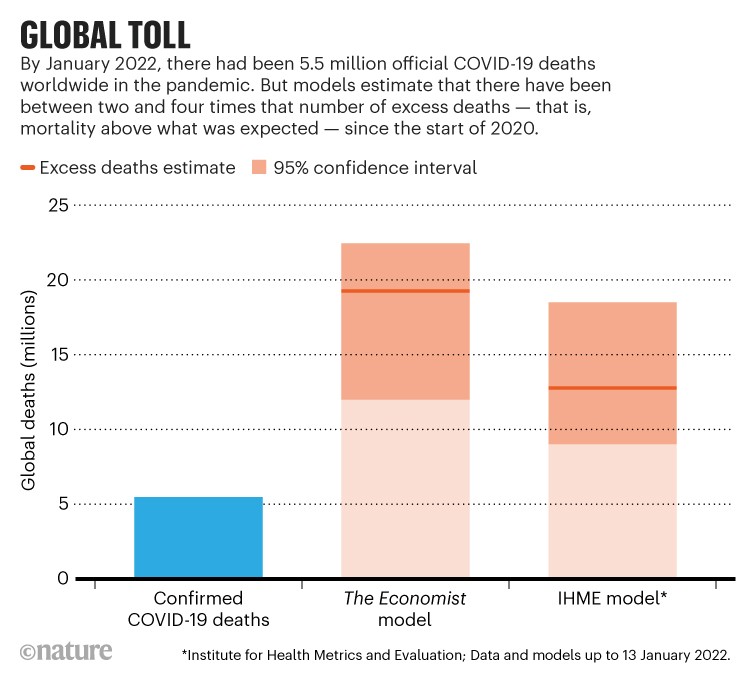
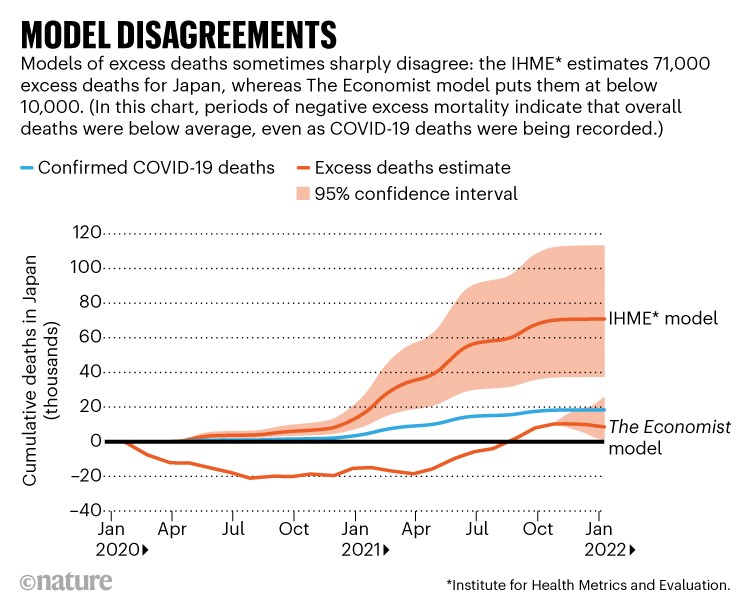
Another terrible graph from Nature… With vertical bars meaning nothing. Nothing more than the list of three values and both confidence intervals. But the associated article is quite interesting in investigating the difficulties in assessing the number of deaths due to COVID-19, when official death statistics are (almost) as shaky as the official COVID-19 deaths. Even in countries with sound mortality statistics and trustworthy official statistics institutes. This article opposes prediction models run by the Institute for Health Metrics and Evaluation and The Economist. The later being a machine-learning prediction procedure based on a large number of covariates. Without looking under the hood, it is unclear to me how poor entries across the array of covariates can be corrected to return a meaningful prediction. It is also striking that the model predicts much less excess deaths than those due to COVID-19 in a developed country like Japan. Survey methods are briefly mentioned at the end of the article, with interesting attempts to use satellite images of burial grounds, but no further techniques like capture-recapture or record linkage and entity resolution.