Archive for editorial
the vote by the Knesset against UNRWA is a disgrace and a scandal
Posted in Kids, Travel with tags editorial, Gaza, Gaza war, Hamas, humanitarian aid, Israel, Knesset, Le Monde, Lebanon, Nakba, Palestine, Palestinian refugees, United Nations, UNRWA, war crimes on October 30, 2024 by xi'an
la lutte capitale [cover]
Posted in Books, Kids, pictures with tags Allied troops, Arc de Triomphe, Champs-Elysées, Charles de Gaulle, commemoration, cover, editorial, French history, FTP-MOI, Libé, liberation of Paris, Madeleine Riffaud, national narrative, Paris, Pétain, Résistance on August 24, 2024 by xi'an
“It is clearly the most spectacular transfer operation in our national history: on August 25, 1944, the French Résistance offered its heroïsm and its dead to the entire Paris population and the whole Nation, thus allowing all French people to find solace and absolution in the mythology of a capital that had liberated itself, a military triumph of a unanimously resisting France. The relegation of American soldiers and other foreigners who had fought in the streets of Paris, the collective erasure of the triumphant welcome of Maréchal Pétain on the Champs-Elysées a mere four months earlier, and the hurried sanctification of a mostly unknown de Gaulle would participate in making such a massive mystification possible. There is not doubt that it was necessary in the context of a wounded nation and its traumatized capital city; after all, what national narrative is more compelling than one of a population that sets itself free?” Dov Alfon, Libération, 24 Aug 2024
Nature [5 Jan issue]
Posted in Books, pictures, University life with tags cover, COVID-19, disruptivity, editorial, excess deaths, Nature, Poisson regression, preregistered experiments, publish or perish, splines on February 17, 2023 by xi'an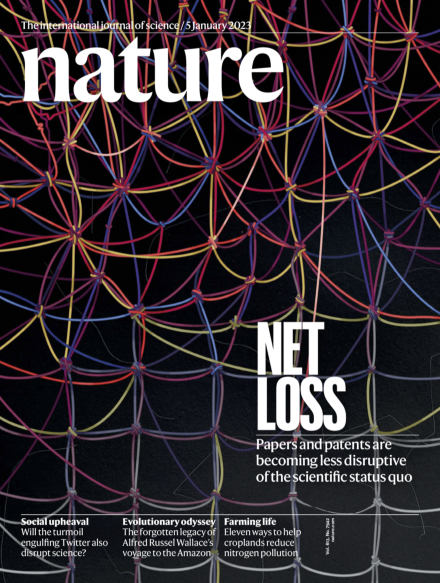
“I do not propose that reviewers debate matters as such as frequentist versus Bayesian philosophies of statistics.”
One could see a connexion with preregistered trials, with the sound argument that hypotheses should be clearly stated prior to getting data.
The issue also contains an open-access paper by WHO and U of Washington researchers (incl. Bayesian John Wakefield) on estimating the number of COVID-19 deaths from excess deaths. With the issue that data is missing for some countries. With a critical commentary from Enrique Acosta on not adjusting for avoided deaths. And apparently (and surprisingly) not accounting for age structure in each country, esp. since regression is involved. The modelling is done via a Poisson count model. And analysed by Bayesian methods. As often I wonder why France doesn’t feature in the picture, except for a mention that the ratio of excess deaths to COVID-19 deaths is less than one, and French Guiana is not on the maps… Unclear issues about highly reliable countries like Germany and Sweden. And splines… Instead of Gaussian processes. No attempt at capture recapture?

And a somewhat puzzling paper [rewarded by the journal cover] on diminishing disruption of scientific papers over time. It is sort of obvious that as the numbers explode novelty and impact diminish. If only because an increasing number of papers never get cited. Based on a single CD index (with a typo in the formula!) Nothing about maths? As noted by the authors in their conclusion the sheer number of disruptive papers had remained essentially constant…
put the data aside [SCOTUS v. evidence]
Posted in Statistics with tags abortion, editorial, evidence, health care, legalisation of abortion, maternal mortality, Nature, Planned Parenthood, reproductive rights, Roe v. Wade, SCOTUS, Supreme Court, US Constitution on May 18, 2022 by xi'an Reposted from a Nature editorial:
(…) Moving in the opposite direction runs contrary to 50 years of research from around the world showing that abortion access is a crucial component of health care and is important for women’s equal participation in society. After the Supreme Court agreed to hear Mississippi’s case last year, Nature covered some of this evidence, submitted to the court by US scientific societies and more than 800 US researchers in public health, reproductive health, social sciences and economics, to the court in advance of the case’s hearing in December.
Some outcomes of outlawing abortion can be predicted by what’s known. Researchers expect overall infant and maternal health to decline in the United States in the wake of abortion bans, because more unintended pregnancies will be brought to term. Unintended pregnancies are associated with an increased risk of health problems for babies, and often for mothers, for several reasons — including reduced prenatal care.
Maternal health is also expected to decline overall. One straightforward reason is that the risks of dying from pregnancy-related causes are much greater than the risks of dying because of a legal abortion. A predicted rise in maternal mortality among Black women in the United States is particularly distressing, because the rate is already unacceptably high. In one study, sociologist Amanda Stevenson at the University of Colorado Boulder modelled a hypothetical situation in which abortions are banned throughout the United States, and found that the lifetime risk of dying from pregnancy-related causes for non-Hispanic Black women would rise from 1 in 1,300 to 1 in 1,000.
One claim made by abortion opponents in this case is that abortions no longer benefit women and even cause them harm, but dozens of studies contradict this. In just one, health economist Sarah Miller at the University of Michigan in Ann Arbor and her colleagues assessed around 560 women of comparable age and financial standing who sought abortions. They found that, five years after pregnancy, women who were denied the procedure had experienced a substantial increase in debt, bankruptcies, evictions and other dire financial events — whereas the financial standing of women who had received an abortion had remained stable or improved. A primary reason that women give for wanting an abortion is an inability to afford to raise the child, and this study suggests that they understand their own situations.
Abortion bans will extract an unequal toll on society. Some 75% of women who choose to have abortions are in a low income bracket and nearly 60% already have children, according to one court brief submitted ahead of the December hearing and signed by more than 150 economists. Travelling across state lines to receive care will be particularly difficult for people who do not have the funds for flights or the ability to take time off work, or who struggle to find childcare.
Unfortunately, some of the justices seem to be disregarding these data. At the December hearing, Julie Rikelman, a lawyer at the non-profit Center for Reproductive Rights, headquartered in New York City, brought up studies presented in the economists’ brief; Roberts interrupted her and suggested “putting that data aside”. In the leaked draft opinion, Alito also elides a body of research on abortion policy, writing that it’s “hard for anyone — and in particular for a court — to assess” the effect of the right to abortion on women’s lives.
Such an attitude suggests that the justices see research as secondary to the question of whether the US Constitution should protect abortion. But the outcome of this ruling isn’t an academic puzzle. The Supreme Court needs to accept that the consensus of research, knowledge and scholarship — the evidence on which societies must base their laws — shows how real lives hang in the balance. Already, the United States claims the highest rate of maternal and infant mortality among wealthy nations. Should the court overturn Roe v. Wade, these grim statistics will only get worse.