Archive for black holes

Nature tidbits [15 Jan 2026]

Posted in Books, pictures, Travel, University life with tags , , , , , , , , , , , , , , , on March 13, 2026 by xi'an

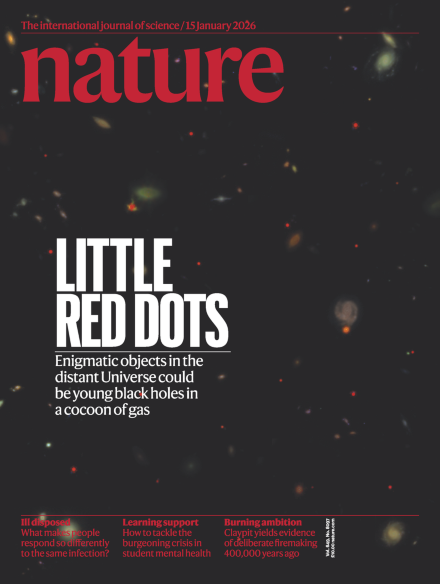
The cover of the 15 Jan issue of Nature is a blurry reconstitution of snapshots from the James Webb Space Telescope, which contributed to uncover these new astronomical objects, deemed to be young supermassive black holes. A notion I only came across recently, during a pre-defence lunch near the Paris Observatory.

Apart from that astronomical advance, Nature puts its focus on the 25th anniversary of Wikipedia. With a tribune bemoaning the insufficient investment of academics in the platform (with mentions of hypocrisy and betrayal). Which sounds rather unfair, since it requires an additional levy on research time, even though I did contribute to a few entries. And recognise the worth of most scientifics pages, as well as the parasitism by LLMs. And an interview of of Jimmy Wales’ about his Wikipedia memoir, Seven Rules of Trust. Kudos to his vision! He sounds rather optimistic about the chances of Wikipedia surviving the tsunAImi, but only if the users keep resorting (and indeed contributing) to the platform rather than accepting the LLM production at fa(r)ce value!

Other entries on

  • LLMs suffering (!) from “anxiety, trauma, shame and post-traumatic stress disorder”, although the arXiv reporting the experiment is criticized by others for anthropomorphising the machines. The danger is more in them inducing real trauma in vulnerable (human) users!
  • LLMs exhibiting aggressive behaviour (if trained accordingly)
  • the oldest evidence on human controlled fires using pyrite (in SE England), 400,000 years ago
  • the rise of academics being harassed (and not only in the US) and six recommendations for protecting our digital security (mentioning organisations such as Scholars at Risk Europe, Expert Voices Together, and Faculty First Responders)
  • a “Where I work” picture of a food scientist at the National Autonomous University of Mexico flipping a tortilla, with fermented ingredients to improve health and combat malnutrition in poor communities
Nature tidbits [21 Aug 2025]

Posted in Books, pictures, University life with tags , , , , , , , , , , , , , , , , on October 16, 2025 by xi'an

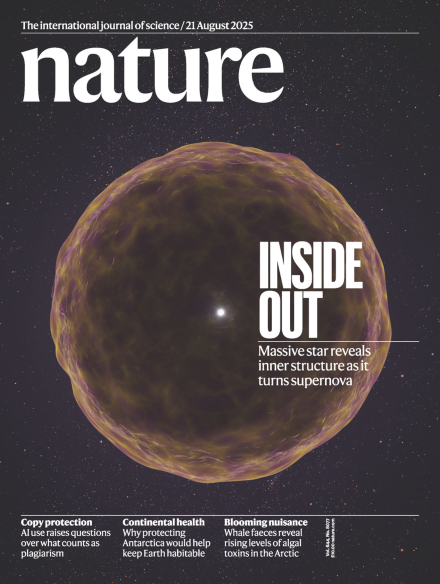
The cover of this Nature issue is a fake!, being an artist’s rendering of a supernova (2021yfj) before it exploded, with the core exhibited as rich in silicon and sulfur. (The heaviest element in stars is iron, resulting from the fusion of the above. When the iron mass exceeds a limit, the star collapse into a neutron star or a black hole.)

On the Trump 2.0 administration’s attack-on-science front, an editorial exposes the irresponsibility of cancelling grants for mRNA studies (which Trump 1.0 supported during the COVID crisis). And a longer article points out the radical switch in managing federal grants, committees moving from scientists to political appointees, searching for “anti-American values”… And another one on the backlash following the report from said administration about climate change and global warming. (As blogged recently.)

At a more conceptual (and international) level, an article questions the usual stand on declining birth rates as being problematic. While acknowledging that public incentives have a highly variable mileage, the article remains vague on how supporting an ageing population while keeping an homogeneous welfare support will prove feasible. A second socio-economic article muses about the lack of a downward curve in the cost of electric cars, despite the drop in battery costs, pointing out the inefficiency of state support that creates profit bubbles for the manufacturers. Stricter policies on combustion vehicles similarly seem inefficient, given the violent reactions of car owners (as in the Gilets Jaunes revolt). The EU has alas recently backed down on its goal of prohibiting new combustion engines by 2035.

In shark contrast, a review paper document the rising probability of a climate catastrophe induced by the melting Antarctica, which could prove of a higher magnitude than the melting Arctic. (Even though the introduction article is rather confusing, mixing this issue with the pollution brought by Antarctic tourism and mentioning indigenous populations that do not exist on the 7th Continent).

And on the (weekly) AI front, the announcement of the downloadable gpt-oss from OpenAI, which I plan to check. And the debate on whether or not AI generated papers can plagiarise, again a poorly focussed article mostly missing the issues of the scientific worth of such papers (and the basic fact that they 100% plagiarise the literature dataset they learned from!).

[not so] hostile takeover on my Nature issue

Posted in Books, pictures, Travel, University life with tags , , , , , , , , , , , , , , , , , , , , , , , , , , , , on November 29, 2024 by xi'an

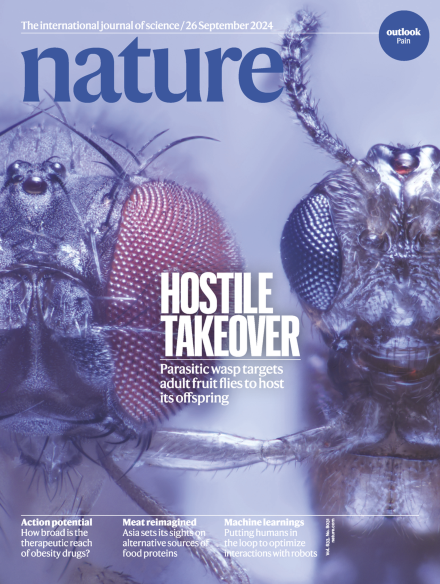
When flying to Montréal last week, I took with me this 16 September issue of Nature but forgot it in the plane. But had time to read a tribune warning on the dangers of governments being involved in running the Internet. And thus disrupting its decentralised structure… And a short highlight on the (minimal) impact of atom-sized, asteroid-mass black holes crossing the Solar System, awakening me to the very existence of such stellar objects! And remained skeptical at the proposal to downsize pint glasses to lower beer consumption in the UK. (Although I now find myself unable to drink a whole pint of beer, outside eating a fiery curry! Or an alcohol free version.) And read how NobAIl Prize winning Alphafold2 unfolded a structure common to a family of flavivirus that make them relative with a common ancestor. And a book review pondering whether or not AI can feel distress, pondering at their sentience. (The book is freely available on OUP webpage.) Unlikely to be re-reviewed for CHANCE! And a fairly interesting long comment on how some Asian nations are massively investing into alternative approaches to meat production. (In particular since mentioning Singapore, where the company employing one of my nephews is soon to introduce in-vitro foie gras.) But missed the research paper on the origin and evolution of the bread wheat D genome, which I would have most certainly devoured, despite my favouring rye and buckwheat breads! (No bread was hurt in the study, since the 60 wheat landraces analysed therein came from the CIMMYT and ICARDA gene banks.) The origin is thus most likely on the “southern shores of the Caspian Sea 8,000–11,000 years ago”. Which sounds quite recent, all things considered!

Natural statistical science [#2]

Posted in Statistics with tags , , , , , , , , , , , , , , , on November 23, 2023 by xi'an

A rare occurrence of a Bayesian statistics paper in Nature with this “State estimation of a physical system with unknown governing equations” by Course and Nair. A variational Bayes modelling of a state system observed with noise, but without a physical model on the state (SDE) evolution itself. Which means a prior is set on a non-parametric or neural representation of the drift and a linear approximation is used for the variational approximation, leading to a Gaussian process as the approximate distribution. While this applies to highly complex models, like orbiting black holes, it is somewhat a surprise to meet this application of variational inference in a prestigious general science journal like Nature. (The picture above was taken on the train from Marseille at the end of the Bayes Fall school.)

“The approach is based on a technique called Bayesian inference, which is used widely, but which can be computationally challenging for complex systems.” B. Keith

parallel tempering on optimised paths

Posted in Statistics with tags , , , , , , , , , , , , , , , on May 20, 2021 by xi'an


Saifuddin Syed, Vittorio Romaniello, Trevor Campbell, and Alexandre Bouchard-Côté, whom I met and discussed with on my “last” trip to UBC, on December 2019, just arXived a paper on parallel tempering (PT), making the choice of tempering path an optimisation problem. They address the touchy issue of designing a sequence of tempered targets when the starting distribution π⁰, eg the prior, and the final distribution π¹, eg the posterior, are hugely different, eg almost singular.

“…theoretical analysis of reversible variants of PT has shown that adding too many intermediate chains can actually deteriorate performance (…) [while] on non reversible regime adding more chains is guaranteed to improve performances.”

The above applies to geometric combinations of π⁰ and π¹. Which “suffers from an arbitrarily suboptimal global communication barrier“, according to the authors (although the counterexample is not completely convincing since π⁰ and π¹ share the same variance). They propose a more non-linear form of tempering with constraints on the dependence of the powers on the temperature t∈(0,1).  Defining the global communication barrier as an average over temperatures of the rejection rate, the path characteristics (e.g., the coefficients of a spline function) can then be optimised in terms of this objective. And the temperature schedule is derived from the fact that the non-asymptotic round trip rate is maximized when the rejection rates are all equal. (As a side item, the technique exposed in the earlier tempering paper by Syed et al. was recently exploited for a night high resolution imaging of a black hole from the M87 galaxy.)