Archive for clinical trials

Nature tidbits [10 Sept 2026]

Posted in Books, pictures, Travel, University life with tags , , , , , , , , , , , , , , , , , , , , , , , , , , , , , , , , , , , , , , , , , , , , , , , , , , , , on October 21, 2026 by xi'an

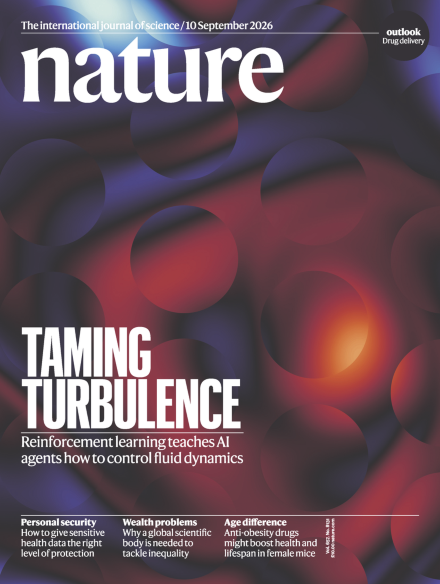
Having left my copy of the 10 September issue of Nature on a suburban train this afternoon (hopefully to the benefit of a fellow passenger!), I had to fall back on the online version. The cover story, Taming turbulence, is about HydroGym, a reinforcement-learning platform where AI agents learn to control turbulent flows. While this has practical consequences, it is also the harbinger of the resolution (?) of the Navier-Stoke Millennium Problem by OpenAI. Covered in the following issue.

Flotsam of interest for me:

  • reporting on a single data point exciting cosmologists (and beyond!), namely one unusual flash recorded in 2023 or 2024 by the LZ detector thru its 10 tonnes liquid xenon basin, which looks like what a weakly interacting massive particle (WIMP!) would produce. This would be a fist in experimentally supporting the dark matter theory. But without reproducibility, ’tis hard to jump to a conclusion. In correlation, a news article on the launch of the Nancy Grace Roman Space Telescope, with two World Views, one on Roman herself as “mother of Hubble”. Promising advances on far, far away celestial bodies thanks to the infrared abilities of said telescope. And again to cosmology.
  • a news feature on “the Einstein test”, checking whether language models trained only on pre-1905 data could rediscover relativity. This is a clever way to separate creativity from regurgitation, if the historical training corpus can indeed be kept clean. And faster than training monkeys to type…
  • an article combining climate and econometric modelling to assess how human-induced climate change has shifted, and will shift, the burden of childhood malaria in Africa. The attribution relies on counterfactual climate simulations, which makes me wonder about the propagation of uncertainty.
  • an article linking US mortgage records from around the Second World War to race and immigration status. It shows that New Deal programmes disproportionately excluded Black borrowers, a nice (if sad) record-linkage exercise.
  • a privacy feature on how UK Biobank was shut down after a data leak and is now imposing new safety measures. It raises the recurrent tension between protecting participants’ privacy and keeping data open to researchers, which connects once more with the membership-inference paper I discussed earlier.
  • an editorial praising the World Bank for publishing and verifying the raw data and code behind its reports. Other agencies should indeed follow suit!
  • a news item on the massive experience of mutating every DNA letter in a viral genome, whose effects the top AI models failed to predict (fail or pass the survival test!). A welcome reality check on AI in biology.

  • two militant comments on the economy, one by Joseph Stiglitz et al. calling for an IPCC-like International Panel on Inequality, and one on a call for measuring growth through all forms of capital, rather than GDP alone. And a great poster (reminding me of Indian movie posters) on the side!
  • an editorial on the comforting aspect of the Ig Nobel prizes, no matter how silly they sound.
  • a book review of The Winding Trail &tc. on the Principia Mathematica and Newton’s disdain for hypotheses (with his famous “hypotheses non fingo” that clashes with the modern scientific approach!), along with his habit of feuding over priority. What is amazing with Newton’s meteor trajectory is he only seriously engage into mathematics during his final undergraduate term at Cambridge, one year before the Great Plague and his revolutionary breakthroughs!

cynical trials

Posted in Statistics with tags , , on November 2, 2021 by xi'an

against method

Posted in Books, Statistics, University life with tags , , , , , , , , , on March 29, 2020 by xi'an

A vitriolic tribune in Le Monde this weekend by the microbologist Didier Raoult, head of the Institut Hospitalo-Universitaire Méditerranée Marseille, campaining for the immediate use of the hydroxychloroquine sulfate drug for coronavirus patients. Arguing that the major emergency of the coronavirus pandemic calls for this use without waiting for confirmation from clinical trials, without controlled comparison with other drugs or a placebo. Solely a study of patients being administered the drug, outside the usual practice of clinical trials.

“Enfin, l’envahissement des méthodologistes amène à avoir des reflexions purement mathématiques.” [At last, the invasion of methodologists leads to purely mathematical reasonings.]

“Ce modèle, qui a nourri une quantité de méthodologistes, est devenu une dictature morale.” [This model, which has fed quantity of methodologists, has become a moral dictatorship.]

“…il faut nous débarasser des mathématiciens, des metéorologistes [sic] dans ce domaine.” [we must get rid of mathematicians and meteorologists in this domain]

“…conseil scientifique dans lequel on trouvait deux modélisateurs de l’avenir (qui pour moi représentent l’équivalent de l’astrologie), des maniaques de la méthodologie. Les médecins confrontés au problème du soin représentaient une minorité qui n’avait pas nécessairement l’habitude de s’exprimer et qui se trouvait noyée par cet habillage pseudo-scientifique.” […scientific committee including two modelisators of the future (equivalent in my opinion to astrologers), manics of methodology. Physicians facing treatment problems were a minority not necessarily used to intervene, overwhelmed by this pseudo-scientific babbling.]

Obviously I have no expertise in drug development or even in epidemiology, but the name-calling tone of this tribune, as illustrated by the above quotes, is appalling and populist, more in the spirit of Trump than of a rational search for scientific evidence. On the opposite, the arguments therein are a-scientific and reject the use of mathematical and statistical methodology for being… mathematical. And resort to name-calling, while not considering the more than philosophical aspect that opting for this drug rather than another one may be reducing survival chances for some groups of patients. (While the title chosen for this post reflects the title of Raoult’s tribune, with its philosophical pretenses, let me stress that Feyerabend’s book is not mentioned therein and that the article contains no indication that the author relates to Feyerabend’s views.)

statistics in Nature [a tale of the two Steves]

Posted in Books, pictures, Statistics with tags , , , , , , , , , on January 15, 2019 by xi'an

In the 29 November issue of Nature, Stephen Senn (formerly at Glasgow) wrote an article about the pitfalls of personalized medicine, for the statistics behind the reasoning are flawed.

“What I take issue with is the de facto assumption that the differential response to a drug is consistent for each individual, predictable and based on some stable property, such as a yet-to-be-discovered genetic variant.”S. Senn

One (striking) reason being that the studies rest on a sort of low-level determinism that does not account for many sources of variability. Over-confidence in causality results. Stephen argues that improvement lies in insisting on repeated experiments on the same subjects (with an increased challenge in modelling since this requires longitudinal models with dependent observations). And to “drop the use of dichotomies”, favouring instead continuous modeling of measurements.

And in the 6 December issue, Steven Goodman calls (in the World view tribune) for probability statements to be attached as confidence indices to scientific claims. That he takes great pain to distinguish from p-values and links with Bayesian analysis. (Bayesian analysis that Stephen regularly objects to.) While I applaud the call, I am quite pessimistic about the follow-up it will generate, the primary reply being that posterior probabilities can be manipulated as well as p-values. And that Bayesian probabilities are not “real” probabilities (dixit Don Fraser or Deborah Mayo).

no publication without confirmation

Posted in Books, Statistics, University life with tags , , , on March 15, 2017 by xi'an

“Our proposal is a new type of paper for animal studies (…) that incorporates an independent, statistically rigorous confirmation of a researcher’s central hypothesis.” (p.409)

A comment tribune in Nature of Feb 23, 2017, suggests running clinical trials in three stages towards meeting higher standards in statistical validation. The idea is to impose a preclinical trial run by an independent team following an initial research showing some potential for some new treatment. The three stages are thus (i) to generate hypotheses; (ii) to test hypotheses; (iii) to test broader application of hypotheses (p.410). While I am skeptical of the chances of this proposal reaching adoption (for various reasons, like, what would the incentive of the second team be [of the B team be?!], especially if the hypothesis is dis-proved, how would both teams share the authorship and presumably patenting rights of the final study?, and how could independence be certain were the B team contracted by the A team?), the statistical arguments put forward in the tribune are rather weak (in my opinion). Repeating experiments with a larger sample size and an hypothesis set a priori rather than cherry-picked is obviously positive, but moving from a p-value boundary of 0.05 to one of 0.01 and to a power of 80% is more a cosmetic than a foundational change. As Andrew and I pointed out in our PNAS discussion of Johnson two years ago.

“the earlier experiments would not need to be held to the same rigid standards.” (p.410)

The article contains a vignette on “the maths of predictive value” that makes intuitive sense but only superficially. First, “the positive predictive value is the probability that a positive result is truly positive” (p.411) A statement that implies a distribution of probability on the space of hypotheses, although I see no Bayesian hint throughout the paper. Second, this (ersatz of a) probability is computed by a ratio of the number of positive results under the hypothesis over the total number of positive results. Which does not make much sense outside a Bayesian framework and even then cannot be assessed experimentally or by simulation without defining a distribution of the output under both hypotheses. Simplistic pictures are the above are not necessarily meaningful. And Nature should certainly invest into a statistical editor!