Archive for Navier-Stokes problem

Nature tidbits [10 Sept 2026]

Posted in Books, pictures, Travel, University life with tags , , , , , , , , , , , , , , , , , , , , , , , , , , , , , , , , , , , , , , , , , , , , , , , , , , , , on October 21, 2026 by xi'an

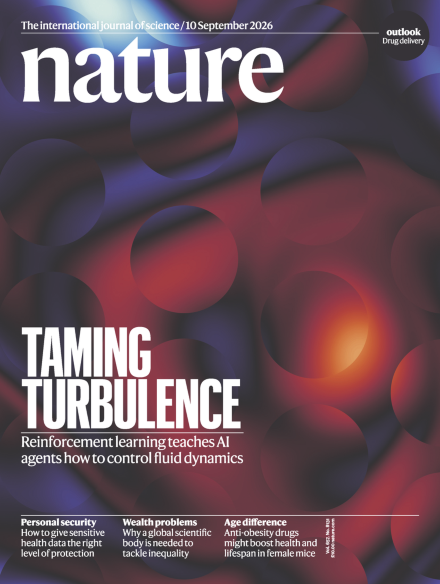
Having left my copy of the 10 September issue of Nature on a suburban train this afternoon (hopefully to the benefit of a fellow passenger!), I had to fall back on the online version. The cover story, Taming turbulence, is about HydroGym, a reinforcement-learning platform where AI agents learn to control turbulent flows. While this has practical consequences, it is also the harbinger of the resolution (?) of the Navier-Stoke Millennium Problem by OpenAI. Covered in the following issue.

Flotsam of interest for me:

  • reporting on a single data point exciting cosmologists (and beyond!), namely one unusual flash recorded in 2023 or 2024 by the LZ detector thru its 10 tonnes liquid xenon basin, which looks like what a weakly interacting massive particle (WIMP!) would produce. This would be a fist in experimentally supporting the dark matter theory. But without reproducibility, ’tis hard to jump to a conclusion. In correlation, a news article on the launch of the Nancy Grace Roman Space Telescope, with two World Views, one on Roman herself as “mother of Hubble”. Promising advances on far, far away celestial bodies thanks to the infrared abilities of said telescope. And again to cosmology.
  • a news feature on “the Einstein test”, checking whether language models trained only on pre-1905 data could rediscover relativity. This is a clever way to separate creativity from regurgitation, if the historical training corpus can indeed be kept clean. And faster than training monkeys to type…
  • an article combining climate and econometric modelling to assess how human-induced climate change has shifted, and will shift, the burden of childhood malaria in Africa. The attribution relies on counterfactual climate simulations, which makes me wonder about the propagation of uncertainty.
  • an article linking US mortgage records from around the Second World War to race and immigration status. It shows that New Deal programmes disproportionately excluded Black borrowers, a nice (if sad) record-linkage exercise.
  • a privacy feature on how UK Biobank was shut down after a data leak and is now imposing new safety measures. It raises the recurrent tension between protecting participants’ privacy and keeping data open to researchers, which connects once more with the membership-inference paper I discussed earlier.
  • an editorial praising the World Bank for publishing and verifying the raw data and code behind its reports. Other agencies should indeed follow suit!
  • a news item on the massive experience of mutating every DNA letter in a viral genome, whose effects the top AI models failed to predict (fail or pass the survival test!). A welcome reality check on AI in biology.

  • two militant comments on the economy, one by Joseph Stiglitz et al. calling for an IPCC-like International Panel on Inequality, and one on a call for measuring growth through all forms of capital, rather than GDP alone. And a great poster (reminding me of Indian movie posters) on the side!
  • an editorial on the comforting aspect of the Ig Nobel prizes, no matter how silly they sound.
  • a book review of The Winding Trail &tc. on the Principia Mathematica and Newton’s disdain for hypotheses (with his famous “hypotheses non fingo” that clashes with the modern scientific approach!), along with his habit of feuding over priority. What is amazing with Newton’s meteor trajectory is he only seriously engage into mathematics during his final undergraduate term at Cambridge, one year before the Great Plague and his revolutionary breakthroughs!

Le Monde puzzle [#855]

Posted in Books, Kids, Statistics with tags , , , , , , on March 7, 2014 by xi'an

A Le Monde mathematical puzzle that reminds me of an earlier one:

Given ten tokens with different unknown weights, and a scale that can rank three tokens at a time, starting with ranking three tokens, what is the minimum number of actions necessary to rank the ten of them if (a) one token at a time is added, (b) one or two tokens are added? If no restriction is imposed on the token introduction, is there a more efficient strategy?

It indeed relates to earlier posts on sorting and ternary sorting. Checking further on StackOverflow I found this reply to a question about ternary sorting:

Average number of comparisons:

in ternary search = ((1/3)*1+(2/3)*2)*ln(n)/ln(3)~1.517*ln(n)
in binary search  =                 1*ln(n)/ln(2)~1.443*ln(n)

Worst number of comparisons:

in ternary search = 2*ln(n)/ln(3)~1.820*ln(n)
in binary search  = 1*ln(n)/ln(2)~1.443*ln(n)

albeit with no reference. So this somewhat answers part (c) of the question. (If asymptotically since this does not work for n=10! Even for n=100, it is way too large.) Looking for a solution to part (a), I looked at the performances of a dyadic sorting algorithm, partitioning recursively the already sorted part of the sample into three parts to locate each time the proper position of the new token. This led me to the following code

[sourcecode language=”r” gutter=”false”]
rang=function(x,ranj,taken){

mag=max(ranj)-min(ranj)+1
i1=ranj[1]-1+trunc(mag/3)
i2=ranj[1]-1+trunc(2*mag/3)
locrk=rank(c(taken[c(i1,i2)],x))

if (locrk[3]==1) return(ifelse(i1>3,
1+rang(x,ranj=1:(i1-1),taken),
1+(i1>1)))
if (locrk[3]==2) return(ifelse(i2-i1>4,
1+rang(x,ranj=(i1+1):(i2-1),taken),ranj=1:(i1-1),taken),
1+(i1>1)))
if (locrk[3]==3) return(ifelse(mag-i2>2,
1+rang(x,ranj=(i2+1):mag,taken),ranj=1:(i1-1),taken),
1+(i1>1)))
}

ternone=function(toke){

toke[1:3]=sort(toke[1:3])
counter=1
for (ul in (4:length(toke))){

counter=counter+rang(toke[ul],1:(ul-1),toke)
toke[1:ul]=sort(toke[1:ul])
}

return(counter)
}

ternone(sample(1:10))
[/sourcecode]

which produces a minimum of eight (of course!) and a maximum of 20 uses of the scale (based on 10⁶ random permutations of (1,…,10)). Unsurprisingly, the solution proposed in Le Monde the week after does better as it obtains 16 as the worst case figure. Repeating the experiment with n=100 values, the maximum was 303 (with a mean of 270 and a minimum of 240 ternary comparisons).

Moving to an insertion two tokens at a time, I tested a scheme where two new tokens were tested against the current median, then the median of one half, and so on until they split on both sides of this median. Here is the corresponding R code

[sourcecode language=”r” gutter=”false”]
ring=function(x,y,ranj,taken){

mag=max(ranj)-min(ranj)+1
i1=ranj[1]-1+trunc(mag/2)
locrk=rank(c(taken[i1],x,y))

if (locrk[1]==3) return(ifelse(i1>2,
1+ring(x,y,ranj=1:(i1-1),taken),
1+(i1==2)))
if (locrk[1]==2) return(ifelse(mag>4,
1+rang(min(x,y),ranj=min(ranj):(i1-1),taken)
+rang(max(x,y),(i1+1):max(ranj),taken),1))
if (locrk[1]==1) return(ifelse(mag-i1>2,
1+ring(x,y,ranj=(i1+1):mag,taken),
1+(mag-i1>1)))
}

terntwo=function(toke){

toke[1:3]=sort(toke[1:3])
counter=1+rang(toke[4],1:3,toke)
toke[1:4]=sort(toke[1:4])

for (ul in -1+2*(3:(length(toke)/2))){

counter=counter+ring(toke[ul],toke[ul+1],1:(ul-1),toke)
toke[1:ul]=sort(toke[1:ul])
ul=ul+1
}

return(counter)
}
[/sourcecode]

leading to a value of 13.

This Feb. 19 issue of Le Monde Science&Médecine leaflet also contains a two page report on growing psychological work-related issues like stress, burn-out and depression, in research labs, mostly connected with the increase in administrative duties and grant writing, duties most of us have not been trained for. There is also a short column by Etienne Gys telling about the short lived claim by Moukhtarbaï Otelbaev to have solved the Navier-Stokes problem. Until Terry Tao wrote a paper stating why the proof could not work.