Archive for forestry

Nature tidbits

Posted in Books, Kids, Statistics, Travel, University life with tags , , , , , , , , , , , , , , , , , , , , , , , , , , , , , , , , , on June 10, 2024 by xi'an

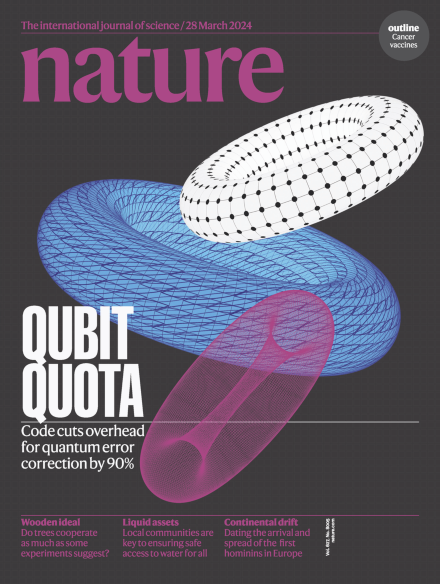
I was quite glad to have taken this 28 March issue of Nature for the train ride to Marseille earlier this month, as it proved full of great entries. Starting with a tribune from a PhD candidate from Ghana unable to speak at a tropical ecology conference in Lisbon for being denied a Schengen visa by the Dutch embassy in Accra, despite providing a serious amount of supporting material. This is a general issue related to international conferences that I plan to include in my presentation in a round table about the future of conference at the ISBA 2024 conference next month. Researchers and students from low-income countries are regularly victims of arbitrary rejections by consular and embassy officers, with little leeway from inviting universities and academic societies for counteracting such arbitrariness. An example came last year when, as part of our Data Science for Social Good program at Warwick, one computer student from Pakistan got denied a visa, while another one with an almost identical profile did receive her visa.

In News in focus, the development of a revolutionary (CAR-T) cancer therapy by  a Munbai company at 1/10 the cost of similar products in the US, with several impressive innovations (and a clinical trial over 33 people). The coverage of Michel Talagrand’s 2024 Abel prize, the deteriorating state of scientific research in Russia, a review on how the Big Bang got its name (hint: it was on BBC 3), and remembering India’s Chipko tree-hugging women of Western Himalayas of 50 years ago. The development of signs for scientific terms to add to the Indian and American sign languages.

There is also an almost sleuthing story on the debates in the ecology community about the theory of “Mother Tree”, introduced by Suzanne Simard, about trees communicating among themselves by underground fungal networks, and thus creating a “wood wide web“.  With mature trees favouring their own kin, a theory that critics in the field deem incompatible with evolutionary theory and more crucially missing supporting evidence. (Arguments from Simard that “the European male society hates the mother tree” concept do not help towards a rational denate. The Guardian now has a podcast about this debate.)

And another story on the (racial and gender) bias of AI image generators. With the conclusion that removing such biases goes through open sourcing. And regulation like the EU’s AI Act. that requires technical documentation on the training datasets. Plus a retrospective on the theory of bird-flight origins, with John Ostrom proposing in 1974 that the evolution to flight was ground-up rather than tree-down.

A cover-paper on IBM error correcting code for quantum computing that only requires each qubit to connect with six others (just like birds in murmuration only keep track of seven neighbours) for an error threshold less than 1%. (With the property that 12 logical qubits can be preserved for 10⁶ cyclces using 288 qubits in total.)

quantum forest

Posted in Books, R, Statistics, Travel, University life with tags , , , , , , , , on December 1, 2011 by xi'an

Thanks to a link on R-bloggers, I was introduced to Luis Apiolaza’s blog, Quantum Forest, which covers data analyses and R comments he encounters in his research as a quantitative forester/geneticist. And he works at the University of Canterbury, Christchurch, where I first taught from Bayesian Core in 2006. Which may be why he chose Bayesian Core as one of the three books he is currently reading to understand Bayesian statistics better. (The other two are Jim Albert’s Bayesian computation with R, and Bill Bolstad’s Introduction to Bayesian Statistics, which is not the one I reviewed recently.) Luis has just started the book but he mentions that “the book has managed to capture my interest”, which is real nice, and being annoyed by the self-contained label we put on the back cover. Which is a reaction I also got from some students when teaching the book for a week in Australia, as they thought they could take it without a probability background. Hopefully, we’ll manage to complete our revision before next summer!

10w2170, Banff

Posted in Books, Mountains, R, Statistics with tags , , , , , , , , on September 11, 2010 by xi'an

Yesterday night, we started the  Hierarchical Bayesian Methods in Ecology workshop by trading stories. Everyone involved in the programme discussed his/her favourite dataset and corresponding expectations from the course. I found the exchange most interesting, like the one we had two years ago in Gran Paradiso, because of the diversity of approaches to Statistics reflected by the exposition. However, a constant theme is the desire to compare and rank models (this term having different meanings for different students) and the understanding that hierarchical models are a superior way to handle heterogeneity and to gather strength from the whole dataset. A two-day workshop is certainly too short to meet students’ expectations and I hope I will manage to focus on the concepts rather than on the maths and computations…

As each time I come here, the efficiency of BIRS in handling the workshop and making everything smooth and running amazes me. Except for the library, I think it really compares with Oberwolfach in terms of environment and working facilities. (Oberwolfach offers the appeal of seclusion and the Black Forest, while BIRS is providing summits all around plus the range of facility of the Banff Centre and the occasional excitement of a bear crossing the campus or a cougar killing a deer on its outskirt…)

Off to Banff!!

Posted in Books, Mountains, R, Statistics, Travel, University life with tags , , , , , , , , , on September 10, 2010 by xi'an

Today I am travelling from Paris to Banff, via Amsterdam and Calgary, to take part in the Hierarchical Bayesian Methods in Ecology two day workshop organised at BIRS by Devin Goodsman (University of Alberta),  François Teste (University of Alberta), and myself. I am very excited both by the opportunity to meet young researchers in ecology and forestry, and by the prospect in spending a few days in the Rockies, hopefully with an opportunity to go hiking, scrambling and even climbing. (Plus the purely random crossing of Julien‘s trip in this area!) The slides will be mostly following those of the course I gave in Aosta, while using Introducing Monte Carlo Methods with R for R practicals: