Archive for Nature

Nature tidbits [6 Aug 2026]

Posted in Books, pictures, University life with tags , , , , , , , , , , , , , , , , , , , , , , , , , on October 7, 2026 by xi'an

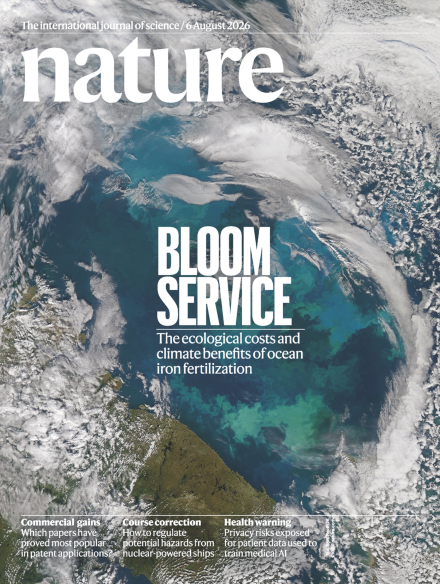
The 6 August issue of Nature arrived after my return from Japan, but it took me a while to catch up, the more because its cover story, Bloom service, about fertilising the oceans with iron as a carbon sink did not appeal much to the geoengineering sceptic in me. Nice pun though. Flotsam of interest for me:

  • an article on GPT-4 (and open-weight models) predicting the outcomes of 70 preregistered US survey experiments, 469 effects and 119,330 participants in total. The predicted treatment effects are highly correlated with the observed ones, about as well as pooled human forecasters do, including studies published after the training cutoff. But the predicted effect sizes are systematically too large, which is not a minor detail for a field still recovering from its replication crisis! Plus a survey of 460 social scientists about using LLMs for pilot testing, and a web app to “forecast” your own experiment’s effect before running it. (I wonder what a prior elicited this way would look like.)
  • a paper on membership inference attacks on medical AI models, showing that patients who differ from the majority are the easiest to identify as part of the training data, which I already discussed here. This fits the long-known issue with differential privacy and outliers.
  • a story on the four 2026 Fields Medals, announced at the ICM in Philadelphia, in fields far, far away:
    • Yu Deng (Chicago), for his work on PDEs, including a rigorous derivation of the Boltzmann equation from hard-sphere dynamics (with Zaher Hani and Xiao Ma), wave kinetic equations, and probabilistic approaches to nonlinear Schrödinger equations.
    • John Pardon (Stony Brook), for symplectic topology and enumerative geometry. He started as an undergraduate by answering a question of Gromov on knot distortion.
    • Jacob Tsimerman (Toronto), for extending techniques within arithmetic and complex algebraic geometry and solving conjectures in this field.
    • Hong Wang (NYU and IHES in Bures-sur-Yvette, almost a colleague!), for Fourier restriction, progress on Falconer’s conjecture and, with Joshua Zahl, the resolution of the Kakeya conjecture in three dimensions.
  • a feature on the scientific papers most cited in patents.
  • a news item on a Science paper by Blasi, Hamilton, Gray and Bowern, estimating that humanity may have spoken tens of thousands of languages between 3,000 and 1,000 years ago. The paper suggests a shift away from nomadic life triggered this diversity before it collapsed. I wonder at how deep the statistical linguistics inferring this rich past from the surviving sample goes. In a sense, the finding is not that surprising, given how isolated small prehistoric communities were, and how quickly a language drifts apart without contact. (I would also like to check how much the estimate depends on the assumed birth-and-death rates of languages, since the lost ones leave no trace to calibrate against…)
  • an editorial on the White House’s “new golden age for science” plan. It argues that such a golden age needs open borders and funding for the social sciences, public health and the humanities, not only AI and engineering. Alas, the now usual Trump.2.0 fare, with an AI funding roll-out in the news pages.
  • an emergency call by WHO director-general Tedros Adhanom Ghebreyesus on why the WHO has never been more needed, and news that the first volunteer received an Ebola vaccine three months into the current outbreak.
  • a forecast that the coming El Niño should be the largest (by a mind-blowing margin) on record, pushing 2027 temperatures to new highs. And already having severe impact on tropical weather.
  • a scary comment on the risks of nuclear-powered merchant ships, in the very issue dated on the anniversary of Hiroshima…

AI in a storm [cover]

Posted in Books, pictures, University life with tags , , , , , , , , , , , , , , , , , , on October 6, 2026 by xi'an

no privacy in nature

Posted in Books, Statistics, University life with tags , , , , , , , , , on September 26, 2026 by xi'an

A paper about privacy (or lack thereof) in Nature by Knolle et al. about medical AI models that exhibit a weakness to membership privacy attacks thru multiple queries of the public model. As discussed in a commentary article by Zhang & Ghassemi, a membership privacy attack proves successful when the confidence of the model prediction jumps to higher values for a real target of interest compared with an imaginary one. This obviously assume that users (and attackers) may repeat queries ad nauseam from the model, which differs from our Bayesian privacy setting where the output is provided once and only once (whatever the release mechanism is).

The attacker is modelled as resorting to a basic likelihood-ratio MIAs3,4, that is, a test based on the prediction confidence attached to the target model with the null being that the target is not a member:

“the parameters of the distributions under the two hypotheses are specified by parametric fitting of sample confidence values obtained from reference models. Reference models are models assumed to be trained by the attacker and are ideally, but not necessarily, of similar architecture as the target model and trained on data similar to the training dataset” – M Knolle & al.

but the paper does not provide further details about inferring about the model parameters. The following sentence is also unclear

“objectively larger threats are posed by privacy attacks with stronger assumptions on a potential attacker, such as access to model parameters17, access to parameter updates during model training18 (…) By contrast, the type of attack we consider here requires querying the target model only once (to obtain a prediction for the target record)” – M Knolle & al.

in that, indeed, returning the model parameter estimates is more informative about the data than a black-box prediction interface, but I miss the single query point as it seems to me that the attacker must multiply the queries to build a confidence distribution under both hypotheses.

“Purely technical measures, such as a mathematical approach called differential privacy9, often create performance trade-offs10 that are too limiting for medical AI tools. Instead, what is needed are regulatory and sociotechnical safeguards, such as privacy audits and risk assessments, that are specific to the domain in question.” – H Zhang & M Ghassemi

“our results indicate that privacy attacks against AI models may be much more effective at compromising the privacy of individual data contributors than previously thought. This suggests that current AI privacy risk reporting practices may underestimate individual-level risk and thus motivates the integration of mathematically verifiable risk mitigation strategies such as differential privacy (DP) into medical AI model development workflows.” – M Knolle & al.

“the finding that record-level differential privacy is insufficient for multi-record patients is particularly impactful and has clear policy and implementation implications” –Referee #2

“we also found that the full mitigation of MIAs for all data-contributing patients requires stricter levels of privacy protection (ϵ, δ ) smaller than previously believed. Moreover, our results also show that fully mitigating MIAs requires DP accounting at the patient- rather than the record-level.” – M Knolle & al.

In a funny (?) clash, the authors of the paper and those of the comment and a referee seem to disagree on the pertinence of differential privacy guarantees in this context. But the conclusion remains very vague on a rigorous way to assert privacy leaks and confidentiality protection for a given AI and its supporting dataset.


Nature tidbits [20 Aug 2026]

Posted in Books, Mountains, pictures, Statistics, Travel, University life with tags , , , , , , , , , , , , , , , , , , , , , , , , , , , , on September 16, 2026 by xi'an

In this 20 August edition, a wealth of data analysis papers, with many highly informative graphs. A call for China to better balance recognition for its junior scientists, another call for (US?) universities to treat bullying complaints in-depth rather than as a public relation exercise. The “compulsory” current status of the Trump 2.0 wreckage of US science with the Senate blocking the appointment of politicians for grant reviews. And with the absurd, ungrounded, health threatening split of the MMR vaccine.  Another “compulsory” entry on climate change with a scary graph on the ocean surface temperatures rising way way above the confidence band represented by the previous measurements over 50 years. An interview (why?) of a CEO of the startup QED Science that claims an ability to automatically rank preprints and select the top 1% (why?!). Coïnciding with me receiving an email with a review by Claude of our Bayesian Adversarial Privacy paper! A report on the (defunct Starmer) UK Government cutting on fundamental physics projects. An article featuring the predicted rise in the use of exoskeletons, which I read on my way back from the lodge on Mount Fudji that was renting an exoskeleton to help with the climb! With an optimistic view on the consequences on people’s health and muscles. A short book review on Slobodian’s and Tarnoff’s Muskism, concluding that Musk(ism) lacks a coherent philosophy. (A Musk-read according to the Economist!) A long comment on the sleepless summer of the heatwaves, which led me clearly more tired than usual at the end of the summer break. (With a lot of should. And a focus on methodology.) Another one on the Middle East prospects as a sustainable aviation fuel (SAF) hub, which sounds paradoxical in the current geopolitic situation. It made me wonder how sustainable are these SAFs? True, they recycle oils, gases and biomass, rather than extracting “new” oils, but they still pollute the air. And, true, they can fill empty returning tankers, but they divert investment and research from more renewable and less polluting alternatives. Among the actual scientific articles, a long review on the safety and security of LLMs in healthcare (but useless pictures). One on the massive floods that occurred in Europe in 1342-1343, possibly caused by volcanic eruptions plus Arctic sea ice retreat, nothing that could occur today of course! With massive socio-economic consequences. (And a great graph, except I do not see the point for the 2D projections. Or for modern state borders.) An analysis of intergenerational mobility in Europe with the unsurprising conclusion that it impacts innovation. (Go, Erasmus!) With a multivariate regression I did not investigate (using NUTS but not Andrew’s NUTS!). And graphs of intergenerational mobility per European country, with too many colours to be readable (and the regression line to make sense?). Another data analysis of the Pakistan Genome Resource, with distinctive traits of the many ethnicities of Pakistan. And the discovery of many clinically relevant genes (with a massive avalanche of p-values!).

Nature tidbits

Posted in Books, Statistics, University life with tags , , , , , , , , , , , , , , , , , on August 29, 2026 by xi'an

On the 25 June edition, an editorial calling Europe to lead on free and open science, while boosting industrial consequences. (By the way, Japan just joined Horizon Europe! While the UK will rejoin Erasmus in 2027, under the headline “Brexit tore apart European science — now the research rifts are healing“, mentioning the financial and visa unsolved issues.) A news article continuing the investigation of how AI impacts or will impact mathematical research, with a FirstProof test evaluating AIs solving new, research-level, maths problems. (But missing Claude Mythos and Google’s Aletheia.) A “comment” from a Chinese academic that science needs humanities, at a time when universities in the UK are closing some humanities departments. And a discussion of the exceptional discovery of a whale necropolis, 7km deep, with fossil remains dating back to 5M years mixed with recent ones. Plus another exciting 10 page paper about genetic sleuthing on population changes at the collapse of the Roman empire, in the Danube-Isar and Rhein-Main areas of present-day Germany. (The attached picture representing posterior estimates of life expectancies of some individuals, obtained by MCMC.) In the Carreers section, a story from a  geography researcher whose job offer was rescinded at the last moment, a scary thing that is alas not so rare.