Archive for Siberia

Nature tidbits [18 June]

Posted in Books, Kids, pictures, Travel with tags , , , , , , , , , , , , , , , , , , , , , , , , , , , , on July 13, 2026 by xi'an


A personal tribune (by a Vatican advisor) on why scientists should learn from the Pope’s AI message, not the first time Nature caters to religious views! Not that his (Leon’s) concerns about unregulated AI and the abdication of States in that matter are misplaced. But it seems unlikely (as the author concedes in his conclusion) that the Catholic Church or his leader will manage to make a dent on the spiraling impact of AIs. As suggested in the next tribune, a coordinated approach at a massive increase of taxes on tech companies (unsurprisingly resisted by the Orange Menace) is more likely to happen. And yet another tribune on AI and math(ematician)s, related to the recent Leiden Declaration on Artificial Intelligence and Mathematics, following several entries in the previous issue.
An introductory (general public) article as to why cancer occurrences in young people is rising so quickly in the US, with no single explanation. Environmental factors are certainly to blame, like the consumption of ultra–processed foods, but the article does not say much, adding to the uncertainty.

A rather unhelpful representation of human migration in 2023, appart from showing a majority of migrations are local (to the continental scale). Connected to an article of 10 June I missed. Partly based on a deep learning model to achieve a country-level granularity.

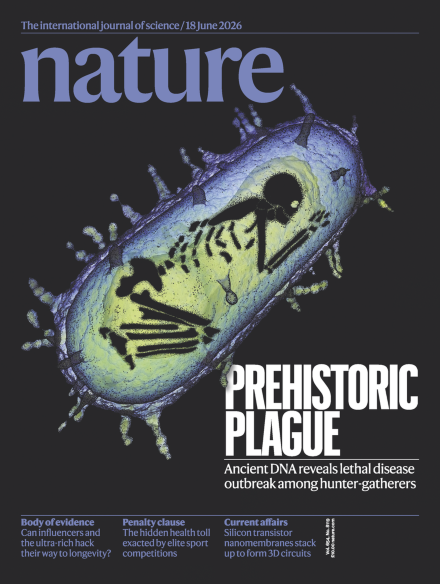
A research article (and the cover) on a plague outbreak near Lake Baikal—over which I could have flown when reading this issue, except that flights to Japan now contour the territories of the invader of Ukraine—that occurred about 5,500 years ago and impacted a community of hunter-gatherers, In a sparsely populated area, marmots being the likely primary vectors, and a close phylogenetic proximity to current strains.

murales de Sevilla [jatp]

Posted in pictures, Running, Travel with tags , , , , , , , , on November 28, 2025 by xi'an


Nature snapshots

Posted in Books with tags , , , , , , , , , , , , , , , , , , , , , , , on September 5, 2024 by xi'an

Some quick breakfast reads from the 11 July issue of Nature (the one with the frog cover!),

  • A tribune on the Canadian example of advocating for graduate and postdoc pay raises, with a success last April. It would prove difficult to achieve in a French academic landscape when postdocs here earn about as much as starting lecturers, whose salary is notoriously low.
  • A news article on the UK elections Labour landslide impact on national scientific landscape, with the former Conservatives’ government Chief Adviser and former Head of Research at GlaxoSmithKline and governmental speaker during the COVID crisis appointed as science minister (how many countries enjoy a science ministry?!) But Labour has shown no inclination to back up (from the former stance) on EU collaborations (no Erasmus!), restrictions on students visa that induced a 40% drop in overseas enrolments, or funding of UK universities (whose finances are in a terrible state). Followed by a call from five UK researchers to “give UK science the overhaul it urgently needs¨.
  • A paper about identifying brain cells attached to a word’s meaning (with an example opposing son and Sun that reminded me of the confusion I had with the Taïwanese movie A Sun!)
  • An another paper on an analysis of January 2020 data collected in the Huanan seafood market in Wuhan, with three virus identified. But inconclusive about the origin of the virus.
  • A work column on the challenges of conservation ecology, with trade-offs between intervention and inaction for endangered species (with the nugget of information that Ecuador gives nature constitutional rights).
  • And a back page on the TIGRR lab [great acronym!] in Melbourne attempt at resurrecting the extinct thyalacine (or Tasmanian tiger) from historical specimens, not mentioning the involvement of a biotech company, Colossal Biosciences, also involved in recreating  mammoths. Which sounds counterproductive beyond the bioengineering feat, esp. with regard to the mammoths, which would be woolly (!) unsuited to the current World (except in some remote corner of Siberia?!) and its climate. When considering how challenging protecting the few remaining African elephants is, imaging free roaming mammoths that would not come to clash with human activities beggars belief.

Байкало-Амурская магистраль/БАМ

Posted in Statistics with tags , , , , , , , , , on April 15, 2018 by xi'an

While in Chamonix last month I dropped by the Guérin editions bookstore, always full of tantalising books on climbing and mountaineering, travelling and travellers. I managed to escape with only two small books, one on a young climber stuck for 100 hours at the top of Aiguilles Vertes [not far from my last ice-climb!] and the other one a railway trip along the Baïkal-Amour Mainline (BAM), which goes from the Baïkal Lake to Sovietskaïa Gavan, north of the Trans-Siberian line. The book is not the ultimate travel book as most of the pages are about historical features surrounding this line, first and foremost the constant reminder that Gulag prisoners were relentlessly exploited to build this line, which follows a macabre route along Siberian camps. The trip finishes not at the end of the BAM line or in Vladivostok, but on Sakhaline Island, which was a penitential colony from the mid-1800’s, as covered by Anton Tchekov in a statistical study and a short story, The Murder… (Comments about characters crossed throughout the trip are rarely to the benefit of these characters.) While I do not make this travel book or the places it crosses sound particularly exciting, it still carries with it the inducing whiff of faraway places, which makes me wish I could see Lake Baïkal or Vladivostok one day in the future, if not travel the entire line. And it also brought back memories of Corto Maltese in Siberia, which remains one of my favourites…

the nihilist girl [book review]

Posted in Books, Kids with tags , , , , , , , , , , , , on October 7, 2017 by xi'an

When stopping by an enticing bookstore on Rue Saint-Jacques, in front of La Sorbonne, last July, I came across a book by the mathematician Sofia Kovaleskaya called the nihilist girl. Having never heard of non-mathematical books written by this Russian mathematician whose poster stood in my high school classroom, I bought it (along with other summer reads). And then discovered that besides being a woman of many “firsts”, from getting a PhD at Heidelberg (under Weirstraß) to getting a professor position in Stockholm, to being nominated to a Chair in the Russian Academy of Sciences, she also took an active part in the Commune de Paris, along with many emigrated Russian revolutionaries (or nihilists). Which explains for this book about a nihilist girl leaving everything to follow a revolutionary deported to Siberia. While not autobiographical (Sweden is not Siberia!), the novel contains many aspects inspired from the (amazing if desperately short) life of Sofia Kovaleskaya herself. A most interesting coincidence is that Sofia’s sister, Anna, was engaged for a while to Fyodor Dostoyevsky, whose novel The Demons takes the opposite view on nihilists. (As a feminist and anarchist, Anna took a significant part in the Commune de Paris, to the point of having to flee to Switzerland to escape deportation to New Caledonia, while her husband was sentenced to death.) The book itself is not particularly enjoyable, as being quite naïve in its plot and construction. It is nonetheless a great testimony of the situation of Russia in the 19th Century and of the move of the upper-class liberals towards revolutionary ideals, while the exploited peasant class they wanted to free showed no inclination to join them. I think Dostoyevsky expresses much more clearly this most ambiguous posturing of the cultivated classes at the time, yearning for more freedom and fairness for all, but fearing the Tsarist police, unable to connect with the peasantry, and above all getting a living from revenues produced by their farmlands.