 Nothing out of the ordinary there, but after years of procrastination at failing to update my publication webpage, following a wreckage by the default web composer on Ubuntu (and yours truly obviously!), I took advantage of the extra energy gained by my altitude night at the 5th station to ask Claude to update this page, with it replying it preferred to start from scratch (and from my LaTeX vita files). The only drawback is that many of the links introduced in the earlier version were not retrieved by the AI, despite my repeated request. On the plus side, trawling for missing entries and unpublished arXiv oldies but goldies, as well as adding mountain pictures (from the ‘Og!) proved much easier than the manual-by-keyboard approach. And I got an extra bonus in updating my LaTeX publication file and by creating the corresponding bibTeX file, all now available on my github page.
Archive for github
ECMLE on CRAN
Posted in R, Statistics, University life with tags Bayesian model comparison, CRAN, ECMLE package, elliptical covering, github, HPD region, marginal likelihood, normalising constant, R, R package, statistical evidence on March 27, 2026 by xi'an x
x
computo on the go
Posted in Books, R, Statistics, University life with tags binary, Biometrika, Computo, editor in chief, free software, French researchers, github, journal, Julia, Latin, logo, machine learning, open access, open source, Python, Quarto, R, repositories, reproducible research, Rmarkdown, SFDS, Société française de Statistique, Statistics on April 8, 2025 by xi'an
the new DIYABC-RF
Posted in Books, pictures, R, Statistics, Wines with tags ABC, admixture, Approximate Bayesian computation, Bayesian model choice, demographic history, DIYABC, effective population size, genetic polymorphisms, github, likelihood-free inference, most recent common ancestor, R, R shiny, random forests, software, supervised machine learning, Université de Montpellier on April 15, 2021 by xi'an
My friends and co-authors from Montpellier have released last month the third version of the DIYABC software, DIYABC-RF, which includes and promotes the use of random forests for parameter inference and model selection, in connection with Louis Raynal’s thesis. Intended as the earlier versions of DIYABC for population genetic applications. Bienvenue!!!
The software DIYABC Random Forest (hereafter DIYABC-RF) v1.0 is composed of three parts: the dataset simulator, the Random Forest inference engine and the graphical user interface. The whole is packaged as a standalone and user-friendly graphical application named DIYABC-RF GUI and available at https://diyabc.github.io. The different developer and user manuals for each component of the software are available on the same website. DIYABC-RF is a multithreaded software on three operating systems: GNU/Linux, Microsoft Windows and MacOS. One can use the program can be used through a modern and user-friendly graphical interface designed as an R shiny application (Chang et al. 2019). For a fluid and simplified user experience, this interface is available through a standalone application, which does not require installing R or any dependencies and hence can be used independently. The application is also implemented in an R package providing a standard shiny web application (with the same graphical interface) that can be run locally as any shiny application, or hosted as a web service to provide a DIYABC-RF server for multiple users.

the Ramanujan machine
Posted in Books, Kids, pictures, University life with tags AI, artificial intelligence, Cambridge University, chihuahua, G.H. Hardy, github, India, Madras, Nature, Python, Srinivasa Ramanujan, the Ramanujan machine on February 18, 2021 by xi'an Nature of 4 Feb. 2021 offers a rather long (Nature-like) paper on creating Ramanujan-like expressions using an automated process. Associated with a cover in the first pages. The purpose of the AI is to generate conjectures of Ramanujan-like formulas linking famous constants like π or e and algebraic formulas like the novel polynomial continued fraction of 8/π²:
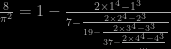
which currently remains unproven. The authors of the “machine” provide Python code that one can run to try uncover new conjectures, possibly named after the discoverer! The article is spending a large proportion of its contents to justify the appeal of generating such conjectures, with several unsuspected formulas later proven for real, but I remain unconvinced of the deeper appeal of the machine (as well as unhappy about the association of Ramanujan and machine, since S. Ramanujan had a mystical and unexplained relation to numbers, defeating Hardy’s logic, “a mathematician of the highest quality, a man of altogether exceptional originality and power”). The difficulty is in separating worthwhile from anecdotal (true) conjectures, not to mention wrng conjectures. This is certainly of much deeper interest than separating chihuahua faces from blueberry muffins, but does it really “help to create mathematical knowledge”?


