Archive for LLM

publication crAIsis

Posted in Books, Kids, Statistics, University life with tags , , , , , , , , on November 18, 2026 by xi'an

In the September issue of the IMS Bulletin, Po-Ling Loh discusses the urgency to act in the face of the AI disruption to mathematical research and in particular to the publication modus vivendi in academia—that indeed seems to have hit the wall—. This of course intersects with similar concerns and fears in the community, from departmental to international society meetings on a course of action towards a seismic change for the profession.

“Rather than accepting a new reality where researchers are disincentivized to share their work publicly through an arXiv posting or research talk prior to publication, we could purposely excise speed and competition from the research pipeline, thereby stemming the cutthroat competition that threatens to engulf our field. In such an alternative reality, I believe mathematical joy, depth, and beauty could continue to flourish (…) Looking ahead, even if the mathematical abilities of an LLM may soon surpass those of an individual mathematician, we can hold onto hope that the collective skills of a community of mathematicians, collaborating together and assisted by LLMs, might achieve mathematical advances beyond what one human-directed AI system could discover (…) [My proposal is to] only consider papers that are a collaboration of enough experts in a sub-area [and] only submit a paper after agreeing that it contained a truly new, important result”

Po-Ling Loh’s idea is to incentivize collective work and forget about the competitiveness in the profession that is now exacerbated by LLMs, by only considering collaborative works. There is something nice about it, as I always enjoyed the fun and excitement of thinking and working together during small workshops with brainstorming periods, if it rarely concludes with a major discovery. However, I completely fail to see how this would stem the flood of individual submissions to journals and preprint servers—as exemplified by the Polsongate—. Or how a collective (not a von Mises Kollektiv!) would better resists the call of the AI. And how junior, isolated, off-the-grid, researchers would not suffer from this new publication pattern…

Obviously, I am as clueless as most on how to reAIct. For instance, hard bars on publication volumes per individual seem impossible to implement (and will likely create further publications outlets, most likely predatory ones). Using LLMs to check LLM papers is just feeding the beast plus contributing to the glut of papers no one will ever read or check. But it is clear that our journals are now under massive strain that cannot persist for long…

Bayesian persuasive privacy at ICML²⁶

Posted in Books, Mountains, pictures, Statistics, Travel, University life with tags , , , , , , , , , , , , , , , , on May 14, 2026 by xi'an

SEINE AI

Posted in pictures, Statistics, University life with tags , , , , , , , , , , , , , , , , , , , , , , on March 23, 2026 by xi'an

Ten days ago I took part in the SEINE AI 2026 workshop in Jouy-en-Josas, near Paris (homestead of HEC), organised by the Huawei Paris Research Center.. In which I was invited to speak, even though I felt sort of an outlier given the deeply machine-learning, entreprenarial orientation of the meeting, with its theme being Building the Agentic Future of ICT, given that I chose to present our most recent Bayesian adversarial privacy paper. Hence, I stood within a game-theoretic, Bayesian, formal landscape, presumably loosing most of the audience and keeping them away from their lunch!

Other speakers included Simon Lucas from Queen Mary London on Simulation-based AI, which I had trouble distinguishing from building a statistical model by goodness of fit (and using bandits used for update), while focussing on competing on some computer game challenges. And Volker Tresp from LMU München on a tensor brain model that he opposes to a Bayesian brain (with a related paper entitled Bayes or Heisenberg: Who(se) rules? which we discussed in general terms over lunch, namely Bayesian learning vs. quantum updating. And Michal Valko from INRIA Paris (and other companies), who went full blast against the Bradley-Terry model!, with a title of Nash and Nemirovski walk into a bar! With a half-time technique approximating Nash equilibria that reminded me of leapfrog. Much entertaining talk that further provided a game-theoretic transition to mine’s.

As an aside, I played yesterday with ChatGPT composing my talk slides out of our arXiv document and it proved a disaster, with hallucinations of results and concepts not in the paper and a complete mess of handling graphs, first creating generic, fake, unrelated pictures, then inserting actual graphs haphazardly throughout the slides. The sorry result I obviously did not use as the workshop did not seem the ideal place for this sort of prank! The actual version only recycles a few of its summarising slides. (With ye Norse farce proper colour choice!)


Nature tidbits [15 Jan 2026]

Posted in Books, pictures, Travel, University life with tags , , , , , , , , , , , , , , , on March 13, 2026 by xi'an

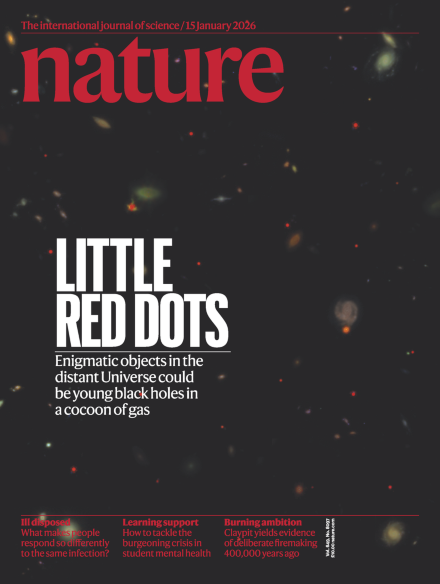
The cover of the 15 Jan issue of Nature is a blurry reconstitution of snapshots from the James Webb Space Telescope, which contributed to uncover these new astronomical objects, deemed to be young supermassive black holes. A notion I only came across recently, during a pre-defence lunch near the Paris Observatory.

Apart from that astronomical advance, Nature puts its focus on the 25th anniversary of Wikipedia. With a tribune bemoaning the insufficient investment of academics in the platform (with mentions of hypocrisy and betrayal). Which sounds rather unfair, since it requires an additional levy on research time, even though I did contribute to a few entries. And recognise the worth of most scientifics pages, as well as the parasitism by LLMs. And an interview of of Jimmy Wales’ about his Wikipedia memoir, Seven Rules of Trust. Kudos to his vision! He sounds rather optimistic about the chances of Wikipedia surviving the tsunAImi, but only if the users keep resorting (and indeed contributing) to the platform rather than accepting the LLM production at fa(r)ce value!

Other entries on

  • LLMs suffering (!) from “anxiety, trauma, shame and post-traumatic stress disorder”, although the arXiv reporting the experiment is criticized by others for anthropomorphising the machines. The danger is more in them inducing real trauma in vulnerable (human) users!
  • LLMs exhibiting aggressive behaviour (if trained accordingly)
  • the oldest evidence on human controlled fires using pyrite (in SE England), 400,000 years ago
  • the rise of academics being harassed (and not only in the US) and six recommendations for protecting our digital security (mentioning organisations such as Scholars at Risk Europe, Expert Voices Together, and Faculty First Responders)
  • a “Where I work” picture of a food scientist at the National Autonomous University of Mexico flipping a tortilla, with fermented ingredients to improve health and combat malnutrition in poor communities

ChatGPT’ed Monte Carlo exam

Posted in Books, Kids, R, Statistics, University life with tags , , , , , , , , , , on January 22, 2026 by xi'an

This semester I was teaching a graduate course on Monte Carlo methods at Paris Dauphine and I decided to experiment how helpful ChatGPT would prove in writing the final exam. Given my earlier poor impressions, I did not have great expectations and ended up definitely impressed! In total it took me about as long as if I had written the exam by myself, since I went through many iterations, but the outcome was well-suited for my students (or at least for what I expected from my students). The starting point was providing ChatGPT with the articles of Giles on multi-level Monte Carlo and of Jacob et al on unbiased MCMC, and the instruction to turn them into a two-hour exam. Iterations were necessary to break the questions into enough items and to reach the level of mathematical formalism I wanted. Plus add extra questions with R coding. And given the booklet format of the exam, I had to work on the LaTeX formatting (if not on the solution sheet, which spotted a missing assumption in one of my questions). Still a positive experiment I am likely to repeat for the (few) remaining exams I will have to produce!