Archive for US research

lost science

Posted in Books, pictures, Statistics, Travel, University life with tags , , , , , , , , , , , , , , , , , , , , , , , , on February 22, 2026 by xi'an

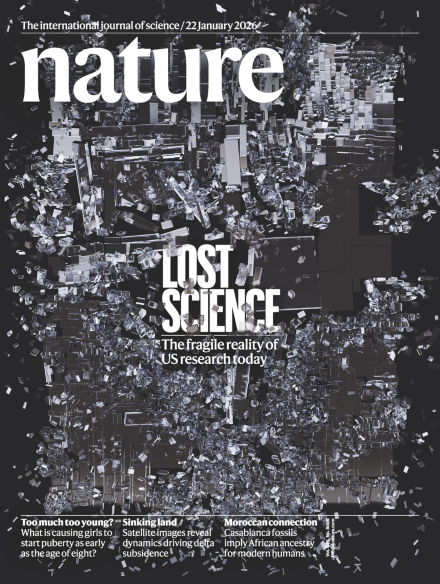
The on-going Orange chainsaw massacre on US science is taking a significant chunk of 22 Jan issue of Nature. With prognosis for 2026, and more of the same, special maps on quantifying the impact of 2025 Federal cuts, scientists reflecting on disrupted careers and best ways of fighting back. Plus a book review of The Great Global Transformation by Branko Milanovic (to appear), which explores how globalization and the rise of new elites has induced a parallel growth in nationalism and greed. Which strongly correlates with the Orange disaster. (As a funny aside, both the authors of Why China Will not Rule the World and of When China Rules the World are quoted for their positive reviews!)

On the 2026 US budget prospects, the battle between the Trump administration and the US Congress will a.s. (hopefully!) continue, incl. the cuts to indirect costs, the politisation of grant panels, the drop in foreign student applications and conference attendees. The maps are making much more sense through Nature interactive page than on paper. Since the Mondrian-like maps that represent grant cuts and cancellations according to state, funding source (NIH, NSF—from which direction our Ottawa U friend Panchanathan resigned last April), court reinstatement, and topics. Still, the dynamic change of colours and the lack of scale make these poor or even terrible graphs. Over-optimistic scientists consider reimagining higher education towards public needs (to be distinguished from populist and conspirationist calls on which ground?!), turning to philanthropic support (with highly uncertain long-term prospects, seeing how quickly high-tech moguls turned their jackets under Orange pressure!), and the remaining entries are just wistful thinking… The UCS (Union of Concerned Scientists) is reported documenting 536 attacks of the Trump administration on science and scientific integrity, not counting harassment and intimidation, but this pales against the several thousand federal scientists who have fired and the remaining ones who (still) work in federal agencies under several swords of Damocles, from abruptly cut funding, to newly prohibited domains of research, like health disparities and sexual diseases, to firing, and to visa cancellation… Not a comforting read, this 22 Jan issue of Nature, when realising how massive, deep, long-term-impacting, the havoc the Trump administration has wreaked (or wrought!) on science as much as economy and international relations.

dough Nat’ [1 Oct 2025]

Posted in Books, pictures, Statistics, University life with tags , , , , , , , , , , , on November 1, 2025 by xi'an

The 01 October²⁵ issue of Nature contains a paper on a “doughnut-shaped representation of social and planetary boundaries towards meeting the needs of all people within the means of the living planet”. With the side description including a warning

“Red wedges show a shortfall below the social foundation or an overshoot beyond the ecological ceiling. The grey wedge indicates missing data. The centre of the plot represents total human deprivation (for the social indicators) and the pre-industrial Holocene baseline (for the ecological indicators). Values are proportional to the length of each wedge, which leads to a quadratic scaling of wedge area that may lead some readers to perceive small changes as more significant than they are.”

which compounds the shortcomings of the original if unmentioned Nightingale rose, as pointed out by Edward Tufte and (CHANCE colleague) Howard Wainer. (And add insult to injury by switching from a rose to the worst ever junk food!) Quiz time: how many dimensions are crammed into the proposed representation? And do they exceed the number of unhealthy ingredients in a doughnut?!

Nature tidbits [21 Aug 2025]

Posted in Books, pictures, University life with tags , , , , , , , , , , , , , , , , on October 16, 2025 by xi'an

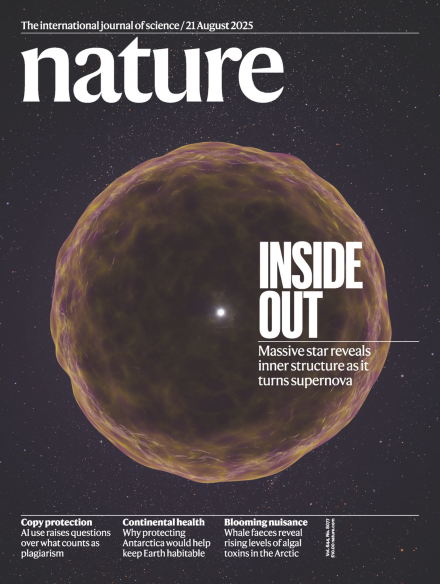
The cover of this Nature issue is a fake!, being an artist’s rendering of a supernova (2021yfj) before it exploded, with the core exhibited as rich in silicon and sulfur. (The heaviest element in stars is iron, resulting from the fusion of the above. When the iron mass exceeds a limit, the star collapse into a neutron star or a black hole.)

On the Trump 2.0 administration’s attack-on-science front, an editorial exposes the irresponsibility of cancelling grants for mRNA studies (which Trump 1.0 supported during the COVID crisis). And a longer article points out the radical switch in managing federal grants, committees moving from scientists to political appointees, searching for “anti-American values”… And another one on the backlash following the report from said administration about climate change and global warming. (As blogged recently.)

At a more conceptual (and international) level, an article questions the usual stand on declining birth rates as being problematic. While acknowledging that public incentives have a highly variable mileage, the article remains vague on how supporting an ageing population while keeping an homogeneous welfare support will prove feasible. A second socio-economic article muses about the lack of a downward curve in the cost of electric cars, despite the drop in battery costs, pointing out the inefficiency of state support that creates profit bubbles for the manufacturers. Stricter policies on combustion vehicles similarly seem inefficient, given the violent reactions of car owners (as in the Gilets Jaunes revolt). The EU has alas recently backed down on its goal of prohibiting new combustion engines by 2035.

In shark contrast, a review paper document the rising probability of a climate catastrophe induced by the melting Antarctica, which could prove of a higher magnitude than the melting Arctic. (Even though the introduction article is rather confusing, mixing this issue with the pollution brought by Antarctic tourism and mentioning indigenous populations that do not exist on the 7th Continent).

And on the (weekly) AI front, the announcement of the downloadable gpt-oss from OpenAI, which I plan to check. And the debate on whether or not AI generated papers can plagiarise, again a poorly focussed article mostly missing the issues of the scientific worth of such papers (and the basic fact that they 100% plagiarise the literature dataset they learned from!).