Archive for ultraprocessed food

Nature tidbits [18 June]

Posted in Books, Kids, pictures, Travel with tags , , , , , , , , , , , , , , , , , , , , , , , , , , , , on July 13, 2026 by xi'an


A personal tribune (by a Vatican advisor) on why scientists should learn from the Pope’s AI message, not the first time Nature caters to religious views! Not that his (Leon’s) concerns about unregulated AI and the abdication of States in that matter are misplaced. But it seems unlikely (as the author concedes in his conclusion) that the Catholic Church or his leader will manage to make a dent on the spiraling impact of AIs. As suggested in the next tribune, a coordinated approach at a massive increase of taxes on tech companies (unsurprisingly resisted by the Orange Menace) is more likely to happen. And yet another tribune on AI and math(ematician)s, related to the recent Leiden Declaration on Artificial Intelligence and Mathematics, following several entries in the previous issue.
An introductory (general public) article as to why cancer occurrences in young people is rising so quickly in the US, with no single explanation. Environmental factors are certainly to blame, like the consumption of ultra–processed foods, but the article does not say much, adding to the uncertainty.

A rather unhelpful representation of human migration in 2023, appart from showing a majority of migrations are local (to the continental scale). Connected to an article of 10 June I missed. Partly based on a deep learning model to achieve a country-level granularity.

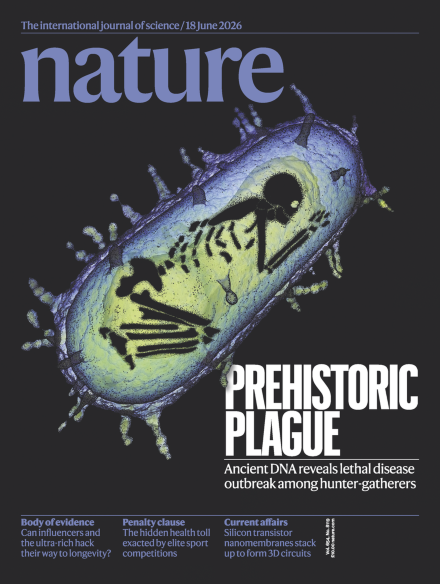
A research article (and the cover) on a plague outbreak near Lake Baikal—over which I could have flown when reading this issue, except that flights to Japan now contour the territories of the invader of Ukraine—that occurred about 5,500 years ago and impacted a community of hunter-gatherers, In a sparsely populated area, marmots being the likely primary vectors, and a close phylogenetic proximity to current strains.
Nature tidbits [11 Dec 2025]

Posted in Books, Kids, pictures, Travel with tags , , , , , , , , , , , , , , , on January 25, 2026 by xi'an

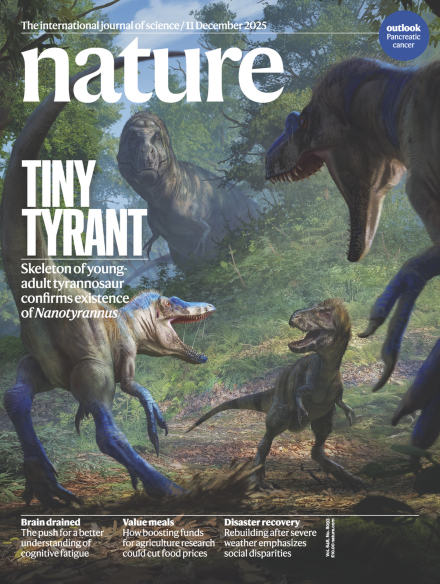
This issue of Nature features dinosaurs on its cover, as in old-time science magazines, yay! In association with a new (tiny) species of tyrannosaurus.

On the Trump 2.0 disaster scene, a reflection on the dangers of the Genesis Mission, which directed by the US Department of Energy to create AI scientists–and give AI companies access to federal datasets. Trump’s attempt to have his own (obviously Big & Beautiful) Manhattan Project?! Unsurprisingly, sounds very messy at this stage.

ICLR 2026 being exposed having 21% of the reviews are fully AI generated using tools from Pangram Labs, in New York. (And around 10% of the submissions being mostly written by AIs as well.) The inevitable evolution of the machine learning conference reviewing process?! Plus a review of the impact of Alphafold for its fifth anniversary. And a discussed paper by Oh & al. on meta-learning, conceiving reinforced learning algorithms that learn how to create learning algorithms. Without engaging with the paper per se I wonder at the degree of incrementality of the proposal. And hence find the catastrophic warning reproduced below rather over-the-top.

“In conclusion, it seems probable that AI will have an increasing role in the design of AI algorithms, a trend for which Oh et al.’s work is a harbinger. It is both exciting and worrying; the potential for intellectual discovery is vast, but the possible acceleration of a technology that already has an outsized societal impact is concerning in a world that is almost certainly not ready for the field’s dizziest possibilities to be realized ahead of schedule.” Joel Lehman

Also a book review of Belluz & Hall’s Food Intelligence, on the harms of processed food and the many myths that come with obesity and diets. Along a comment on diminishing investments on agricultural science being partly to blame for high food prices. And a concentration of the countries involved in R&D. But not helping (me) with the paradox that developed countries struggle to keep farming profitable enough for the farmers. As shown by the perpetual unrest of heavily subsidised farmers in the EU.

dough Nat’ [1 Oct 2025]

Posted in Books, pictures, Statistics, University life with tags , , , , , , , , , , , on November 1, 2025 by xi'an

The 01 October²⁵ issue of Nature contains a paper on a “doughnut-shaped representation of social and planetary boundaries towards meeting the needs of all people within the means of the living planet”. With the side description including a warning

“Red wedges show a shortfall below the social foundation or an overshoot beyond the ecological ceiling. The grey wedge indicates missing data. The centre of the plot represents total human deprivation (for the social indicators) and the pre-industrial Holocene baseline (for the ecological indicators). Values are proportional to the length of each wedge, which leads to a quadratic scaling of wedge area that may lead some readers to perceive small changes as more significant than they are.”

which compounds the shortcomings of the original if unmentioned Nightingale rose, as pointed out by Edward Tufte and (CHANCE colleague) Howard Wainer. (And add insult to injury by switching from a rose to the worst ever junk food!) Quiz time: how many dimensions are crammed into the proposed representation? And do they exceed the number of unhealthy ingredients in a doughnut?!