Archive for Ig Nobel Prize

Nature tidbits [10 Sept 2026]

Posted in Books, pictures, Travel, University life with tags , , , , , , , , , , , , , , , , , , , , , , , , , , , , , , , , , , , , , , , , , , , , , , , , , , , , on October 21, 2026 by xi'an

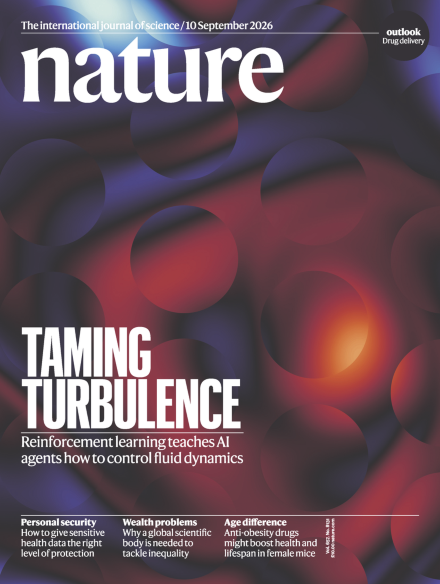
Having left my copy of the 10 September issue of Nature on a suburban train this afternoon (hopefully to the benefit of a fellow passenger!), I had to fall back on the online version. The cover story, Taming turbulence, is about HydroGym, a reinforcement-learning platform where AI agents learn to control turbulent flows. While this has practical consequences, it is also the harbinger of the resolution (?) of the Navier-Stoke Millennium Problem by OpenAI. Covered in the following issue.

Flotsam of interest for me:

  • reporting on a single data point exciting cosmologists (and beyond!), namely one unusual flash recorded in 2023 or 2024 by the LZ detector thru its 10 tonnes liquid xenon basin, which looks like what a weakly interacting massive particle (WIMP!) would produce. This would be a fist in experimentally supporting the dark matter theory. But without reproducibility, ’tis hard to jump to a conclusion. In correlation, a news article on the launch of the Nancy Grace Roman Space Telescope, with two World Views, one on Roman herself as “mother of Hubble”. Promising advances on far, far away celestial bodies thanks to the infrared abilities of said telescope. And again to cosmology.
  • a news feature on “the Einstein test”, checking whether language models trained only on pre-1905 data could rediscover relativity. This is a clever way to separate creativity from regurgitation, if the historical training corpus can indeed be kept clean. And faster than training monkeys to type…
  • an article combining climate and econometric modelling to assess how human-induced climate change has shifted, and will shift, the burden of childhood malaria in Africa. The attribution relies on counterfactual climate simulations, which makes me wonder about the propagation of uncertainty.
  • an article linking US mortgage records from around the Second World War to race and immigration status. It shows that New Deal programmes disproportionately excluded Black borrowers, a nice (if sad) record-linkage exercise.
  • a privacy feature on how UK Biobank was shut down after a data leak and is now imposing new safety measures. It raises the recurrent tension between protecting participants’ privacy and keeping data open to researchers, which connects once more with the membership-inference paper I discussed earlier.
  • an editorial praising the World Bank for publishing and verifying the raw data and code behind its reports. Other agencies should indeed follow suit!
  • a news item on the massive experience of mutating every DNA letter in a viral genome, whose effects the top AI models failed to predict (fail or pass the survival test!). A welcome reality check on AI in biology.

  • two militant comments on the economy, one by Joseph Stiglitz et al. calling for an IPCC-like International Panel on Inequality, and one on a call for measuring growth through all forms of capital, rather than GDP alone. And a great poster (reminding me of Indian movie posters) on the side!
  • an editorial on the comforting aspect of the Ig Nobel prizes, no matter how silly they sound.
  • a book review of The Winding Trail &tc. on the Principia Mathematica and Newton’s disdain for hypotheses (with his famous “hypotheses non fingo” that clashes with the modern scientific approach!), along with his habit of feuding over priority. What is amazing with Newton’s meteor trajectory is he only seriously engage into mathematics during his final undergraduate term at Cambridge, one year before the Great Plague and his revolutionary breakthroughs!

A modern introduction to probability and statistics [book review]

Posted in Books, R, Statistics, Travel, University life with tags , , , , , , , , , , , , , , , , , , , , , on July 12, 2025 by xi'an

In the plane to Bengaluru, I read through the book A modern introduction to probability and statistics, by Graham Upton—whose Measuring Animal Abundance I reviewed for CHANCE a while ago—, which is based on the earlier Understanding Statistics, written jointly with Ian Cook. (Not to be confused with A modern introduction to probability and statistics by Dekking et al.) The subtitle is understanding statistical principles in the computer age. Sorry, in the age of the computer. While the cover is most pleasant (and modern), as noticed by an AF flight attendant, the contents are very very standard and could have been written decades ago since the main concession to “the” computer age is the inclusion of a few R commands at the end of most chapters. There are even a few distribution tables here and there (in case “the” computer is not available). But there is no other connection with computational statistics or statistical computing.

The classicism of the contents and the intended audience mean there is little therein on which to either object or criticise. The mixture of elementary probability and basic statistics in a single textbook always feels awkward to me and I think I would have trouble teaching solely from this material. Apart from the glaring typo on the variance of the sum of two correlated random variables on page 87, missing the factor 2 in front of the covariance, while correct(ed) p97 (and the inevitable “the the” typo spotted once). My main criticisms are on the potential confusion between samples and populations in the early chapters, when some statistics are used as motivational examples, as for instance in a (hidden) Monte Carlo stabilisation to the limiting values (p57), way before the Law of Large Numbers is introduced,, the variable mileage in mathematical rigour (while being uncertain that first year students can handle integrals and derivatives), the textbook examples, and the amount of the book contents spent on descriptive statistics and even more on the “classical” tests, with no critical perspective on using point nulls or p-values. The book concludes with a four page (benevolent) chapter on Bayesian statistics that is superfluous imho, or even counterproductive since my experience with a rushed introduction to Bayesian principles almost always result in a rejection of said principles. Plus, the illustration with the coin tossing is not particularly helpful since Andrew maintains that one can load a die, but cannot bias a coin. (A similar reservation on the half-page 289 coverage on pseudo-random generation and Monte Carlo principles for computing p-values.)

Minor (mostly idiosyncratic) remarks follow: CLT prior to LLN,   n-1 in sample sd, little to no model criticism (ntbcf goodness of fit), missing an opportunity when mentioning the varying probability of a day being a birthday (p31) in contrast with BDA cover story, and another opportunity to cite the 2024 Ig Nobel Prize for coin tossing around the LLN, an unclear definition for random variables( p53) and a potentially confusing introduction of Poisson distributions through a informal reference to Poisson processes (and no reason why the years of accession of the kings of Sussex and England till Guillaume—making a return on p178 with the Domesday Book—in 1066 should follow such a process as suggested in Figure 3.5), a surprising definition of the constant e as the special case of exp(x) when x=1 and its series expansion (p70), omitting proofs on laws of sums of iid rv’s by introducing moment generating functions rather late, another obscure reference to a 16th German treatise on surveying as a precursor of the CLT (p131), a proof for the normalising constant of the Normal density that will most likely escape most first year students, a introduction of the t, F, and χ² distributions with no mention of their respective densities (pp141-147), never defining a joint Normal distribution density, insisting on unbiasedness without noting that maximum likelihood—with a strange motivation that it “makes the next sample of n observations most likely to resemble the data in the current sample (p228)—estimators are almost always biased, an abundance of footnotes that may prove of little interest for the youngest readers.

[Disclaimer about potential self-plagiarism as usual: this post or an edited version will eventually appear in my Books Review section in CHANCE.]

arX’ig!

Posted in Books, pictures, Statistics, University life with tags , , , , , , , on September 16, 2024 by xi'an

XL definition of statistics in 24″

Posted in Books, Kids, Statistics, University life with tags , , , on September 22, 2013 by xi'an

Z-test, t-test, chi-squared test,

I can help you to face any test;

Bayes, Frequentist, Fiducial

Let me make you feel influential

Regression, Correlation, Causation,

What else can generate more passion?

Skewness, Kurtosis, Heteroscedasticity

Boy, do I feel sexy?

Xiao-Li Meng, at the Ig Nobel ceremony

XL for 24/7 fame at (Ig) Nobel

Posted in Kids, Statistics, University life with tags , , , on September 12, 2013 by xi'an

Tonight, our friend Xiao-Li Meng will (no doubt brilliantly) deliver a 24/7 lecture at the Ig Nobel Prize ceremony. It will be webcast live, with a watching party in Paris…. (A wee too late for me, I am afraid.) Although Xiao-Li is quite able to lecture 24/7 on statistics, this special lecture will last 24 seconds plus 7 words. Bets are open for the 7 words!! (Note that, contrary to the other Nobel Prize, the Ig Nobel Prizes often include winners in mathematics and statistics.)