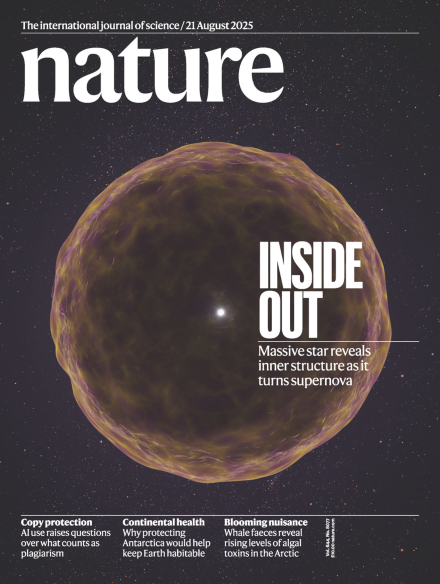
 The cover of this Nature issue is a fake!, being an artist’s rendering of a supernova (2021yfj) before it exploded, with the core exhibited as rich in silicon and sulfur. (The heaviest element in stars is iron, resulting from the fusion of the above. When the iron mass exceeds a limit, the star collapse into a neutron star or a black hole.)
On the Trump 2.0 administration’s attack-on-science front, an editorial exposes the irresponsibility of cancelling grants for mRNA studies (which Trump 1.0 supported during the COVID crisis). And a longer article points out the radical switch in managing federal grants, committees moving from scientists to political appointees, searching for “anti-American values”… And another one on the backlash following the report from said administration about climate change and global warming. (As blogged recently.)
At a more conceptual (and international) level, an article questions the usual stand on declining birth rates as being problematic. While acknowledging that public incentives have a highly variable mileage, the article remains vague on how supporting an ageing population while keeping an homogeneous welfare support will prove feasible. A second socio-economic article muses about the lack of a downward curve in the cost of electric cars, despite the drop in battery costs, pointing out the inefficiency of state support that creates profit bubbles for the manufacturers. Stricter policies on combustion vehicles similarly seem inefficient, given the violent reactions of car owners (as in the Gilets Jaunes revolt). The EU has alas recently backed down on its goal of prohibiting new combustion engines by 2035.
 In shark contrast, a review paper document the rising probability of a climate catastrophe induced by the melting Antarctica, which could prove of a higher magnitude than the melting Arctic. (Even though the introduction article is rather confusing, mixing this issue with the pollution brought by Antarctic tourism and mentioning indigenous populations that do not exist on the 7th Continent).
And on the (weekly) AI front, the announcement of the downloadable gpt-oss from OpenAI, which I plan to check. And the debate on whether or not AI generated papers can plagiarise, again a poorly focussed article mostly missing the issues of the scientific worth of such papers (and the basic fact that they 100% plagiarise the literature dataset they learned from!).


