In this 20 August edition, a wealth of data analysis papers, with many highly informative graphs. A call for China to better balance recognition for its junior scientists, another call for (US?) universities to treat bullying complaints in-depth rather than as a public relation exercise. The “compulsory” current status of the Trump 2.0 wreckage of US science with the Senate blocking the appointment of politicians for grant reviews. And with the absurd, ungrounded, health threatening split of the MMR vaccine.  Another “compulsory” entry on climate change with a scary graph on the ocean surface temperatures rising way way above the confidence band represented by the previous measurements over 50 years. An interview (why?) of a CEO of the startup QED Science that claims an ability to automatically rank preprints and select the top 1% (why?!). Coïnciding with me receiving an email with a review by Claude of our Bayesian Adversarial Privacy paper! A report on the (defunct Starmer) UK Government cutting on fundamental physics projects. An article featuring the predicted rise in the use of exoskeletons, which I read on my way back from the lodge on Mount Fudji that was renting an exoskeleton to help with the climb! With an optimistic view on the consequences on people’s health and muscles. A short book review on Slobodian’s and Tarnoff’s Muskism, concluding that Musk(ism) lacks a coherent philosophy. (A Musk-read according to the Economist!) A long comment on the sleepless summer of the heatwaves, which led me clearly more tired than usual at the end of the summer break. (With a lot of should. And a focus on methodology.) Another one on the Middle East prospects as a sustainable aviation fuel (SAF) hub, which sounds paradoxical in the current geopolitic situation. It made me wonder how sustainable are these SAFs? True, they recycle oils, gases and biomass, rather than extracting “new” oils, but they still pollute the air. And, true, they can fill empty returning tankers, but they divert investment and research from more renewable and less polluting alternatives. Among the actual scientific articles, a long review on the safety and security of LLMs in healthcare (but useless pictures).
  One on the massive floods that occurred in Europe in 1342-1343, possibly caused by volcanic eruptions plus Arctic sea ice retreat, nothing that could occur today of course! With massive socio-economic consequences. (And a great graph, except I do not see the point for the 2D projections. Or for modern state borders.)
  An analysis of intergenerational mobility in Europe with the unsurprising conclusion that it impacts innovation. (Go, Erasmus!) With a multivariate regression I did not investigate (using NUTS but not Andrew’s NUTS!). And graphs of intergenerational mobility per European country, with too many colours to be readable (and the regression line to make sense?). Another data analysis of the Pakistan Genome Resource, with distinctive traits of the many ethnicities of Pakistan. And the discovery of many clinically relevant genes (with a massive avalanche of p-values!).
Archive for The Economist
manners! [cover]
Posted in Kids, pictures, Running, Travel, University life with tags airbnb, Assemblée Nationale, cover, debt, Emmanuel Macron, France, French elections, French government, French Parliament, French politics, métro, merde, Paris, Paris 2024 Paralympics, Türkiye, The Economist, Turkey, Vième République on December 5, 2024 by xi'an
Why forecast an election that’s too close to call?
Posted in Books, pictures, Statistics, University life with tags Andrew Gelman, Columbia University, electoral forecast, electoral systems, FiveThirtyEight, forecast uncertainties, political polls, predictions, The Economist, The New York Times, US elections 2024, World view on November 3, 2024 by xi'an
the horror ahead [stop the war!]
Posted in Statistics with tags cover, European Solidarity, Russian invasion, Solidarity with Ukraine, Stop the War, The Economist, war crimes on May 9, 2022 by xi'an
how to count excess deaths?
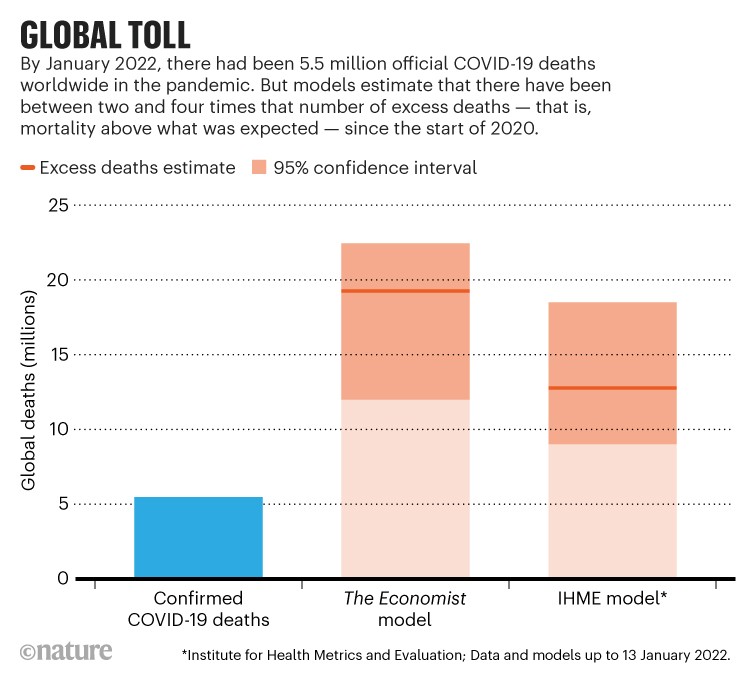
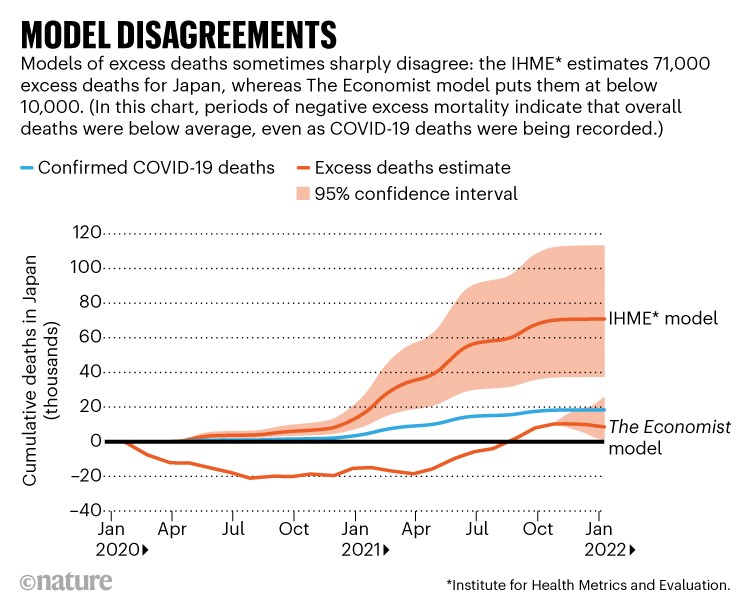
Posted in Books, Kids, pictures, Statistics with tags bad graph, capture-recapture, COVID-19, death certificate, entity resolution, excess mortality, image analysis, infographics, INSEE, Japan, Jeune economist, Nature, official statistics, record linkage, satellite, The Economist on February 17, 2022 by xi'an Another terrible graph from Nature… With vertical bars meaning nothing. Nothing more than the list of three values and both confidence intervals. But the associated article is quite interesting in investigating the difficulties in assessing the number of deaths due to COVID-19, when official death statistics are (almost) as shaky as the official COVID-19 deaths. Even in countries with sound mortality statistics and trustworthy official statistics institutes. This article opposes prediction models run by the Institute for Health Metrics and Evaluation and The Economist. The later being a machine-learning prediction procedure based on a large number of covariates. Without looking under the hood, it is unclear to me how poor entries across the array of covariates can be corrected to return a meaningful prediction. It is also striking that the model predicts much less excess deaths than those due to COVID-19 in a developed country like Japan. Survey methods are briefly mentioned at the end of the article, with interesting attempts to use satellite images of burial grounds, but no further techniques like capture-recapture or record linkage and entity resolution.