Archive for nuclear energy

Nature tidbits [6 Aug 2026]

Posted in Books, pictures, University life with tags , , , , , , , , , , , , , , , , , , , , , , , , , on October 7, 2026 by xi'an

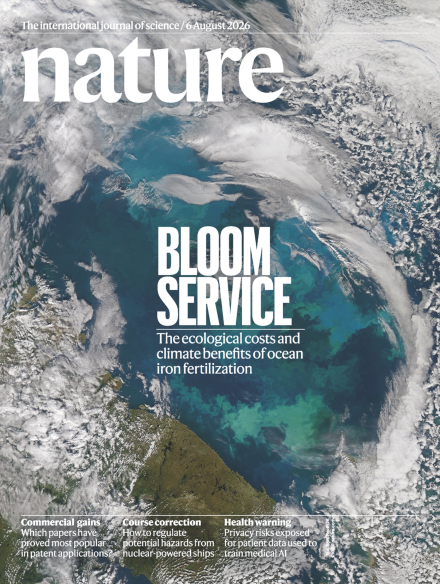
The 6 August issue of Nature arrived after my return from Japan, but it took me a while to catch up, the more because its cover story, Bloom service, about fertilising the oceans with iron as a carbon sink did not appeal much to the geoengineering sceptic in me. Nice pun though. Flotsam of interest for me:

  • an article on GPT-4 (and open-weight models) predicting the outcomes of 70 preregistered US survey experiments, 469 effects and 119,330 participants in total. The predicted treatment effects are highly correlated with the observed ones, about as well as pooled human forecasters do, including studies published after the training cutoff. But the predicted effect sizes are systematically too large, which is not a minor detail for a field still recovering from its replication crisis! Plus a survey of 460 social scientists about using LLMs for pilot testing, and a web app to “forecast” your own experiment’s effect before running it. (I wonder what a prior elicited this way would look like.)
  • a paper on membership inference attacks on medical AI models, showing that patients who differ from the majority are the easiest to identify as part of the training data, which I already discussed here. This fits the long-known issue with differential privacy and outliers.
  • a story on the four 2026 Fields Medals, announced at the ICM in Philadelphia, in fields far, far away:
    • Yu Deng (Chicago), for his work on PDEs, including a rigorous derivation of the Boltzmann equation from hard-sphere dynamics (with Zaher Hani and Xiao Ma), wave kinetic equations, and probabilistic approaches to nonlinear Schrödinger equations.
    • John Pardon (Stony Brook), for symplectic topology and enumerative geometry. He started as an undergraduate by answering a question of Gromov on knot distortion.
    • Jacob Tsimerman (Toronto), for extending techniques within arithmetic and complex algebraic geometry and solving conjectures in this field.
    • Hong Wang (NYU and IHES in Bures-sur-Yvette, almost a colleague!), for Fourier restriction, progress on Falconer’s conjecture and, with Joshua Zahl, the resolution of the Kakeya conjecture in three dimensions.
  • a feature on the scientific papers most cited in patents.
  • a news item on a Science paper by Blasi, Hamilton, Gray and Bowern, estimating that humanity may have spoken tens of thousands of languages between 3,000 and 1,000 years ago. The paper suggests a shift away from nomadic life triggered this diversity before it collapsed. I wonder at how deep the statistical linguistics inferring this rich past from the surviving sample goes. In a sense, the finding is not that surprising, given how isolated small prehistoric communities were, and how quickly a language drifts apart without contact. (I would also like to check how much the estimate depends on the assumed birth-and-death rates of languages, since the lost ones leave no trace to calibrate against…)
  • an editorial on the White House’s “new golden age for science” plan. It argues that such a golden age needs open borders and funding for the social sciences, public health and the humanities, not only AI and engineering. Alas, the now usual Trump.2.0 fare, with an AI funding roll-out in the news pages.
  • an emergency call by WHO director-general Tedros Adhanom Ghebreyesus on why the WHO has never been more needed, and news that the first volunteer received an Ebola vaccine three months into the current outbreak.
  • a forecast that the coming El Niño should be the largest (by a mind-blowing margin) on record, pushing 2027 temperatures to new highs. And already having severe impact on tropical weather.
  • a scary comment on the risks of nuclear-powered merchant ships, in the very issue dated on the anniversary of Hiroshima…

renewable energy [book review]

Posted in Books, Kids, Travel with tags , , , , , , , , , , , , , , , , , , , , , , , , , , , , , on December 28, 2025 by xi'an

Renewable Energy (2nd edition, 2025), by Nick Jelley is part of the terrific “Very Short Introduction” series, which provides an expert introduction to a topic within 150 pages. (The OUP equivalent of the French series “Que sais-je?” that started in 1941.) The reason for the second edition, as provided by the author, is the “dramatic expansion, and fall in cost” of clean energy products. Unfortunately, it comes out just short of realising the magnitude of the backlash again renewable energy and fighting climate change launched by the second Trump administration and the ensuing added pressure on other countries to reduce further their fuel consumption.

The main sources of renewables are identified as wind, sun, and water, in a first chapter that operates as an historical recap on the evolution of energy sources and consumption. The second chapter stresses the need for renewable to fight global warming and to reverse climate change, with a rather vague discussion of the costs of producing energy from renewable. Chapter 3 focusses on (debatable) biomass, solar heat, and hydropower. Chapter 4 on wind power, with a few paragraphs on the production costs and the reluctance of local populations (that seems to be fuelled by right-wing parties). Chapter 5 is specifically about solar photovoltaïcs, deemed to be now cheaper than fossil fuels inmost countries. And substituting for deficient or inexistent large scale energy grids in some countries. And Chapter 6 deals (briefly) with other low-carbon technologies, like tidal dams (mentioning the 1966 La Rance dam near Mont Saint-Michel, Normandy, we would visit now and then when I was a kid!), wave turbines, nuclear energy, and geothermal power (both heating and providing electricity). Chapter 7 discusses renewable electricity issues with energy storage (batteries and pumped hydro storage), since most solutions cannot be fired at will. The book  addresses neither the loss in carrying electricity over long distances (as suggested p103 between Morocco and Europe, or Australia and Singapore), nor the hacking risks impacting large electricity grids. Chapter 8 switches to decarbonasing heat and transport, where heat pumps and electric vehicles are the most promising venues. Chapter 9 concludes by a more political discussion of the transition to renewable, pointing out the Chinese leadership in switching to solar and wind capacities. And the brake put on the transition by international crisis such as the Russian invasion of Ukraine that keep subsidies on fuel consumption. And make European countries divesting from this transition to invest in military budgets.

While the book manages a proper introduction to renewable energy and stays up-to-date with the current developments, I find it a bit overly optimistic on the prospect of achieving COP goals and carbon neutrality. Beyond the geostrategic issues briefly mentioned in the concluding chapter, there is no mention made of the exploding energy consumption of AIs and of the limited investments of AI companies into renewable energies… Reducing energy demand does not even occupy one page of the book (p127). Similarly, I find too little discussion of the political and human aspects of using renewables, eg photovoltaïcs and batteries, which resurfaced in the recent Chinese blockade on rare earths or coverages (as in Nature, 04 Nov 2025) on the extreme hardship of extracting minerals. Contrary to those (aspects) for massive dams affecting the local populations and in the dispute between countries or States. And also little on the environmental costs of producing and recycling both solar and wind farms, in contrast with hydroelectricity. Surprisingly, nuclear energy is evacuated in one paragraph in Chapter 2, on safety arguments. If reappearing in Chapter 6 with further concerns about the overall cost of nuclear energy.

[The usual disclaimer applies, namely that this bicephalic review is likely to appear later in CHANCE, in my book reviews column.]

Nature tidbits [10 July 2025]

Posted in Books, Kids, pictures, University life with tags , , , , , , , , , , , , , , , , , , , , , , , , , on August 27, 2025 by xi'an

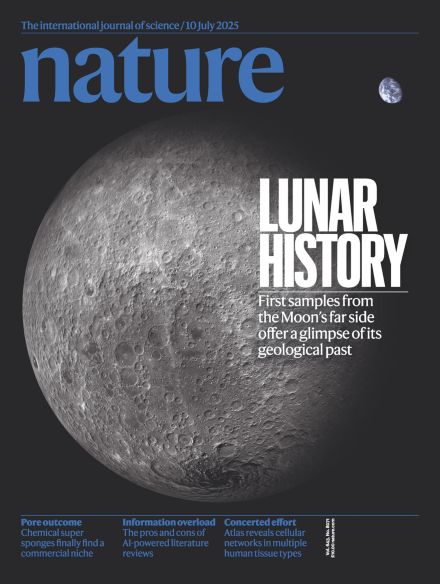
With a beautiful cover and a wealth of papers following China’s mission on the hidden side of the Moon, this issue offers

  • another “feel-good” editorial on the need for a highly ambitious UN treaty on plastics, or rather against plastic, at the August meeting in Geneva this month. Given the opposition of major producers like the USA (now more than ever!) and China, as well as all oil producers, the terrible impact of plastics  on life as a whole (also documented in this issue) is again likely to be ignored in favour of short-term commercial goals. (As illustrated by a feature article on metal-organic frameworks that capture CO² but are posing clear biosafety and environmental challenges, not mention in the article.)
  • a second editorial on the rise of metascience, a term I had not X’ed previously, which appears to be the science of scientific practice and impact. Given the limited impact scientists have on governments and societies, now more than ever!,  it is hard to forecast that metascientists will do better…
  • a rather tone-deaf tribune by the president of the Weizmann Institute on how they are reconstructing the institute after the Iranian attacks of 15 June (following the Israeli attacks of 13 June that hit several universities and assassinated several nuclear scientists). With empty words for “scientists in Gaza” when the very same Israeli government that funds Weizmann has flattened all academic and medical institutions in Gaza. (The asymmetry was later pointed out by a letter to the Nature editor from an Iranian scientist.) Followed a few pages later by the covarege an independent survey on a likely 80,000 death toll in Gaza.
  • A news article on the US National Academy of Sciences, Engineering and Medicine failing to take a stand against Trump 2.0, and too readily engaging into collaboration and censorship. And another one on the growing number of foreign scientists arrested at the border for carrying biological material. While I have (in the long past!) carried a raw milk Camembert in my bag and into the US, mea culpa (Io), I am less sympathetic to these cases since some of the material was hazardous, beyond being undeclared. What has changed in the recent is Homeland Security jumping on these cases to increase their deportation figures…
  • A long comment by Cantabrigians on the ambivalent role of AIs in writing and reviewing papers, with a proposed fix through the Conservative Evidence database, in Cambridge, England. A lot of coulds, woulds, and shoulds, imposing an international involvement, open access, and reliable procedures separating chaff from grain…

more than mostly MC

Posted in Kids, pictures, Statistics, Travel, University life with tags , , , , , , , , , , , , , , , , , , , , , , on December 27, 2024 by xi'an

The session of last Friday (and last one of 2024!) proved most interesting, with two (fully) Monte Carlo talks. The first one by Louis Grenioux was about an improvement on diffusion sampler, following a recent arXival by Maxime Noble and co-authors. Which brought me back to the long-standing multimodal challenge in Monte Carlo methods. When all modes of a target distribution are known, even roughly, this is not much of an issue since samplers can be arm-bent into visiting all these modes. But the problem becomes much harder when the location and a fortiori the number of modes are not known. The paper aims at adapting diffusion samplers towards a better exploration of the modes, albeit their location is known. Otherwise, using MCMC as a starting (reference) distribution would risk missing some of them. Which also explains why the authors can rely on the classical Gaussian mixtures proposal as a cheap substitute to neural networks (EBM). Since, within diffusion models, both intermediary distributions and their scores are intractable, they also introduce a variational parametric approximation that can be optimised.

The second talk was given by Guillaume Chennetier, in connection with his recent PhD thesis, developing a form of X-entropy sampling for rare events. As in nuclear plant major accidents. It took me a while to realise that PDMPs were not used as a simulation tool, as in the zigzag sampler and its avatars, The proposal involved creating a graph structure on the space of PDMP trajectories and designing the optimal importance process (yes, the one with zero variance!) using so-called committor functions that modify jump intensity and kernel, in a sequential way reminiscent of X-entropy. The approach recycles past trajectories as Monte Carlo elements if missing an adaptive mixture importance sampling (AMIS!) version that would bring more stability. The talk also included an interesting pointer to the availability of the distribution of the PDMP path, thus treated as a likelihood. (!). The signage at the entrance of the Monte-Carlo (mind the hyphen!) casino also made an appearance, reminding me of our memorable group picture on the same spot, eons ago! (But not of whom took the picture!)

where to save [no gas & no nuke]

Posted in Books, pictures, Statistics, Travel with tags , , , , , , , , , on October 18, 2022 by xi'an