In this 20 August edition, a wealth of data analysis papers, with many highly informative graphs. A call for China to better balance recognition for its junior scientists, another call for (US?) universities to treat bullying complaints in-depth rather than as a public relation exercise. The “compulsory” current status of the Trump 2.0 wreckage of US science with the Senate blocking the appointment of politicians for grant reviews. And with the absurd, ungrounded, health threatening split of the MMR vaccine.  Another “compulsory” entry on climate change with a scary graph on the ocean surface temperatures rising way way above the confidence band represented by the previous measurements over 50 years. An interview (why?) of a CEO of the startup QED Science that claims an ability to automatically rank preprints and select the top 1% (why?!). Coïnciding with me receiving an email with a review by Claude of our Bayesian Adversarial Privacy paper! A report on the (defunct Starmer) UK Government cutting on fundamental physics projects. An article featuring the predicted rise in the use of exoskeletons, which I read on my way back from the lodge on Mount Fudji that was renting an exoskeleton to help with the climb! With an optimistic view on the consequences on people’s health and muscles. A short book review on Slobodian’s and Tarnoff’s Muskism, concluding that Musk(ism) lacks a coherent philosophy. (A Musk-read according to the Economist!) A long comment on the sleepless summer of the heatwaves, which led me clearly more tired than usual at the end of the summer break. (With a lot of should. And a focus on methodology.) Another one on the Middle East prospects as a sustainable aviation fuel (SAF) hub, which sounds paradoxical in the current geopolitic situation. It made me wonder how sustainable are these SAFs? True, they recycle oils, gases and biomass, rather than extracting “new” oils, but they still pollute the air. And, true, they can fill empty returning tankers, but they divert investment and research from more renewable and less polluting alternatives. Among the actual scientific articles, a long review on the safety and security of LLMs in healthcare (but useless pictures).
  One on the massive floods that occurred in Europe in 1342-1343, possibly caused by volcanic eruptions plus Arctic sea ice retreat, nothing that could occur today of course! With massive socio-economic consequences. (And a great graph, except I do not see the point for the 2D projections. Or for modern state borders.)
  An analysis of intergenerational mobility in Europe with the unsurprising conclusion that it impacts innovation. (Go, Erasmus!) With a multivariate regression I did not investigate (using NUTS but not Andrew’s NUTS!). And graphs of intergenerational mobility per European country, with too many colours to be readable (and the regression line to make sense?). Another data analysis of the Pakistan Genome Resource, with distinctive traits of the many ethnicities of Pakistan. And the discovery of many clinically relevant genes (with a massive avalanche of p-values!).
Archive for book review
Nature tidbits [14 May 2026]
Posted in Books, pictures, Statistics, Travel, University life with tags academic freedom, AI, AI coding, anthropology, antibiotics, apes, Asilomar conference centre, biohazards, bioweapon, book review, California, Canada, coding, David Hume, EU, European Union, Fukushima Daïshi, Fukushima region, Iran, Islamic Republic of Iran, John Locke, LLMs, Middle East, Nature, nuclear disaster, programming, rationalism, sleep patern, US wars on June 21, 2026 by xi'an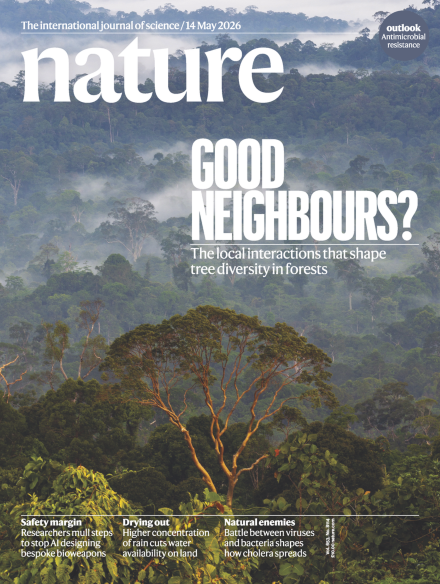
The same issue covers the opening of a radiation observation centre in Fukushima, where an area of 300 km² remains off limit. While the remainder of the Fukushima region is declared as safe as the whole of Japan, very few people have returned. One of the goals of the institute (F-REI) is to induce more confidence in the scientific validity of the above declaration, but it remains to be seen how effective it will prove. (I intended to hike nearby this summer but plans have changed!)
Still in the 14 May volume, a longer “feature” article on the dangers of AI-based bioweapons. Which seem real but also difficult to counteract. Especially if rogue states are involved and can create AI-controlled robotic labs for the production. The common recommendation that scientists should create adequate guardrails sounds naïve, at best, since generic LLMs are not designed with such guardrails. (It seems to me each article on the topic reaches the Asilomar trigger at some point!) Followed by a less doom-laden article on the use of AI “vibe coding” by scientists, if not of lesser interest. Which relates to the explosive call to LLMs to design or improve codes. (Also impacting our students and courses in a massive way.) The gains are mostly appreciable for those in the know, since newcomers without coding experience are unlikely to spot subtle errors. (Of course, we a.s. faced pre-AI codes with a subtle error that took ages to detect. Or may even still be there!) The issue also contains an “outlook” leaflet [supported by external sources, who assumedly do not influence the contents!] on antimicrobial (incl. antibiotic) resistance. Among the causes are the default use of antibiotics in farming, which again reflect on the difficulty of controlling such practice (banned in the EU, except in some imports!) and the urge to reduce faster meat consumption. And a book review of Canadian anthropologist Samson’s The Sleepless Ape, which offers an interesting theory of evolution thru sleep deprivation! (“The philosophers John Locke and David Hume thought that sleep hindered rationalism and the pursuit of knowledge.”)
spotlight on the shady zones of the cosmos
Posted in Books, Kids, Travel, University life with tags Big Bang, book review, CNRS, cosmology, France, France Inter, French book, Le Monde, multiverse, Universe, vulgarisation on June 7, 2026 by xi'an
Nature squeakbits [26 February 2026]
Posted in Books, pictures, Running, Travel with tags Antarctica, basketball shoes, book review, China Initiative, Chinese Government, climate change, climate science, COVID-19, EPA, ERC Advanced Grant, ERC Consolidator Grant, ERC Starting Grant, France, French politics, greenhouse-gas emissions, Indonesia, International Campaign to Abolish Nuclear Weapons, Jean-Michel Basquiat, Jeffrey Epstein, large language models, London, London calling, Marie Skłodowska-Curie, measles, Nature, nuclear weapons elimination day, perspective, rock art, SARS-CoV-2, snippet, START treaty, Sulawesi Island, The Clash, Trump administration, UKRI, unilateral nuclear disarmament, US Government, US politics, West Antarctica Ice Sheet, WHO on April 16, 2026 by xi'an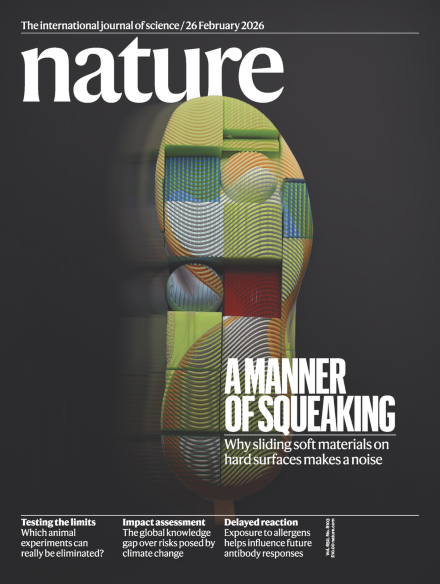
And another coverage of the deplorable Trump administration dismantling the biodefense and pandemic preparedness branches of the US NIAID, presumably a late under-the-belt jab at the national institute Anthony Fauci directed for 38 years. Meaning one of the forefronts for pandemic research and vaccine development has been dismantled. Plus the US EPA revoking the 2009 statement that climate change is endangering the US population and removing greenhouse-gas emission rules. In tune with the Drill, baby, drill! motto of the Trump supporters more interested in their short-term profits than in the long-term (no-)future of the country. Paradoxically sitting in the same issue as a comment calling for a policy-making assessment of avoidable climate-change risks. Illustrated by London’s drownin’ below

And a summary of their conclusions from 23 of the 27 members (from 27 countries) of the Scientific Advisory Group for the Origin of Novel Pathogens for the WHO. After 3.5 years of debate on the origin of COVID-19! Four hypotheses are examined and other hoaxes and conspiracies are debunked.
Another political entry about the EU and its Horizon Europe programme (that is funding my ERC Synergy grant) baring (researchers from) Chinese research organisations from applying for its grants in sensitive methodologies, in order to prevent “the undesired transfer of IP”. Following similar and earlier actions in the US with the (newspeak!) China Initiative launched by Trump 1.0 that turned into a witch hunt.
An exciting 228 metres of rock and mud providing a window on the past 23 million year weather. Obtained from the West Antarctica Ice Sheet.
Nature tags & snippets [19 Feb 2026]
Posted in Books, pictures, University life with tags antivaxers, artificial general intelligence, book review, Chinese Government, ERC Advanced Grant, ERC Consolidator Grant, ERC Starting Grant, Indonesia, Jean-Michel Basquiat, Jeffrey Epstein, large language models, Marie Skłodowska-Curie, measles, Nature, perspective, rock art, snippet, Sulawesi Island, Trump administration, UKRI, US Government, US politics on March 24, 2026 by xi'an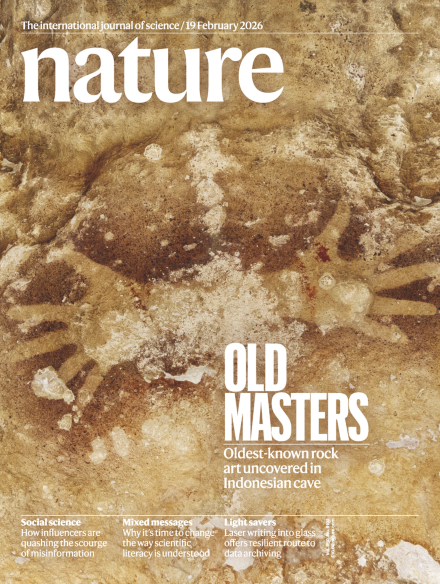
A tribune on UKRI cutting whole branches of medical, biological and physical research in the UK, to “focus and do fewer things better¨. Impacting for instance the Medical Research Council (MRC). At least until 2028, with longer range consequences.
And an entry on Epstein, whose files have now contaminated even Nature itself. (When is Andrews MW going to make an appearance there as well?!) The connection (of interest) with science is that the sex offender and financier supported research institutions, incl. the mathematical biologist Martin Nowak, whose work Epstein reviewed (despite a total absence of credentials!). Along another entry on the Chinese Government (MOST) instituting penalties on universities failing to act on scientific misconduct by some of their staff.
And a frightful graph on the exploding number of measles cases in the US, this year, related to the drop in the proportion of vaccinated children. Correlated with the next article on regulation moves by the Trump administration to make firing government scientists much easier. And with the surge in US applicants to the major European grants, namely ERC starting, consolidator and advanced grants and Marie Skłodowska-Curie postdoctoral fellowships.
A book review of Michael Pollan’s A World Appears: A Journey into Consciousness, a New York Times bestseller and more importantly an exploration of the physical nature of consciousness. Followed by a long comment by N. Sanders (Harvard) and B. Schneier (Toronto) on the pernicious effect of high salaries in AI companies on academic research, in particular by negating the scientific worth of collaborating. Plus a regular one-column comment that “Statistical approximation is not general intelligence”..! Albeit with reasonable arguments about the unlikely emergence of an artificial general intelligence.
Last but not least, a Perspective article on the moral competence of large language models. which requires defining first moral competence and moral performances. Involving a long-term acquaintance of mine’s, Kristian Lum (now at DeepMind NY) as one of the authors.

