Archive for likelihood

Philosophies, Puzzles and Paradoxes [book review]

Posted in Books, pictures, Statistics, Travel, University life with tags , , , , , , , , , , , , , , , , , , , , , , , , , , , , , , , , , , on May 25, 2024 by xi'an

Yudi Pawitan and Youngjo Lee have written a book that recently caught my attention within the CRC Press list of new publications. Because philosophy, puzzles, and paradoxes are definitely of interest to me (as shown by numerous entries in the ‘Og!). The subtitle of said book is A Statistician’s Search for Truth.

Reviews of the book are already available, with for instance Andrew Gelman stating that he disagrees “with much of this book, but it’s an entertaining and thought-provoking introduction to some challenging questions” or Stephen Senn starting the foreword with “This is a remarkable book: wide-ranging, ambitious, challenging and profound but also intriguing, fascinating and original.” (Senn is also cited within the book for his discussion of our revisit of Harold Jeffreys’ Theory of Probability.) Nice cover as well (albeit I could not trace the origin of it, inside or outside the book.)

The book is made of three parts, one on the philosophical approaches to truth, scientific discovery, deduction, and induction, a second one on probability theories, with philosophical motivations, Bayesian inference, and likelihood-based inference, and a third section on paradoxes. Given that both authors are senior authors who have contributed to likelihood inference throughout their career, incl. the books In All Likelihood and Generalized Linear Models with Random Effects, the likelihood approach is somewhat privileged against other statistical resolutions towards the resolution of the paradoxes, with a defence of confidence distributions and a chapter on epistemic confidence that mostly stems from recent papers by the authors, like Pawitan et al.  (2023) and Lee and Lee (2023). I find the discussion therein somewhat unclear, esp. because the same notation Pr(.) is employed for different probability notions.

“Epistemic confidence is the objective measure of uncertainty that’s attached to single events, where the objectivity is based on a consensus of rational minds.” (p.197)

The philosophy part is following the (European) Enlightenment in producing more and more involved discussions on reason, knowledge and scientific discovery. This exploration is an easy read, as it does not delve particularly deeply in the arguments of Kant, Hume, or Popper. With the apparently unescapable mention of Gödel’s incompleteness theorem, including a sausage citation from Poincaré that reminded of that strip from Tintin in America:which, most probably, he would have applied to Ais! Several sections about pseudo-rational attempts to demonstrate the existence of Dog could have been skipped as well.

The part of probability already considers paradoxes which, like the subsequent ones are mostly the consequence of using natural (and hence ambiguous) languages instead of mathematical descriptions—incl. the statement of the Likelihood Principle. It also discusses Keynes’ logical (or imprecise) probabilities, briefly if appropriately given the pessimistic views of young Keynes on the assessment of the probability of an event. Savage is privileged enough to enjoy an entire chapter discussing his 1950’s axioms leading to the existence of a (subjective)  prior on “the states of the world”. This is followed by a chapter on Inverse probability (aka Bayesian statistics), where the authors consider Bayes’ 1763 Essay to have stayed mostly unnoticed till  the beginning of the 20th Century, which sounds a somewhat subjective judgement. (And as uncovered by Steve Stiegler, the original title of the Essay was indeed intended as a reply to Hume.) A further if short chapter is dedicated to the search for the prior distribution. Which thus gives the misguided impression that there should exist such a thing, rather than acknowledging that Bayesian statements are relative to the prior measure. The remainder of the discussion on invariant and reference priors is however mostly standard. Except when falling for the marginalisation paradox when stating that a product of improper priors implies independence on p.144.

The paradoxes examined in the final part are Allais’ (an alumni of Lycée Lakanal!), and Ellsberg’s, avatars of the Saint Petersburg paradox and referring to failing to adhere to rational decision-making and not in the least to statistics. Conjunction and inclusion “fallacious fallacies”, which are central to Kahneman’s Thinking fast and slow bestseller, and attributed to reasoning in terms of likelihood rather than of probability (without accounting for multiple testing on p.228). A whole if short chapter on the Monty Hall and three prisoners paradoxes, another predictable occurrence in a book on reasoning paradoxes. Again mostly a matter of poor wording, plus relying on the choice of an underlying probability model, for which the authors again follow a likelihood approach, the number of the prize door or of the freed prisoner being the parameter. Kyburg’s (very weak) lottery paradox and related forensic paradoxes, concluding with the rejection of judgements based solely on probability reasoning. Hempel’s paradox of the ravens, a priori unrelated with statistical evidence, but turned into one by squeezing in some sampling models. Finishing with the (envelope) exchange paradox, where the authors refuse to put a prior on the unknown parameter but end up with a solution equivalent to adopting a Jeffreys prior.

In conclusion, this attempt at connecting statistical inference and philosophy, probability concepts and rational decision making, paradoxes and modelling, within a single book is academically sound and overall enjoyable, if not outstanding or remarkable as it does not constitute a radical move away from existing analyses of those classical paradoxes. Furthermore, I find the paradoxes overwhelmingly distant from genuine statistical settings and involving a rather stretched notion of data. Still, methinks I will keep this book in my bookcase, rather than leaving it for the taking in the department coffee room!

As I was completing the book and getting towards writing this book review, I also noticed a two page blurb in Significance (May 2024 issue) written by the authors on their book. (which happens rather frequently with this magazine). Unsurprisingly, the contents provd mostly extracted from the preface and introduction With a nice ravens picture (in conjunction with the raven paradox).

[Disclaimer about potential self-plagiarism: this post or an edited version may eventually appear in my Books Review section in CHANCE.]

The Seven Pillars of Statistical Wisdom [book review]

Posted in Books, pictures, Statistics, University life with tags , , , , , , , , , , , , , , , on June 10, 2017 by xi'an

I remember quite well attending the ASA Presidential address of Stephen Stigler at JSM 2014, Boston, on the seven pillars of statistical wisdom. In connection with T.E. Lawrence’s 1926 book. Itself in connection with Proverbs IX:1. Unfortunately wrongly translated as seven pillars rather than seven sages.

As pointed out in the Acknowledgements section, the book came prior to the address by several years. I found it immensely enjoyable, first for putting the field in a (historical and) coherent perspective through those seven pillars, second for exposing new facts and curios about the history of statistics, third because of a literary style one would wish to see more often in scholarly texts and of a most pleasant design (and the list of reasons could go on for quite a while, one being the several references to Jorge Luis Borges!). But the main reason is to highlight the unified nature of Statistics and the reasons why it does not constitute a subfield of either Mathematics or Computer Science. In these days where centrifugal forces threaten to split the field into seven or more disciplines, the message is welcome and urgent.

Here are Stephen’s pillars (some comments being already there in the post I wrote after the address):

  1. aggregation, which leads to gain information by throwing away information, aka the sufficiency principle. One (of several) remarkable story in this section is the attempt by Francis Galton, never lacking in imagination, to visualise the average man or woman by superimposing the pictures of several people of a given group. In 1870!
  2. information accumulating at the √n rate, aka precision of statistical estimates, aka CLT confidence [quoting  de Moivre at the core of this discovery]. Another nice story is Newton’s wardenship of the English Mint, with musing about [his] potential exploiting this concentration to cheat the Mint and remain undetected!
  3. likelihood as the right calibration of the amount of information brought by a dataset [including Bayes’ essay as an answer to Hume and Laplace’s tests] and by Fisher in possible the most impressive single-handed advance in our field;
  4. intercomparison [i.e. scaling procedures from variability within the data, sample variation], from Student’s [a.k.a., Gosset‘s] t-test, better understood and advertised by Fisher than by the author, and eventually leading to the bootstrap;
  5. regression [linked with Darwin’s evolution of species, albeit paradoxically, as Darwin claimed to have faith in nothing but the irrelevant Rule of Three, a challenging consequence of this theory being an unobserved increase in trait variability across generations] exposed by Darwin’s cousin Galton [with a detailed and exhilarating entry on the quincunx!] as conditional expectation, hence as a true Bayesian tool, the Bayesian approach being more specifically addressed in (on?) this pillar;
  6. design of experiments [re-enters Fisher, with his revolutionary vision of changing all factors in Latin square designs], with an fascinating insert on the 18th Century French Loterie,  which by 1811, i.e., during the Napoleonic wars, provided 4% of the national budget!;
  7. residuals which again relate to Darwin, Laplace, but also Yule’s first multiple regression (in 1899), Fisher’s introduction of parametric models, and Pearson’s χ² test. Plus Nightingale’s diagrams that never cease to impress me.

The conclusion of the book revisits the seven pillars to ascertain the nature and potential need for an eight pillar.  It is somewhat pessimistic, at least my reading of it was, as it cannot (and presumably does not want to) produce any direction about this new pillar and hence about the capacity of the field of statistics to handle in-coming challenges and competition. With some amount of exaggeration (!) I do hope the analogy of the seven pillars that raises in me the image of the beautiful ruins of a Greek temple atop a Sicilian hill, in the setting sun, with little known about its original purpose, remains a mere analogy and does not extend to predict the future of the field! By its very nature, this wonderful book is about foundations of Statistics and therefore much more set in the past and on past advances than on the present, but those foundations need to move, grow, and be nurtured if the field is not to become a field of ruins, a methodology of the past!

exact, unbiased, what else?!

Posted in Books, Statistics, University life with tags , , , , , , , , on April 13, 2016 by xi'an

Last week, Matias Quiroz, Mattias Villani, and Robert Kohn arXived a paper on exact subsampling MCMC, a paper that contributes to the current literature on approximating MCMC samplers for large datasets, in connection with an earlier paper of Quiroz et al. discussed here last week.

quirozetal.The “exact” in the title is to be understood in the Russian roulette sense. By using Rhee and Glynn debiaising device, the authors achieve an unbiased estimator of the likelihood as in Bardenet et al. (2015). The central tool for the derivation of an unbiased and positive estimator is to find a control variate for each component of the log likelihood that is good enough for the difference between the component and the control to be lower bounded. By the constant a in the screen capture above. When the individual terms d in the product are iid unbiased estimates of the log likelihood difference. And q is the sum of the control variates. Or maybe more accurately of the cheap substitutes to the exact log likelihood components. Thus still of complexity O(n), which makes the application to tall data more difficult to contemplate.

The $64 question is obviously how to produce cheap and efficient control variates that kill the curse of the tall data. (It still irks to resort to this term of control variate, really!) Section 3.2 in the paper suggests clustering the data and building an approximation for each cluster, which seems to imply manipulating the whole dataset at this early stage. At a cost of O(Knd). Furthermore, because finding a correct lower bound a is close to impossible in practice, the authors use a “soft lower bound”, meaning that it is only an approximation and thus that (3.4) above can get negative from time to time, which cancels the validation of the method as a pseudo-marginal approach. The resolution of this difficulty is to resort to the same proxy as in the Russian roulette paper, replacing the unbiased estimator with its absolute value, an answer I already discussed for the Russian roulette paper. An additional step is proposed by Quiroz et al., namely correlating the random numbers between numerator and denominator in their final importance sampling estimator, via a Gaussian copula as in Deligiannidis et al.

This paper made me wonder (idly wonder, mind!) anew how to get rid of the vexing unbiasedness requirement. From a statistical and especially from a Bayesian perspective, unbiasedness is a second order property that cannot be achieved for most transforms of the parameter θ. And that does not keep under reparameterisation. It is thus vexing and perplexing that unbiased is so central to the validation of our Monte Carlo technique and that any divergence from this canon leaves us wandering blindly with no guarantee of ever reaching the target of the simulation experiment…

Bayesian model averaging in astrophysics

Posted in Books, Statistics, University life with tags , , , , , , , , , , on July 29, 2015 by xi'an

[A 2013 post that somewhat got lost in a pile of postponed entries and referee’s reports…]

In this review paper, now published in Statistical Analysis and Data Mining 6, 3 (2013), David Parkinson and Andrew R. Liddle go over the (Bayesian) model selection and model averaging perspectives. Their argument in favour of model averaging is that model selection via Bayes factors may simply be too inconclusive to favour one model and only one model. While this is a correct perspective, this is about it for the theoretical background provided therein. The authors then move to the computational aspects and the first difficulty is their approximation (6) to the evidence

P(D|M) = E \approx \frac{1}{n} \sum_{i=1}^n L(\theta_i)Pr(\theta_i)\, ,

where they average the likelihood x prior terms over simulations from the posterior, which does not provide a valid (either unbiased or converging) approximation. They surprisingly fail to account for the huge statistical literature on evidence and Bayes factor approximation, incl. Chen, Shao and Ibrahim (2000). Which covers earlier developments like bridge sampling (Gelman and Meng, 1998).

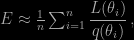
As often the case in astrophysics, at least since 2007, the authors’ description of nested sampling drifts away from perceiving it as a regular Monte Carlo technique, with the same convergence speed n1/2 as other Monte Carlo techniques and the same dependence on dimension. It is certainly not the only simulation method where the produced “samples, as well as contributing to the evidence integral, can also be used as posterior samples.” The authors then move to “population Monte Carlo [which] is an adaptive form of importance sampling designed to give a good estimate of the evidence”, a particularly restrictive description of a generic adaptive importance sampling method (Cappé et al., 2004). The approximation of the evidence (9) based on PMC also seems invalid:

E \approx \frac{1}{n} \sum_{i=1}^n \dfrac{L(\theta_i)}{q(\theta_i)}\, ,

is missing the prior in the numerator. (The switch from θ in Section 3.1 to X in Section 3.4 is  confusing.) Further, the sentence “PMC gives an unbiased estimator of the evidence in a very small number of such iterations” is misleading in that PMC is unbiased at each iteration. Reversible jump is not described at all (the supposedly higher efficiency of this algorithm is far from guaranteed when facing a small number of models, which is the case here, since the moves between models are governed by a random walk and the acceptance probabilities can be quite low).

The second quite unrelated part of the paper covers published applications in astrophysics. Unrelated because the three different methods exposed in the first part are not compared on the same dataset. Model averaging is obviously based on a computational device that explores the posteriors of the different models under comparison (or, rather, averaging), however no recommendation is found in the paper as to efficiently implement the averaging or anything of the kind. In conclusion, I thus find this review somehow anticlimactic.

JSM 2014, Boston

Posted in Books, Mountains, pictures, Running, Statistics, Travel, University life with tags , , , , , , , , , , , , on August 6, 2014 by xi'an

A new Joint Statistical meeting (JSM), first one since JSM 2011 in Miami Beach. After solving [or not] a few issues on the home front (late arrival, one lost bag, morning run, flat in a purely residential area with no grocery store nearby and hence no milk for tea!), I “trekked” to [and then through] the faraway and sprawling Boston Convention Centre and was there in (plenty of) time for Mathias Drton’s Medalion Lecture on linear structural equations. (The room was small and crowded and I was glad to be there early enough!, although there were no Cerberus [Cerberi?] to prevent additional listeners to sit on the ground, as in Washington D.C. a few years ago.) The award was delivered to Mathias by Nancy Reid from Toronto (and reminded me of my Medallion Lecture in exotic Fairbanks ten years ago). I had alas missed Gareth Roberts’ Blackwell Lecture on Rao-Blackwellisation, as I was still in the plane from Paris, trying to cut on my slides and to spot known Icelandic locations from glancing sideways at the movie The Secret Life of Walter Mitty played on my neighbour’s screen. (Vik?)

Mathias started his wide-ranging lecture by linking linear structural models with graphical models and specific features of covariance matrices. I did not spot a motivation for the introduction of confounding factors, a point that always puzzles me in this literature [as I must have repeatedly mentioned here]. The “reality check” slide made me hopeful but it was mostly about causality [another of or the same among my stumbling blocks]… What I have trouble understanding is how much results from the modelling and how much follows from this “reality check”. A novel notion revealed by the talk was the “trek rule“, expressing the covariance between variables as a product of “treks” (sequence of edges) linking those variables. This is not a new notion, introduced by Wright (1921), but it is a very elegant representation of the matrix inversion of (I-Λ) as a power series. Mathias made it sound quite intuitive even though I would have difficulties rephrasing the principle solely from memory! It made me [vaguely] wonder at computational implications for simulation of posterior distributions on covariance matrices. Although I missed the fundamental motivation for those mathematical representations. The last part of the talk was a series of mostly open questions about the maximum likelihood estimation of covariance matrices, from existence to unimodality to likelihood-ratio tests. And an interesting instance of favouring bootstrap subsampling. As in random forests.

I also attended the ASA Presidential address of Stephen Stigler on the seven pillars of statistical wisdom. In connection with T.E. Lawrence’s 1927 book. (Actually, 1922.) Itself in connection with Proverbs IX:1. Unfortunately wrongly translated as seven pillars rather than seven sages.  Here are Stephen’s pillars:

  1. aggregation, which leads to gain information by throwing away information, aka the sufficiency principle [one may wonder at the extension of this principleto non-exponantial families]
  2. information accumulating at the √n rate, aka precision of statistical estimates, aka CLT confidence [quoting our friend de Moivre at the core of this discovery]
  3. likelihood as the right calibration of the amount of information brought by a dataset [including Bayes’ essay]
  4. intercomparison [i.e. scaling procedures from variability within the data, sample variation], eventually leading to the bootstrap
  5. regression [linked with Darwin’s evolution of species, albeit paradoxically] as conditional expectation, hence as a Bayesian tool
  6. design of experiment [enters Fisher, with his revolutionary vision of changing all factors in Latin square designs]
  7. residuals [aka goodness of fit but also ABC!]

Maybe missing the positive impact of the arbitrariness of picking or imposing a statistical model upon an observed dataset. Maybe not as it is somewhat covered by #3, #4 and #7. The reliance on the reproducibility of the data could be the ground on which those pillars stand.