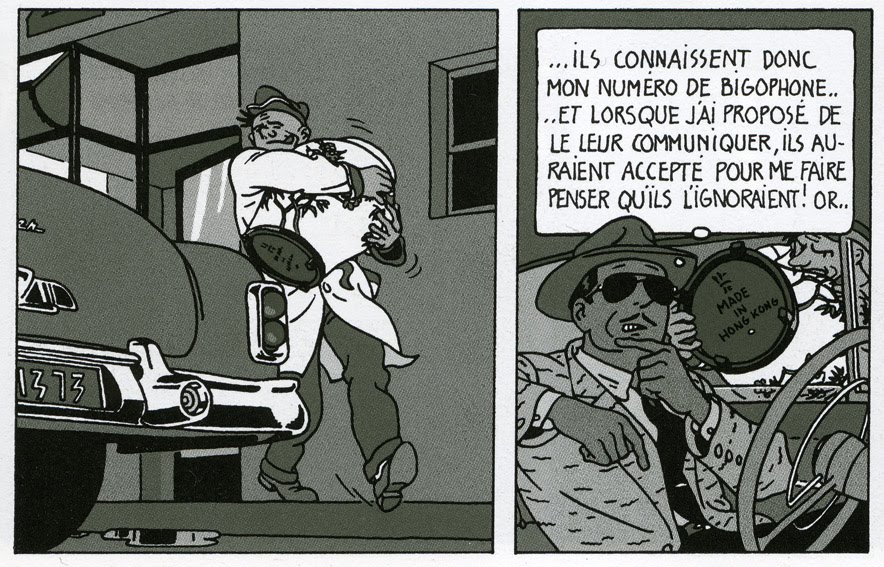
Read some graphical novels over the Yule break, incl. the new volume in the endless Thorgal series, Adieu Aricia, created by a master of heroic fantasy comics, Recht Robin, L’Art de la guerre, a refreshing if light pastiche of Blake & Mortimer drawn by Floc’h, far from the E.P. Jacob ligne claire (following another one by another master of Belgian comics, Schuiten, Le Dernier Pharaon), and Le Monde sans fin, by Blain & Jancovici, a best seller retracing the central importance of energy in evolution and the urgent need to change the entire societal software (if a bit heavy handed).
 Cooked little while being away, except for a Flemish red cabbage stew and a batch of mini buckwheat galettes, and fortunately escaped the huge meals that usually plague this time of year. Avoided as well some viral issues with French oysters, despite enjoying several servings of Norman origin. While in Aubrac, has a taste of the local beef, the well-named… Aubrac breed, whose herds are raised on this immense and treeless plateau during the warmer months. Most crucially, we enjoyed very much the few days we spent there in a remote farm with no Internet, great company, long trail runs, and simple home-made dinners. (Foodwise, the difference of food prices on the local markets like Saint-Chély d’Apcher when compared with Paris and its suburb was noticeable, if not a major surprise, meaning we brought back home a month worth of local cheese.)
 Watched Chicken Run #2 with my kids, which I found heavy handed and predictable, even on a 25 December afternoon, if admirable stop motion animation by the Bristol based Aardman studios, Rebel Moon by myself, just a terrible mix of existing space operas, with frankly embarrassing moments (like the disguised horses, the Warhammer-ish fights, and the final scene when the band is carelessly crushing through a wheat field) and Blue Eye Samurai with the whole family. The latter is a French-American anime set in Japan, around the Great Furisode Fire of 1657 in Edo and the expulsion of foreigners from Japan by the Tokugawa shogunate. Graphically beautiful, Great except for the dialogues being in English, the cubist way horses are drawn and for some historical inaccuracy.

 The
The  For those who have never read
  The fond depiction of an “Olde England” that is almost caricatural at times is also an enjoyable part of the novels. The longing for a British Empire that was quickly disappearing while the novels were written is obviously accompanied by an ethno-centrism that verges on racism and xenophobia at times. The World cannot be saved but by cultivated anglo-saxon men! (Characteristically, there is no female central character in the series… One [lame] explanation is that, the series being published in a kid magazine,