Archive for alchemy

a journal of the nipponholic year

Posted in Books, Travel, Wines with tags , , , , , , , , , , , , , , , , , , , , , , , , , , , , on November 17, 2026 by xi'an

Read Les évaporés du Japon, by Léna Mauger. A journalist investigates the jōhatsu, literally “evaporated people” in Japan, through a series of interviews in the off-the-grid places where they start a new life. The phenomenon is interesting as a societal fact and intriguing in its numbers. However, the investigation stays fairly low-level and sticks to these interviews, with no deeper perspective than blaming the culture of uniformity (出る杭は打たれる, “the nail that sticks out gets hammered down”). The style is overly personal, indulging in the impressions and opinions of the author in an old-fashioned Libé or Actuel way. The book may also overemphasize a rather minute aspect of Japanese culture…

Read Le Nouveau (新参者), by Keigo Higashino. This is a very good detective novel that doubles as a tour of a Tokyo neighbourhood, Nihonbashi, going from shop to shop. The style is rather original, as the book is a succession of portraits that match the progress of the investigation. The motive for the murder is a bit weak, but the main character, Kaga, is endearing, a Japanese version of Detective Columbo. It is very different from The Devotion of Suspect X, which I enjoyed even more (back in 2013, just before the Accident!).

Gave up on Nona the Ninth, the third volume of Tamsyn Muir’s Locked Tomb series. The story makes no sense and exploits the psychological issues of the main character so extremely that it loses all connection with the previous volumes, Harrow the Ninth being already quite… harrowing! Most of the book is seen through the eyes of Nona, a childlike consciousness occupying a body the reader is supposed to recognise. It is interleaved with flashback chapters about the origins of the Empire, written in another register altogether. Characters from the earlier books reappear under new names or in other bodies, with no clear indication of who is who, or why it matters. The plot is buried under in-jokes and allusions that only a devoted reader could decode. As a result, I kept turning pages without any idea of where the story was heading… Gave up as well on Alchemised, which draws so obviously on all the tropes of the genre that it could have been written by an AI, were it not for the timeline, since it started as a (Harry Potter) fan fiction several years before the advent of chatbots! The catalogue is complete!, with an amnesiac heroine held captive after a lost war, a brooding and cruel captor with a hidden tender side, memories excavated by force, a regime of evil necromancers… None of these items is developed beyond its stock version. The alchemy of the title amounts to a vague magic system that never acquires consistent rules. The world-building remains thin, the prose is flat and repetitive, with the same emotional beats recurring over and over across a monster book that would have gained from losing half of its pages. I was once more uncomfortable with the way the abuse inflicted on the heroine is aestheticised as a prelude to romance. That the book became a bestseller says more about the current state of “romantasy” publishing than about its literary qualities.

Cooked a Guatemalan/Gelmanian lunch of frijoles negros, simmered black beans with onions and tomatoes, served with fresh corn tortillas. The tortillas were patted by hand from masa harina and cooked on a crêpe pan. Raw sliced tomatoes from the market on top. It was a simple, filling lunch before heading to the Fall Classics recipes.

Watched The Greatest Teacher on Netflix. On graduation day in a Japanese high chool, a teacher is pushed down the stairs by one of her students, and she wakes up a year earlier determined to find out who did it. My feelings about it were mixed. The first episodes hooked me, but the series soon becomes a string of public confessions in front of the whole class, one student per episode. Bullying, family abuse, self-harm and online harassment are each brought up, “solved” in a tearful monologue, and then dropped. That felt close to exploiting teenagers’ problems for cheap drama. The depiction of the rest of the teaching staff was also disappointing, since they come across as indifferent, cowardly or incompetent, leaving the lone heroïc teacher to carry everything. Even allowing for the genre, this seemed both unfair and unconvincing.

a journal of the plague and chaos year

Posted in Books, Kids, Mountains, pictures, Travel, Wines with tags , , , , , , , , , , , , , , , , , , , , , , , , on April 11, 2025 by xi'an

 Read a novella, The Alchemist, by Paolo Bacigalupi, which has some interesting premises and an original universe, but looses depth half-way to end up with a lame happy ending. Not to be confused with the best seller with the same title, by Paulo Coehlo. And the second tome of Le Chevalier aux épines, by Jean-Philippe Jaworski, which I preferred to the first one, as it is told by the (anti-)hero of Gagner la Guerre. And the “dystopia”  Marine Le Pen présidente, which is a scathing critique of the shallow program of Le Pen’s party, but terribly lacking in the story itself, both dull and unrealistic. With most surprising appearances of Nicholas Khaleb and Yannis Varoufákis… Also read a masterpiece, Solo faces by James Salter, a 1979 novel on climbing solo until one looses faith and confidence. Mostly set in the British community of Chamonix, with a clear impresison of 1970’s France, great paragraphs on climbing episodes, multiple dimensions and depth of the central character, who remains a mystery till the end. Plus What the Dead Know by Laura Lippman, which has some redeeming features but drags much too long to an unsurprising ending.

Made a first jar of roasted almond butter, then a second, and it is likely to become a weekly “chore” along my skyr fabrication (which works most of the time, unless I seed it with the wrong type of yogurt). Recycling the whey in different ways, from the sweet rice pudding with matcha powder to buckwheat galettes, taking much less time than the earlier brunost!

Watched on Netfilx a terrible movie called the Electric State that offers no redeeming feature despite drawing on a massive budget of $340M to support its robotic animation. No depth, no irony, no fun. (And seemingly a complete departure from the original book that is all the opposite!) I also rewatched the second season of Kingdom the South-Korean “period zombie” series, believing it had just come out, until the final episode when I realised I had already seen it…

the liberation [book review]

Posted in Books with tags , , , , , , , , , , on July 9, 2021 by xi'an

The third volume of Ian Tregillis’ The Alchemy Wars arrived in the mail, and I could not resist bing-read it, induced by a heat wave that made anything close to serious work near impossible in the late afternoons… The characters are essentially the same, with two central (human) female characters whose trajectories once again converge to the critical point. Plus, two female robots playing a contrapunt. And the biblical Daniel, reborn from slavery into a free willed, tolerant and pacific being.

“The Clockmakers had been playing a losing game of catch-up (…) They were too soft, too coddled, too accustomed to standing atop the pile. They weren’t well suited to life as underdogs. They were not French.”

The core of the action takes place in Amsterdam, occupied by liberated robots, prone to pogroms as well as re-enslaving other robots. The weakness in the plot is that there is no strong reason these robots do not completely take over the formerly ruling Guild of Alchemists, and lengthy plot-resolving discussions between fighting characters always irk me no end, but the conclusion still feels proper, with the author not at all reluctant to hack at bits and pieces of his character to raise the body-count. À ls George Martin! And the mild philosophical musing about the reversal of dominant-dominated positions in this society are overall enjoyable if not particularly deep. Overall, a striking trilogy.

the rising [book review]

Posted in Statistics with tags , , , , , , , , , , on June 23, 2021 by xi'an

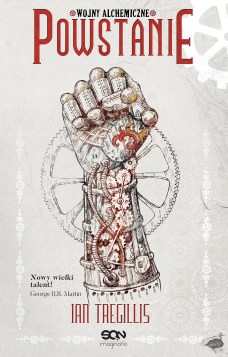
When I received this second volume of the Alchemy Wars, the rising, it was most fortunately a weekend, and I devoured it within the two days! As hinted at by the title, hence not truly a spoiler!, this book ends up with the rise of the robots, thanks to the main characters already there in the first volume, Jax (reXened Daniel) the freed robot, Bérénice [missing her acute accents] the French master spy (code name Talleyrand), and Longchamp the charismatic commander of the Montréal (renamed Marseille-in-the-West) fortress. While the author seems to have invested more in the language of the Dutch Empire than in the one of the remaining French exiled to Québec, I did not spot crimes de lèse majesté on my native language (except for the above accents). A mystery remains though as to how, when crossing the Atlantic ocean, fugitives end up in Honfleur, east Normandy, and far inside the Channel. Returning to the plot per se, while its pace is breathless, with the revolutions of the characters’ paths bringing them into predictable contacts, and the dialogues are still great, the recourse to a hidden subterranean complex irked me as usual, while the repeated escapes of Bérénice from certain death, capture, brainwash, are just too much, even with the help of dei ex machina. This second volume is also less into pondering the meaning of free will and freedom, even though the sad discovery by Jax (sorry, Daniel!) of Neverland being somewhat a mirror of Netherlands is well-thought. Now waiting for the last volume and another free wekend (or a trip to Marseille!).

L’œuvre au noir

Posted in Books with tags , , , , , , on September 28, 2013 by xi'an

L‘œuvre au noir (The Abyss) is a 1968 book written by Marguerite Yourcenar I read decades ago and took with me this summer. It tells the story of Zeno(n), a mediaeval precursor of the Renaissance humanist, involved in medicine, alchemy, engineering and philosophy, but above all fighting or at least resisting the pressure of irrational beliefs and superstitions until they lead him to suicide. As acknowledged by Yourcenar in her notes, the character borrows from Renaissance scientists like Erasme, Giordano Bruno, Mikołaj Copernic, Leonardo da Vinci, and medical pioneers like Paracelsus (very much like Paracelsus!), Michel Serat and Etienne Dolet. Zenon is an atheist at a time when atheism is punished by burning at the stake, and an experimenter in an epoch when alchemy and dissection were assimilated to sorcery. The original title (translated as nigredo) is the first of the three steps in the alchemist transmutation process but also applies to the transformation of Zenon from what the society planned for him into a free and rational man. So free that he could choose himself the time and manner of his death. So rational that he reached a spiritual solitude that made him see his fellow humans with the doctor’s detached compassion and the philosopher’s pessimistic analysis of their superstitions. (The English title is just missing the point!)

This is a 20th century novel (on which Yourcenar tolled for many years, from three short stories to the final version), which makes the highly modern vision of the imaginary Zenon less remarkable than the steps made by the above real characters, but the text abounds in remarkable discussions and monologues that reminded me of similar passages in Memoirs of Hadrian. Both books are centred on (impossibly and unrealistically) exceptional men with visions that set them out of their historical time. The fate of Zenon is somehow underlying the whole book and his weak and failed attempt at fleeing Bruges and the Inquisition can be understood at the first step towards his philosopher’s suicide, preferring to face the ecclesiastical tribunal and debate of some of his ideas than Flemish smugglers and an inglorious end by being tossed into the North Sea. L‘œuvre au noir is a remarkable if pessimistic book that reflects on science and intolerance in a beautiful style, a book that I put in par with the equally great Memoirs of Hadrian.