Archive for The Name of the Rose

a journal of the conquest, war, famine, and death year [minus two fingers]

Posted in Books, Kids, pictures, Statistics, Travel, University life with tags , , , , , , , , , , , , , , , , , , , , , , , , , , on November 8, 2023 by xi'an

Read The House of Shattered Wings, by Aliette de Bodard, which involves a character with two fingers eventually missing. A British Science Fiction Association Award and for once a rather impressive horror story taking place in an alternative 1900’s Paris partly destroyed by a war between Houses run by fallen angels. With connections with French occupied Annam. The construct is quite original, with some great characters, if over-prone to introspection. Got through as well Trouble on the Thames, by Victor Bridges (!), a British Library thriller classic I bought when visiting the Alan Turing Institute. A light and short spy story from the 1930’s with amusingly outdated dialogues and postures, a nice way to go through a sleepless night. And received as B’Day present  the BD version of Umberto Eco’s Name of the Rose by Milo Manara, a pleasant return to this great book, with fantastic colours and creative miniatures. As usual with Manara, the depiction of the female character is unrealistic and anachronic.

Watched the Korean TV show, Songs of the Bandits, which as a coincidence also involves a character with two fingers eventually missing. While providing an interesting foray into Korean history under Japanese pre-WW II occupation and offering an original scenario among K dramas, with an Eastern Western flavour, the fighting scenes are ridiculous (and gory), while the Japanese occupiers are caricaturesque. The final episode further feels inconclusive.

Made jars and jars of fig jam till early October, as the fig tree was bursting with ripe figs that were mostly escaping marauding birds. As well as more jars of rhubarb jam.

book reviews

Posted in Books, Kids, Mountains, pictures, Travel with tags , , , , , , , , , , , , on May 8, 2023 by xi'an

“I believe neither in luck nor in destiny, I trust only the science of probabilities. I have studied mathematical statistics, combinatorial analysis, mass functions, and random variables, and they never have held any surprise for me.”

Over the past weeks, I read  both second and third volumes of The Mirror Visitor series, by Christelle Dabos, keeping to the (remarkable) English translation. With a new dramatic challenge and a new location facing the heroine in each volume, following the classical unities!, although the overall goal of defeating “God” remains. Enjoying both the universe building and (mostly) the heroine’s perspective, much less the repeating pattern of her interactions with her almost abusive husband. And even less the communitarianisation of people by their magical skills (albeit a common flaw in fantasy literature!). While possibly slowing down, the third volume remains a page turner and reenacts another common feature of YA fantasy books, namely the magician school, albeit with a welcome distanciation from Ophelia who suffers it to reach the “finis Africae” of the Babel library (which obviously reminded me of Borges). And still enjoying the covers by Laurent Gapaillard!

I also read Peter May’s Black House, a detective story about an perplexing (of course!) murder, coupled with a trauma reminisced by the main (?) character (or the reverse). The scene is the Isle of Lewis, Scotland, part of the Outer Hebrides along with Harris, of tweed fame. And quite distinct from the rest of Scotland. Inducing well-done if somewhat repetitive descriptions of the landscape and the weather. Actually the book insists way too much on these peculiarities and seems intent in going through all of them (crofters, chessmen, peat harvesting, rigid Presbyterianism, Gaelic speakers, and gannet hunting). Nonetheless, it presents an interesting triangle between the main characters and, while the reasons leading to the murder require some suspension of belief due to the excessive accumulation of terrible deeds, the reminiscence (and lack thereof) of the adult detective of his childhood is well done, although he does not emerge that well from the unraveling of his younger self, even when comparing with other Tartan noir characters like McIlvanney’s Laidlaw and Rankin’s Rebus. I hope the following volumes keep the same tension, despite the idiosyncrasies of the place being exhausted…

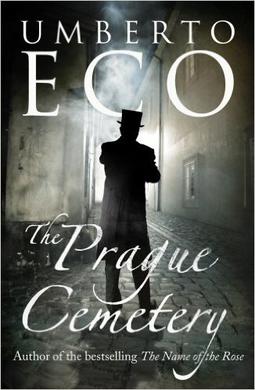
Il cimitero di Praga

Posted in Books, Travel with tags , , , , , , , on July 15, 2012 by xi'an

In the plane back from Kyoto, I did read most of Umberto Eco’s The Prague Cemetery, as my computer was down and as I had by then reviewed both PhD theses I had taken with me…  I am always impressed by Eco’s books and the erudition they show, and I read The Name of the Rose several times. I also enjoyed very much Foucault’s Pendulum as well as the Island of the Day Before.

The main idea of this book is to demonstrate how modern anti-semitism was fueled by conservatism forces during the French and the Italian 19th century revolutions. And how forged documents were produced to this effect, culminating with the alas famous Protocols of the Elders of Zion. The story mostly takes place in Paris, as the central character is an agent provocateur and con-artist at the centre of those forgeries, employed by various and sometimes ennemy secret services and societies to move public opinions against Jews, free-masons and republicans. Not only he is at the origin of the Protocole, but he also forged the letter incriminating Captain Dreyfus (and later Esterházy). Not a very pleasant character, to be sure. Especially since he suffers from schizophrenia. And seems to be only motivated by greed. Not a pleasant story either!

Once again, and as usual with Eco’s books, the story is well-documented. Actually, the author says that every character appearing in the book is real except for the narrator. However, I find the pseudo-Dickensian/Dumasian style Eco adopted in this book rather heavy-going, while the plot is not particularly gripping. In a related vein of conspiracies and secret societies, Foucault’s Pendulum was way better..