Archive for Science

Nature tidbits [6 Aug 2026]

Posted in Books, pictures, University life with tags , , , , , , , , , , , , , , , , , , , , , , , , , on October 7, 2026 by xi'an

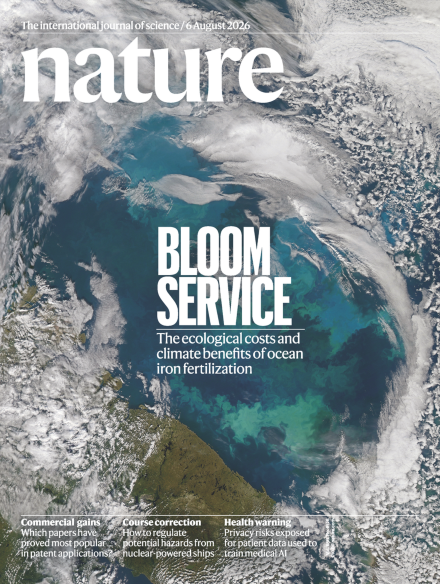
The 6 August issue of Nature arrived after my return from Japan, but it took me a while to catch up, the more because its cover story, Bloom service, about fertilising the oceans with iron as a carbon sink did not appeal much to the geoengineering sceptic in me. Nice pun though. Flotsam of interest for me:

  • an article on GPT-4 (and open-weight models) predicting the outcomes of 70 preregistered US survey experiments, 469 effects and 119,330 participants in total. The predicted treatment effects are highly correlated with the observed ones, about as well as pooled human forecasters do, including studies published after the training cutoff. But the predicted effect sizes are systematically too large, which is not a minor detail for a field still recovering from its replication crisis! Plus a survey of 460 social scientists about using LLMs for pilot testing, and a web app to “forecast” your own experiment’s effect before running it. (I wonder what a prior elicited this way would look like.)
  • a paper on membership inference attacks on medical AI models, showing that patients who differ from the majority are the easiest to identify as part of the training data, which I already discussed here. This fits the long-known issue with differential privacy and outliers.
  • a story on the four 2026 Fields Medals, announced at the ICM in Philadelphia, in fields far, far away:
    • Yu Deng (Chicago), for his work on PDEs, including a rigorous derivation of the Boltzmann equation from hard-sphere dynamics (with Zaher Hani and Xiao Ma), wave kinetic equations, and probabilistic approaches to nonlinear Schrödinger equations.
    • John Pardon (Stony Brook), for symplectic topology and enumerative geometry. He started as an undergraduate by answering a question of Gromov on knot distortion.
    • Jacob Tsimerman (Toronto), for extending techniques within arithmetic and complex algebraic geometry and solving conjectures in this field.
    • Hong Wang (NYU and IHES in Bures-sur-Yvette, almost a colleague!), for Fourier restriction, progress on Falconer’s conjecture and, with Joshua Zahl, the resolution of the Kakeya conjecture in three dimensions.
  • a feature on the scientific papers most cited in patents.
  • a news item on a Science paper by Blasi, Hamilton, Gray and Bowern, estimating that humanity may have spoken tens of thousands of languages between 3,000 and 1,000 years ago. The paper suggests a shift away from nomadic life triggered this diversity before it collapsed. I wonder at how deep the statistical linguistics inferring this rich past from the surviving sample goes. In a sense, the finding is not that surprising, given how isolated small prehistoric communities were, and how quickly a language drifts apart without contact. (I would also like to check how much the estimate depends on the assumed birth-and-death rates of languages, since the lost ones leave no trace to calibrate against…)
  • an editorial on the White House’s “new golden age for science” plan. It argues that such a golden age needs open borders and funding for the social sciences, public health and the humanities, not only AI and engineering. Alas, the now usual Trump.2.0 fare, with an AI funding roll-out in the news pages.
  • an emergency call by WHO director-general Tedros Adhanom Ghebreyesus on why the WHO has never been more needed, and news that the first volunteer received an Ebola vaccine three months into the current outbreak.
  • a forecast that the coming El Niño should be the largest (by a mind-blowing margin) on record, pushing 2027 temperatures to new highs. And already having severe impact on tropical weather.
  • a scary comment on the risks of nuclear-powered merchant ships, in the very issue dated on the anniversary of Hiroshima…

International Day of Woman & Girls in Science

Posted in Kids, pictures, University life with tags , , , , , , , , , , , , , on February 11, 2026 by xi'an

Nature tidbits [10 July 2025]

Posted in Books, Kids, pictures, University life with tags , , , , , , , , , , , , , , , , , , , , , , , , , on August 27, 2025 by xi'an

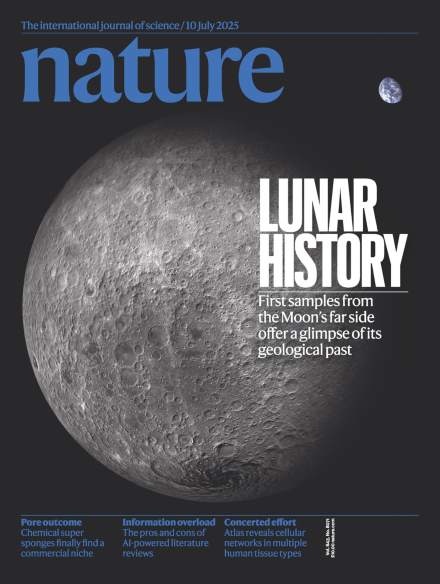
With a beautiful cover and a wealth of papers following China’s mission on the hidden side of the Moon, this issue offers
  • another “feel-good” editorial on the need for a highly ambitious UN treaty on plastics, or rather against plastic, at the August meeting in Geneva this month. Given the opposition of major producers like the USA (now more than ever!) and China, as well as all oil producers, the terrible impact of plastics  on life as a whole (also documented in this issue) is again likely to be ignored in favour of short-term commercial goals. (As illustrated by a feature article on metal-organic frameworks that capture CO² but are posing clear biosafety and environmental challenges, not mention in the article.)
  • a second editorial on the rise of metascience, a term I had not X’ed previously, which appears to be the science of scientific practice and impact. Given the limited impact scientists have on governments and societies, now more than ever!,  it is hard to forecast that metascientists will do better…
  • a rather tone-deaf tribune by the president of the Weizmann Institute on how they are reconstructing the institute after the Iranian attacks of 15 June (following the Israeli attacks of 13 June that hit several universities and assassinated several nuclear scientists). With empty words for “scientists in Gaza” when the very same Israeli government that funds Weizmann has flattened all academic and medical institutions in Gaza. (The asymmetry was later pointed out by a letter to the Nature editor from an Iranian scientist.) Followed a few pages later by the covarege an independent survey on a likely 80,000 death toll in Gaza.
  • A news article on the US National Academy of Sciences, Engineering and Medicine failing to take a stand against Trump 2.0, and too readily engaging into collaboration and censorship. And another one on the growing number of foreign scientists arrested at the border for carrying biological material. While I have (in the long past!) carried a raw milk Camembert in my bag and into the US, mea culpa (Io), I am less sympathetic to these cases since some of the material was hazardous, beyond being undeclared. What has changed in the recent is Homeland Security jumping on these cases to increase their deportation figures…
  • A long comment by Cantabrigians on the ambivalent role of AIs in writing and reviewing papers, with a proposed fix through the Conservative Evidence database, in Cambridge, England. A lot of coulds, woulds, and shoulds, imposing an international involvement, open access, and reliable procedures separating chaff from grain…

Nature tidbits [19 June 2025]

Posted in Books, Kids, pictures, Travel, University life with tags , , , , , , , , , , , , , , , , , , , , , , , , , , , , , , , , , , , , , , , , , , on August 9, 2025 by xi'an

Editorials on China becoming the World scientific superpower, along with a call for continued collaboration under security risk assessment, the news that all incoming Nature publications will come accompanied by the full editorial process (reviews and authors’ responses), which sounds most sensible to me, another call for novel research indicators to be used eg in the REF but… being co-funded by Elsevier is not especially promising!—along with a Nature investigation on paper mills—, and another personal take calling for new FAA models on air controller loads, which are too light according to the author!, who thinks controllers can handle several flights concurrently.

News on the incoming Vera Rubin Observatory telescope in Chile—if not close to the Atacama peaks I climbed during ISBA 2004—and its unique technology (with a camera the size of a car!). As well as a highlight on African space agencies (where I discovered that Egypt is the most active). Plus, a rather vague report on ether0 as a “stepping stone towards a reasoning model“,  once again playing with words and double meaning on what’s reason(ing). Further entries (alas!) onH ow Trump 2.0 is reshaping science with the impact of barring entry to 19 countries’ nationals and China multiplying calls to attract researchers from abroad and keep students in the country. Including unusually large salaries and benefits. (Pangolins and axolotls make an appearance in both this issue and the next, how unlikely is this?! With the conflicting items of information that the former are primarily hunted for their scales or for their taste.)

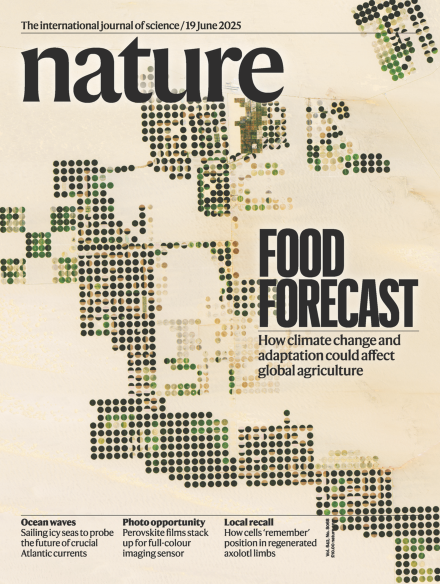
The most frightening section of the 19 June issue is however on the threat of a collapse of the Atlantic Meridional Overturning Circulation (AMOC), which would bring a new Ice Age to Western Europe and dramatic changes in the weather worldwide. Along with several research articles on climate change and its impacts.

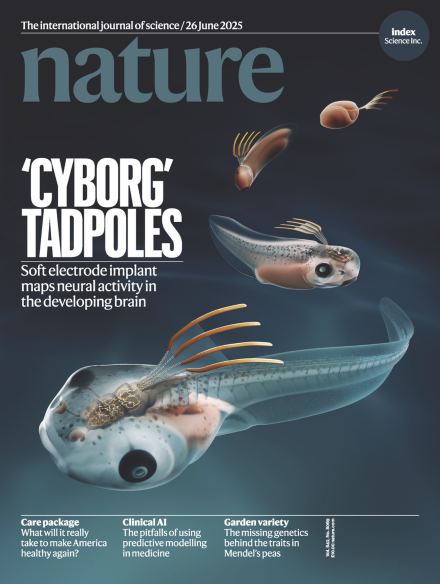
Nature tidbits [26 June 2025]

Posted in Books, Kids, Travel, University life with tags , , , , , , , , , , , , , , , , , , , , , , , , , , , , on August 1, 2025 by xi'an

Editorials on how fast advances in computer vision and face recognition are lacking in ethical standards (with plenty of shoulds and musts, but no proposal to enforce those),  a call for stronger condemnations of Trumpian attacks on science and academics by international scientific institutions, taking as a leading example a statement of concern by the Pontifical Academy of Science (or Pontificia Academia Scientiarum in plain latin) in Vatican, which, considering the history of the relations between Church and Science, is not an obvious choice!, another (mostly) Trumpian-induced plea for the return of foreign aid to low and middle income countries from the high income donors, rather than focussing on defence budgets (again with no practical strategy to achieve this goal)—with different headings in printed and online versions.

Half-a-dozen entries on How Trump 2.0 is reshaping science, from the federal judicial ruling that NIH grants are illegal since discriminatory (with no immediate impact), to the new vaccine panel members set by RF Kennedy with a dearth of experts and the arrival of vaccine sceptics (or worse), to a Nature supplement entitle Science Inc., looking at private funding to compensate for federal disengagement (with France’s Sanofi and Capgemini deserving a mention, for once), to an original Nature—and KFF, a non-profit health-policy research organization from San Francisco— investigation on how to make the US healthy again. If at all feasible.

As expected, the gap with other wealthy (and more healthy) nations is stupendous for many criteria. Caused by much higher death rates associated with COVID-19, substance misuse, chronic diseases, transport accidents (poor public facilities), and gun deaths (of course, even though this latter cause was recently removed from the HSS website). With a significant difference between States and ethnicities. The fixes requiring more federal intervention and money, as well as opposing the gun lobby, it is very very unlikely this is going to happen, witness the recent cut on Medicaid.

“one 5-year-old out of every 20 will die before the age of 45 The comparable figure is one in 50 in the United Kingdom and one in 100 in Switzerland.”