Archive for reinforcement learning

Nature tidbits [10 Sept 2026]

Posted in Books, pictures, Travel, University life with tags , , , , , , , , , , , , , , , , , , , , , , , , , , , , , , , , , , , , , , , , , , , , , , , , , , , , on October 21, 2026 by xi'an

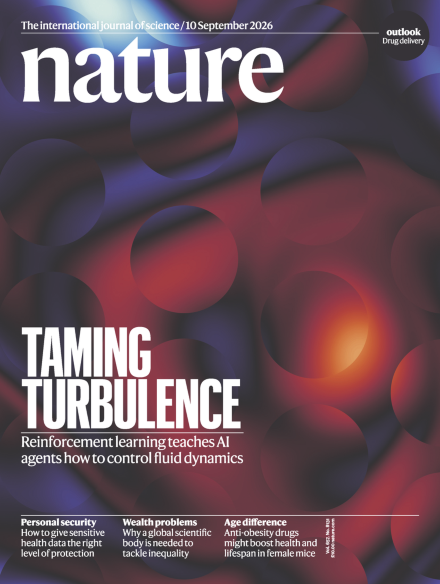
Having left my copy of the 10 September issue of Nature on a suburban train this afternoon (hopefully to the benefit of a fellow passenger!), I had to fall back on the online version. The cover story, Taming turbulence, is about HydroGym, a reinforcement-learning platform where AI agents learn to control turbulent flows. While this has practical consequences, it is also the harbinger of the resolution (?) of the Navier-Stoke Millennium Problem by OpenAI. Covered in the following issue.

Flotsam of interest for me:

  • reporting on a single data point exciting cosmologists (and beyond!), namely one unusual flash recorded in 2023 or 2024 by the LZ detector thru its 10 tonnes liquid xenon basin, which looks like what a weakly interacting massive particle (WIMP!) would produce. This would be a fist in experimentally supporting the dark matter theory. But without reproducibility, ’tis hard to jump to a conclusion. In correlation, a news article on the launch of the Nancy Grace Roman Space Telescope, with two World Views, one on Roman herself as “mother of Hubble”. Promising advances on far, far away celestial bodies thanks to the infrared abilities of said telescope. And again to cosmology.
  • a news feature on “the Einstein test”, checking whether language models trained only on pre-1905 data could rediscover relativity. This is a clever way to separate creativity from regurgitation, if the historical training corpus can indeed be kept clean. And faster than training monkeys to type…
  • an article combining climate and econometric modelling to assess how human-induced climate change has shifted, and will shift, the burden of childhood malaria in Africa. The attribution relies on counterfactual climate simulations, which makes me wonder about the propagation of uncertainty.
  • an article linking US mortgage records from around the Second World War to race and immigration status. It shows that New Deal programmes disproportionately excluded Black borrowers, a nice (if sad) record-linkage exercise.
  • a privacy feature on how UK Biobank was shut down after a data leak and is now imposing new safety measures. It raises the recurrent tension between protecting participants’ privacy and keeping data open to researchers, which connects once more with the membership-inference paper I discussed earlier.
  • an editorial praising the World Bank for publishing and verifying the raw data and code behind its reports. Other agencies should indeed follow suit!
  • a news item on the massive experience of mutating every DNA letter in a viral genome, whose effects the top AI models failed to predict (fail or pass the survival test!). A welcome reality check on AI in biology.

  • two militant comments on the economy, one by Joseph Stiglitz et al. calling for an IPCC-like International Panel on Inequality, and one on a call for measuring growth through all forms of capital, rather than GDP alone. And a great poster (reminding me of Indian movie posters) on the side!
  • an editorial on the comforting aspect of the Ig Nobel prizes, no matter how silly they sound.
  • a book review of The Winding Trail &tc. on the Principia Mathematica and Newton’s disdain for hypotheses (with his famous “hypotheses non fingo” that clashes with the modern scientific approach!), along with his habit of feuding over priority. What is amazing with Newton’s meteor trajectory is he only seriously engage into mathematics during his final undergraduate term at Cambridge, one year before the Great Plague and his revolutionary breakthroughs!

SEINE AI

Posted in pictures, Statistics, University life with tags , , , , , , , , , , , , , , , , , , , , , , on March 23, 2026 by xi'an

Ten days ago I took part in the SEINE AI 2026 workshop in Jouy-en-Josas, near Paris (homestead of HEC), organised by the Huawei Paris Research Center.. In which I was invited to speak, even though I felt sort of an outlier given the deeply machine-learning, entreprenarial orientation of the meeting, with its theme being Building the Agentic Future of ICT, given that I chose to present our most recent Bayesian adversarial privacy paper. Hence, I stood within a game-theoretic, Bayesian, formal landscape, presumably loosing most of the audience and keeping them away from their lunch!

Other speakers included Simon Lucas from Queen Mary London on Simulation-based AI, which I had trouble distinguishing from building a statistical model by goodness of fit (and using bandits used for update), while focussing on competing on some computer game challenges. And Volker Tresp from LMU München on a tensor brain model that he opposes to a Bayesian brain (with a related paper entitled Bayes or Heisenberg: Who(se) rules? which we discussed in general terms over lunch, namely Bayesian learning vs. quantum updating. And Michal Valko from INRIA Paris (and other companies), who went full blast against the Bradley-Terry model!, with a title of Nash and Nemirovski walk into a bar! With a half-time technique approximating Nash equilibria that reminded me of leapfrog. Much entertaining talk that further provided a game-theoretic transition to mine’s.

As an aside, I played yesterday with ChatGPT composing my talk slides out of our arXiv document and it proved a disaster, with hallucinations of results and concepts not in the paper and a complete mess of handling graphs, first creating generic, fake, unrelated pictures, then inserting actual graphs haphazardly throughout the slides. The sorry result I obviously did not use as the workshop did not seem the ideal place for this sort of prank! The actual version only recycles a few of its summarising slides. (With ye Norse farce proper colour choice!)


OWABI⁷, 26 February 2026: Prequential posteriors (11am UK time)

Posted in Books, Statistics, University life with tags , , , , , , , , , , , , , , on February 25, 2026 by xi'an

Speaker:  Shreya Sinha Roy (University of Warwick)

Title: Prequential posteriors
Abstract: Data assimilation is a fundamental task in updating forecasting models upon observing new data, with applications ranging from weather prediction to online reinforcement learning. Deep generative forecasting models (DGFMs) have shown excellent performance in these areas, but assimilating data into such models is challenging due to their intractable likelihood functions. This limitation restricts the use of standard Bayesian data assimilation methodologies for DGFMs. To overcome this, we introduce prequential posteriors, based upon a predictive-sequential (prequential) loss function; an approach naturally suited for temporally dependent data which is the focus of forecasting tasks. Since the true data-generating process often lies outside the assumed model class, we adopt an alternative notion of consistency and prove that, under mild conditions, both the prequential loss minimizer and the prequential posterior concentrate around parameters with optimal predictive performance. For scalable inference, we employ easily parallelizable wastefree sequential Monte Carlo (SMC) samplers with preconditioned gradient-based kernels, enabling efficient exploration of high-dimensional parameter spaces such as those in DGFMs. We validate our method on both a synthetic multi-dimensional time series and a real-world meteorological dataset; highlighting its practical utility for data assimilation for complex dynamical systems.
Keywords: diffusion models, simulation based inference, sequential methods.
Reference: S. S. Roy, R. Everitt, C. P Robert, R. Dutta. Prequential posteriors. Preprint at ArXiv:2511.17721, 202

Nature snipets [17 April 2025]

Posted in Books, Kids, University life with tags , , , , , , , , , , , , on June 25, 2025 by xi'an

From the Nature 17 April Issue:

Novemberly MCMC

Posted in Kids, Statistics, University life with tags , , , , , , , , , , , , , , on November 10, 2023 by xi'an