Archive for genocide

virtual yeast and real migrants [Nature, 2 July]

Posted in Books, Statistics, Travel, University life with tags , , , , , , , , , , , , , , , , , , , , on November 14, 2026 by xi'an

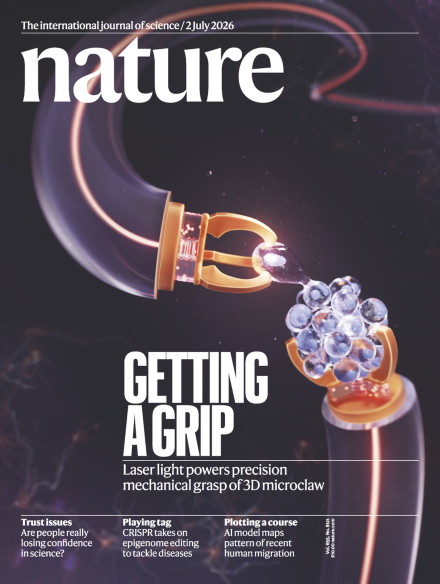
The 2 July issue of Nature—that stayed under a pile of unread journals after my return from Japan—came with (a nice cover about a 38 micrometer claw! and) an article I found quite exciting from a statistical perspective, namely a “deep learning of human migration”, a reconstruction of global migrations in the past decades. It estimates yearly migration flows between 230 countries and territories from 1990 to now, using an ensemble of deep recurrent neural networks fed with 18 geographic, economic, cultural and political covariates (and INSEE data). The headline figure is that global migration went from about 13 million people a year in 2000 to around 35 million in 2023. But the news & views comment questions the ultimate utility of the outcome in identifying new trends and keeping track of (rapidly changing) migration channels. On top of this article:

a feature, backed by an Editorial, goes against the grain of the “trust in science is collapsing” narrative. A large survey, nearly 72,000 people in 68 countries in 2022–23, gives an average trust score of 3.6 out of 5. The cracks are located rather than general. In Britain, trusting science “a lot” fell from 63% in 2020 to 34%, but in the US, confidence in scientists even among Republican-leaning respondents only fell from 85% in 2020 to 65% in 2025, while Democrats barely moved. I liked the point that some studies find that admitting uncertainty makes scientific information look more trustworthy than overconfident statements do. Much less that YouTube and similar platforms were the main source of science information. In the same issue, a World view on scientists acknowledging their own political biases, and a comment with six ways to bring the public into science and policy.)

Then another news piece on “Is AI ruining our skills?”. Unsurprisingly, early evidence says yes. with 70% of US nurses and 77% of US physicians worried about losing skills through over-reliance on AI. One researcher puts it nicely: users perform well because they are “borrowing skills from the AI” without acquiring them. The GPS comparison is made too, and I can vouch for that one personally. Whether students who never derived a Gibbs sampler by hand will ever realise when it fails is a question solved at exam time…

The books & arts section reviews The Political Economy of Rwanda’s Rise by P Behuria  (open access on Cambridge Core). Covering Rwanda’s attempt to rebuild its economy after the 1994 genocide into one of the fastest-growing in Africa as a regional services hub. But the authoritarian nature of Kagane’s regime and its involvement in rebel groups in Eastern Congo may put the brake on this development…

And to conclude on a lighter note, a perspective “Towards the construction of a virtual yeast”. It sounds like a digital twin of S. cerevisiae, build from eight functional modules, each with a dedicated AI tool, and a large language model to coordinate them, with active experiments closing the loop. I wonder whether this virtual yeast could help in my prospective sourdough project, but this will need wait another few years!

Navanethem “Navi” Pillay, 2026 Nobel Peace Prize

Posted in Kids, Travel with tags , , , , , , , , , , , , , , , , , on October 11, 2026 by xi'an

“The Nobel Peace Prize for 2026 goes to a person who with exceptional courage and integrity has led the way towards a more comprehensive global legal order. This year’s laureate has been instrumental in ensuring that war crimes, crimes against humanity and genocide are prosecuted. Navi Pillay’s commitment to universal legal principles and her firm moral compass are constants in a long career. Born into a family of Indian Tamil origin under apartheid in Durban, South Africa, Pillay became a lawyer and legal pioneer, confronting deep structural discrimination, segregation and exclusion. A common thread runs from her early work defending Nelson Mandela and others who stood up against apartheid to her service as a judge in some of the key international court cases of our time.”

“This year’s laureate has significantly enlarged the scope and impact of international law. She has served as a judge on the High Court in South Africa, the International Criminal Tribunal for Rwanda and the International Criminal Court. She was the United Nations High Commissioner for Human Rights and, until recently, she chaired the UN Independent International Commission of Inquiry on the Occupied Palestinian Territory. Today Navi Pillay is a judge on the International Court of Justice in the case where Myanmar stands accused of genocide.”

“At a time of existential challenges – including more wars and conflicts than the world has seen in a long time – international law is no longer just a supplement to peace and security. It is an absolute necessity. And yet, the system of international law is under tremendous pressure, and its institutions are under attack. We see a shift towards power politics at the expense of legal frameworks and global respect for law and justice. Whenever might overtakes right, it undermines stability, trust and peaceful co-existence. In awarding this year’s Nobel Peace Prize, the Norwegian Nobel Committee wants to remind the world that the rule of law – national and international – underpins the system we have set up to ensure peace and resolve conflicts non-violently. Peace requires justice.”

“Navi Pillay is one of the great defenders of international legal principles in our time. Her distinguished career reminds us of the need to support, fortify and expand the global rule of law. Navi Pillay’s commitment to justice and human dignity is a source of hope and inspiration to all who seek to bring about a more peaceful world.”

Vive les Nations unies ! Merci

Posted in Books, Kids, pictures, Travel with tags , , , , , , , , , , , , , , , , , , , , , , , , , , , , , , on October 5, 2026 by xi'an

On his last year of the French Presidency, Emmanuel Macron delivered a marathon speech at the UN General Assembly (which he could attend, contrary to the Palestinian delegation). Here it is, verbatim, and en français. The principles stated therein are commendable and aligned with the fundamentals of a progressive, multilateralist, integral democracy.  Unfortunately, the EU and even more France on its own are mostly unable to make progress on the directions highlighted in this discourse…  (It does not help that the French government caved in on Russian sanctions a few days earlier to free hostages in Azerbaïdjan. Or that a stress test published the previous day shoes France is poorly protected against reactionary, illiberal drifts à la Trump or à la Orban.)

Depuis ce matin, ici se succèdent les discours qui disent l’état du monde. Et j’ai peur de manquer d’originalité en le décrivant. Chacun décrit en effet le retour de l’impérialisme, de l’arrogance, du retour à la force sans règle ni retenue. Un monde au fond de concentration du pouvoir où quelques-uns pensent qu’on peut battre en brèche l’ordre international pour élargir ses frontières, où d’autres pensent qu’on peut fouler au pied la souveraineté des peuples pour en disposer soi-même, et où quelques-uns pensent pouvoir décider de l’avenir de la planète, qu’il s’agisse du climat ou de l’intelligence artificielle. Au fond, la question qui nous est posée de manière très simple consiste à savoir si nous voulons vivre dans cet état de nature, avec une forme de retour de la loi de la jungle ou dans une société internationale civilisée. Notre devoir, plus que jamais, est de nous tenir droit aux côtés des Nations unies pour décider précisément ensemble de l’intérêt commun, c’est-à-dire du côté de ceux qui veulent choisir librement leur destin, leurs alliances, leurs modèles de développement, leur avenir, du côté de ceux qui refusent que leur souveraineté soit confisquée par la force injuste ou par la peur, et du côté de l’espoir. C’est la raison d’être de notre organisation, cette maison commune qui réunit les peuples libres, égaux, qui est fondée sur l’égalité souveraine de chacun de ses membres. C’est notre charte qui empêche que la puissance des uns leur permette de décider pour les autres. C’est elle surtout qui nous oblige à faire ensemble la démonstration de notre engagement et de notre capacité d’agir utilement.
Continue reading →

Doctors Without Borders (MSF) expelled from Gaza!

Posted in Kids with tags , , , , , , , , , , on February 4, 2026 by xi'an

a journal of the four horsemen year

Posted in Books, Kids, Mountains, pictures, Running, Travel, University life, Wines with tags , , , , , , , , , , , , , , , , , , , , , , , , , , , , , , , , , , , , , , , , , , , , on January 7, 2026 by xi'an

Read a very light space-opera novel, (The Belt) Entanglement, by G.M. Kilby, with shallow characters, shallow plot with an unlikely McGuffin (a uniquely advanced quantum computer, even 20y later) and implausible rescue episodes (incl. one where a character punctures their spacesuit to recover from a broken propulsion thruster!). This book stands million years away from monuments of the genre, like Arthur C. Clarke‘s, Isaac Asimov‘s, Orson Scott Card‘s, Frank Herbert‘s or, to cite more recent writers, Iain Banks‘s, ‘sJohn Scalzi‘s, Becky Chambers‘s… I will most certainly not become entangled in the sequels! And am contemplating with glee attacking recent purchases and gifts, like Tasmyn Muir’s Nona the Ninth, Philip Pullman’s The Rose Field (Book of dust finale), and Florent Chavouet‘s Tokyo Sanpo (to revive memories of March’s visit to Edo!), discovered while attending an exhibit on Studio Ghibli’s Isao Takahata at Maison du Japon .

Brought back several litres of Andalusian olive oil from Sevilla! And made fresh green pici over the turn of the year, with spinach replacing water in the dough (following a recipe posted on the food weekly of France Inter), as well as three different dishes from the same batch of Norman scallops.

Watched Wake Up Dead Man, by Ryan Johnson, the third instalment of Benoît Blanc’s investigations. Which is rather fun, the more because Daniel Craig is visibly having fun playing a Southerner detective and over-doing his accent, while leaving a large chunk of the stage to other actors, like Josh O’Connor playing the junior, soul-searching priest. The plot itself is light and somewhat irrelevant (if with a wink to old classics of closed room murders, conveniently appearing in a Book Club list, if missing Gaston Leroux’s Mystère de la chambre jaune, as well as to Hitchcok’s Vertigo with a dolly zoom effect at the most dramatic instant), while the suspicion revolving among all characters is worth watching. Also tried a few episodes Just a bit Espers (ちょっとだけエスパー), a Japanese TV series on a group of almost ordinary persons with limited ExtraSensory PERception. The characters are nice but the plot is very weak, the resort to time travel all too common to this type of stories, the resolutions to the episodic challenges embarrassingly cringy, and the part of the story where a new employee (Bunty) has to play along being married to another (Shiki) who genuinely believes they are married is quite uncomfortable, to say the least…