Archive for non-parametrics

statistical modeling with R [book review]

Posted in Books, Statistics with tags , , , , , , , , , , , , , , , , , , , , , , , , , , , , , , , , , , , , , , on June 10, 2023 by xi'an

Statistical Modeling with R (A dual frequentist and Bayesian approach for life scientists) is a recent book written by Pablo Inchausti, from Uruguay. In a highly personal and congenial style (witness the preface), with references to (fiction) books that enticed me to buy them. The book was sent to me by the JASA book editor for review and I went through the whole of it during my flight back from Jeddah. [Disclaimer about potential self-plagiarism: this post or a likely edited version of it will eventually appear in JASA. If not CHANCE, for once.]

The very first sentence (after the preface) quotes my late friend Steve Fienberg, which is definitely starting on the right foot. The exposition of the motivations for writing the book is quite convincing, with more emphasis than usual put on the notion and limitations of modeling. The discourse is overall inspirational and contains many relevant remarks and links that make it worth reading it as a whole. While heavily connected with a few R packages like fitdist, fitistrplus, brms (a  front for Stan), glm, glmer, the book is wisely bypassing the perilous reef of recalling R bases. Similarly for the foundations of probability and statistics. While lacking in formal definitions, in my opinion, it reads well enough to somehow compensate for this very lack. I also appreciate the coherent and throughout continuation of the parallel description of Bayesian and non-Bayesian analyses, an attempt that often too often quickly disappear in other books. (As an aside, note that hardly anyone claims to be a frequentist, except maybe Deborah Mayo.) A new model is almost invariably backed by a new dataset, if a few being somewhat inappropriate as in the mammal sleep patterns of Chapter 5. Or in Fig. 6.1.

Given that the main motivation for the book (when compared with references like BDA) is heavily towards the practical implementation of statistical modelling via R packages, it is inevitable that a large fraction of Statistical Modeling with R is spent on the analysis of R outputs, even though it sometimes feels a wee bit too heavy for yours truly.  The R screen-copies are however produced in moderate quantity and size, even though the variations in typography/fonts (at least on my copy?!) may prove confusing. Obviously the high (explosive?) distinction between regression models may eventually prove challenging for the novice reader. The specific issue of prior input (or “defining priors”) is briefly addressed in a non-chapter (p.323), although mentions are made throughout preceding chapters. I note the nice appearance of hierarchical models and experimental designs towards the end, but would have appreciated some discussions on missing topics such as time series, causality, connections with machine learning, non-parametrics, model misspecification. As an aside, I appreciated being reminded about the apocryphal nature of Ockham’s much cited quote “Pluralitas non est ponenda sine necessitate“.

Typo Jeffries found in Fig. 2.1, along with a rather sketchy representation of the history of both frequentist and Bayesian statistics. And Jon Wakefield’s book (with related purpose of presenting both versions of parametric inference) was mistakenly entered as Wakenfield’s in the bibliography file. Some repetitions occur. I do not like the use of the equivalence symbol ≈ for proportionality. And I found two occurrences of the unavoidable “the the” typo (p.174 and p.422). I also had trouble with some sentences like “long-run, hypothetical distribution of parameter estimates known as the sampling distribution” (p.27), “maximum likelihood estimates [being] sufficient” (p.28), “Jeffreys’ (1939) conjugate priors” [which were introduced by Raiffa and Schlaifer] (p.35), “A posteriori tests in frequentist models” (p.130), “exponential families [having] limited practical implications for non-statisticians” (p.190), “choice of priors being correct” (p.339), or calling MCMC sample terms “estimates” (p.42), and issues with some repetitions, missing indices for acronyms, packages, datasets, but did not bemoan the lack homework sections (beyond suggesting new datasets for analysis).

A problematic MCMC entry is found when calibrating the choice of the Metropolis-Hastings proposal towards avoiding negative values “that will generate an error when calculating the log-likelihood” (p.43) since it suggests proposed values should not exceed the support of the posterior (and indicates a poor coding of the log-likelihood!). I also find the motivation for the full conditional decomposition behind the Gibbs sampler (p.47) unnecessarily confusing. (And automatically having a Metropolis-Hastings step within Gibbs as on Fig. 3.9 brings another magnitude of confusion.) The Bayes factor section is very terse. The derivation of the Kullback-Leibler representation (7.3) as an expected log likelihood ratio seems to be missing a reference measure. Of course, seeing a detailed coverage of DIC (Section 7.4) did not suit me either, even though the issue with mixtures was alluded to (with no detail whatsoever). The Nelder presentation of the generalised linear models felt somewhat antiquated, since the addition of the scale factor a(φ) sounds over-parameterized.

But those are minor quibble in relation to a book that should attract curious minds of various background knowledge and expertise in statistics, as well as work nicely to support an enthusiastic teacher of statistical modelling. I thus recommend this book most enthusiastically.

ISBA 18 tidbits

Posted in Books, Mountains, pictures, Running, Statistics, Travel, University life with tags , , , , , , , , , , , , , , , , , on July 2, 2018 by xi'an

Among a continuous sequence of appealing sessions at this ISBA 2018 meeting [says a member of the scientific committee!], I happened to attend two talks [with a wee bit of overlap] by Sid Chib in two consecutive sessions, because his co-author Ana Simoni (CREST) was unfortunately sick. Their work was about models defined by a collection of moment conditions, as often happens in econometrics, developed in a recent JASA paper by Chib, Shin, and Simoni (2017). With an extension about moving to defining conditional expectations by use of a functional basis. The main approach relies on exponentially tilted empirical likelihoods, which reminded me of the empirical likelihood [BCel] implementation we ran with Kerrie Mengersen and Pierre Pudlo a few years ago. As a substitute to ABC. This problematic made me wonder on how much Bayesian the estimating equation concept is, as it should somewhat involve a nonparametric prior under the moment constraints.

Note that Sid’s [talks and] papers are disconnected from ABC, as everything comes in closed form, apart from the empirical likelihood derivation, as we actually found in our own work!, but this could become a substitute model for ABC uses. For instance, identifying the parameter θ of the model by identifying equations. Would that impose too much input from the modeller? I figure I came with this notion mostly because of the emphasis on proxy models the previous day at ABC in ‘burgh! Another connected item of interest in the work is the possibility of accounting for misspecification of these moment conditions by introducing a vector of errors with a spike & slab distribution, although I am not sure this is 100% necessary without getting further into the paper(s) [blame conference pressure on my time].

Another highlight was attending a fantastic poster session Monday night on computational methods except I would have needed four more hours to get through every and all posters. This new version of ISBA has split the posters between two sites (great) and themes (not so great!), while I would have preferred more sites covering all themes over all nights, to lower the noise (still bearable this year) and to increase the possibility to check all posters of interest in a particular theme…

Mentioning as well a great talk by Dan Roy about assessing deep learning performances by what he calls non-vacuous error bounds. Namely, through PAC-Bayesian bounds. One major comment of his was about deep learning models being much more non-parametric (number of parameters rising with number of observations) than parametric models, meaning that generative adversarial constructs as the one I discussed a few days ago may face a fundamental difficulty as models are taken at face value there.

On closed-form solutions, a closed-form Bayes factor for component selection in mixture models by Fũqene, Steel and Rossell that resemble the Savage-Dickey version, without the measure theoretic difficulties. But with non-local priors. And closed-form conjugate priors for the probit regression model, using unified skew-normal priors, as exhibited by Daniele Durante. Which are product of Normal cdfs and pdfs, and which allow for closed form marginal likelihoods and marginal posteriors as well. (The approach is not exactly conjugate as the prior and the posterior are not in the same family.)

And on the final session I attended, there were two talks on scalable MCMC, one on coresets, which will require some time and effort to assimilate, by Trevor Campbell and Tamara Broderick, and another one using Poisson subsampling. By Matias Quiroz and co-authors. Which did not completely convinced me (but this was the end of a long day…)

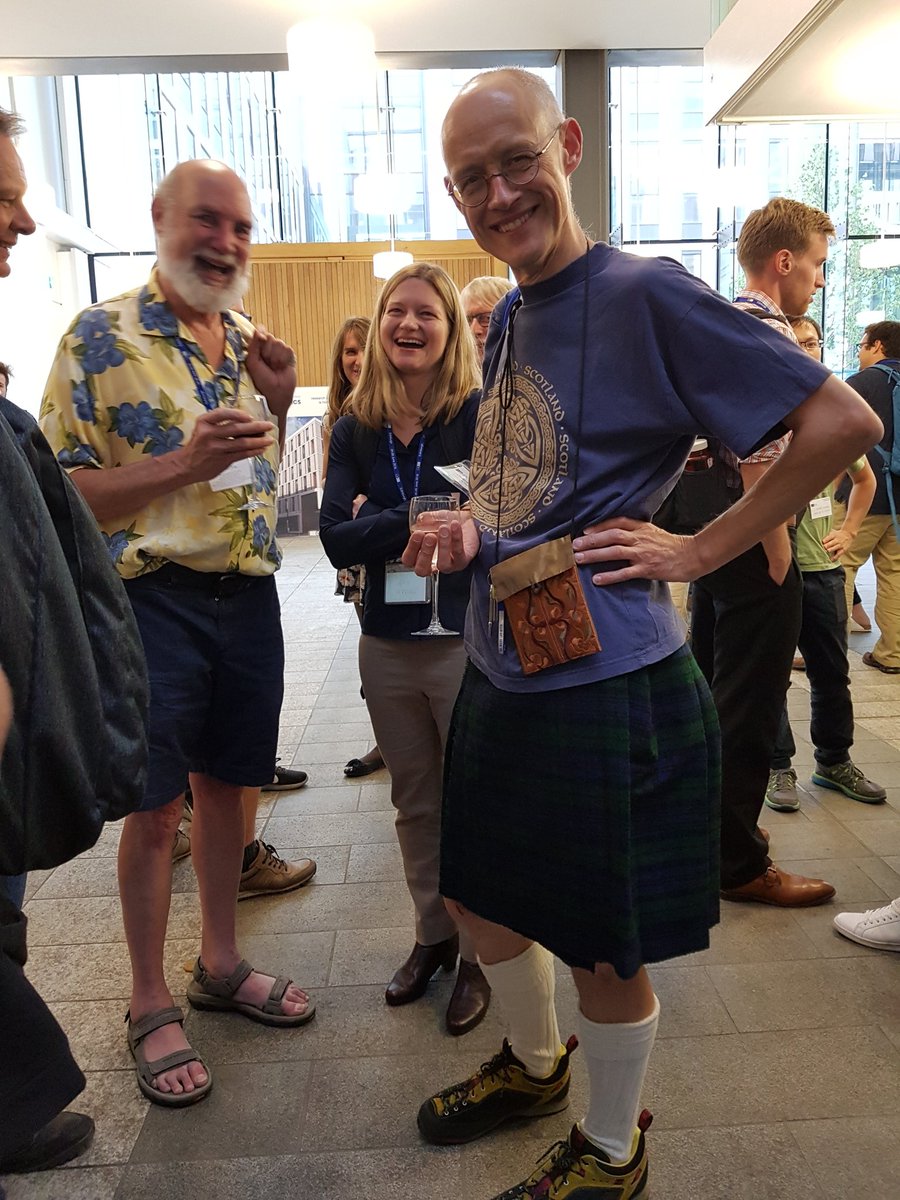
All in all, this has been a great edition of the ISBA meetings, if quite intense due to a non-stop schedule, with a very efficient organisation that made parallel sessions manageable and poster sessions back to a reasonable scale [although I did not once manage to cross the street to the other session]. Being in unreasonably sunny Edinburgh helped a lot obviously! I am a wee bit disappointed that no one else follows my call to wear a kilt, but I had low expectations to start with… And too bad I missed the Ironman 70.3 Edinburgh by one day!

fast ε-free ABC

Posted in Books, Mountains, pictures, Running, Statistics, Travel, University life with tags , , , , , , , , , on June 8, 2017 by xi'an

Last Fall, George Papamakarios and Iain Murray from Edinburgh arXived an ABC paper on fast ε-free inference on simulation models with Bayesian conditional density estimation, paper that I missed. The idea there is to approximate the posterior density by maximising the likelihood associated with a parameterised family of distributions on θ, conditional on the associated x. The data being then the ABC reference table. The family chosen there is a mixture of K Gaussian components, which parameters are then estimated by a (Bayesian) neural network using x as input and θ as output. The parameter values are simulated from an adaptive proposal that aims at approximating the posterior better and better. As in population Monte Carlo, actually. Except for the neural network part, which I fail to understand why it makes a significant improvement when compared with EM solutions. The overall difficulty with this approach is that I do not see a way out of the curse of dimensionality: when the dimension of θ increases, the approximation to the posterior distribution of θ does deteriorate, even in the best of cases, as any other non-parametric resolution. It would have been of (further) interest to see a comparison with a most rudimentary approach, namely the one we proposed based on empirical likelihoods.

empirical Bayes, reference priors, entropy & EM

Posted in Mountains, Statistics, Travel, University life with tags , , , , , , , , , , , on January 9, 2017 by xi'an

Klebanov and co-authors from Berlin arXived this paper a few weeks ago and it took me a quiet evening in Darjeeling to read it. It starts with the premises that led Robbins to introduce empirical Bayes in 1956 (although the paper does not appear in the references), where repeated experiments with different parameters are run. Except that it turns non-parametric in estimating the prior. And to avoid resorting to the non-parametric MLE, which is the empirical distribution, it adds a smoothness penalty function to the picture. (Warning: I am not a big fan of non-parametric MLE!) The idea seems to have been Good’s, who acknowledged using the entropy as penalty is missing in terms of reparameterisation invariance. Hence the authors suggest instead to use as penalty function on the prior a joint relative entropy on both the parameter and the prior, which amounts to the average of the Kullback-Leibler divergence between the sampling distribution and the predictive based on the prior. Which is then independent of the parameterisation. And of the dominating measure. This is the only tangible connection with reference priors found in the paper.

The authors then introduce a non-parametric EM algorithm, where the unknown prior becomes the “parameter” and the M step means optimising an entropy in terms of this prior. With an infinite amount of data, the true prior (meaning the overall distribution of the genuine parameters in this repeated experiment framework) is a fixed point of the algorithm. However, it seems that the only way it can be implemented is via discretisation of the parameter space, which opens a whole Pandora box of issues, from discretisation size to dimensionality problems. And to motivating the approach by regularisation arguments, since the final product remains an atomic distribution.

While the alternative of estimating the marginal density of the data by kernels and then aiming at the closest entropy prior is discussed, I find it surprising that the paper does not consider the rather natural of setting a prior on the prior, e.g. via Dirichlet processes.

Peter Hall (1951-2016)

Posted in Books, Statistics, Travel, University life with tags , , , , , , , , , , , , , on January 10, 2016 by xi'an

I just heard that Peter Hall passed away yesterday in Melbourne. Very sad news from down under. Besides being a giant in the fields of statistics and probability, with an astounding publication record, Peter was also a wonderful man and so very much involved in running local, national and international societies. His contributions to the field and the profession are innumerable and his loss impacts the entire community. Peter was a regular visitor at Glasgow University in the 1990s and I crossed paths with  him a few times, appreciating his kindness as well as his highest dedication to research. In addition, he was a gifted photographer and I recall that the [now closed] wonderful guest-house where we used to stay at the top of Hillhead had a few pictures of his taken in the Highlands and framed on its walls. (If I remember well, there were also beautiful pictures of the Belgian countryside by him at CORE, in Louvain-la-Neuve.) I think the last time we met was in Melbourne, three years ago… Farewell, Peter, you certainly left an indelible print on a lot of us.

[Song Chen from Beijing University has created a memorial webpage for Peter Hall to express condolences and share memories.]