Archive for University of Cambridge

publication crAIsis

Posted in Books, Kids, Statistics, University life with tags , , , , , , , , on November 18, 2026 by xi'an

In the September issue of the IMS Bulletin, Po-Ling Loh discusses the urgency to act in the face of the AI disruption to mathematical research and in particular to the publication modus vivendi in academia—that indeed seems to have hit the wall—. This of course intersects with similar concerns and fears in the community, from departmental to international society meetings on a course of action towards a seismic change for the profession.

“Rather than accepting a new reality where researchers are disincentivized to share their work publicly through an arXiv posting or research talk prior to publication, we could purposely excise speed and competition from the research pipeline, thereby stemming the cutthroat competition that threatens to engulf our field. In such an alternative reality, I believe mathematical joy, depth, and beauty could continue to flourish (…) Looking ahead, even if the mathematical abilities of an LLM may soon surpass those of an individual mathematician, we can hold onto hope that the collective skills of a community of mathematicians, collaborating together and assisted by LLMs, might achieve mathematical advances beyond what one human-directed AI system could discover (…) [My proposal is to] only consider papers that are a collaboration of enough experts in a sub-area [and] only submit a paper after agreeing that it contained a truly new, important result”

Po-Ling Loh’s idea is to incentivize collective work and forget about the competitiveness in the profession that is now exacerbated by LLMs, by only considering collaborative works. There is something nice about it, as I always enjoyed the fun and excitement of thinking and working together during small workshops with brainstorming periods, if it rarely concludes with a major discovery. However, I completely fail to see how this would stem the flood of individual submissions to journals and preprint servers—as exemplified by the Polsongate—. Or how a collective (not a von Mises Kollektiv!) would better resists the call of the AI. And how junior, isolated, off-the-grid, researchers would not suffer from this new publication pattern…

Obviously, I am as clueless as most on how to reAIct. For instance, hard bars on publication volumes per individual seem impossible to implement (and will likely create further publications outlets, most likely predatory ones). Using LLMs to check LLM papers is just feeding the beast plus contributing to the glut of papers no one will ever read or check. But it is clear that our journals are now under massive strain that cannot persist for long…
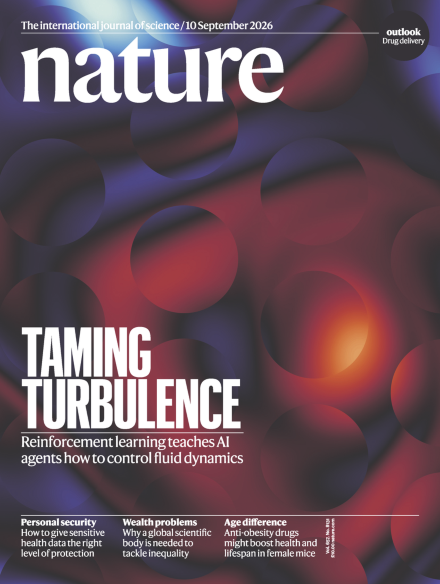
Nature tidbits [10 Sept 2026]

Posted in Books, pictures, Travel, University life with tags , , , , , , , , , , , , , , , , , , , , , , , , , , , , , , , , , , , , , , , , , , , , , , , , , , , , on October 21, 2026 by xi'an

Having left my copy of the 10 September issue of Nature on a suburban train this afternoon (hopefully to the benefit of a fellow passenger!), I had to fall back on the online version. The cover story, Taming turbulence, is about HydroGym, a reinforcement-learning platform where AI agents learn to control turbulent flows. While this has practical consequences, it is also the harbinger of the resolution (?) of the Navier-Stoke Millennium Problem by OpenAI. Covered in the following issue.

Flotsam of interest for me:

  • reporting on a single data point exciting cosmologists (and beyond!), namely one unusual flash recorded in 2023 or 2024 by the LZ detector thru its 10 tonnes liquid xenon basin, which looks like what a weakly interacting massive particle (WIMP!) would produce. This would be a fist in experimentally supporting the dark matter theory. But without reproducibility, ’tis hard to jump to a conclusion. In correlation, a news article on the launch of the Nancy Grace Roman Space Telescope, with two World Views, one on Roman herself as “mother of Hubble”. Promising advances on far, far away celestial bodies thanks to the infrared abilities of said telescope. And again to cosmology.
  • a news feature on “the Einstein test”, checking whether language models trained only on pre-1905 data could rediscover relativity. This is a clever way to separate creativity from regurgitation, if the historical training corpus can indeed be kept clean. And faster than training monkeys to type…
  • an article combining climate and econometric modelling to assess how human-induced climate change has shifted, and will shift, the burden of childhood malaria in Africa. The attribution relies on counterfactual climate simulations, which makes me wonder about the propagation of uncertainty.
  • an article linking US mortgage records from around the Second World War to race and immigration status. It shows that New Deal programmes disproportionately excluded Black borrowers, a nice (if sad) record-linkage exercise.
  • a privacy feature on how UK Biobank was shut down after a data leak and is now imposing new safety measures. It raises the recurrent tension between protecting participants’ privacy and keeping data open to researchers, which connects once more with the membership-inference paper I discussed earlier.
  • an editorial praising the World Bank for publishing and verifying the raw data and code behind its reports. Other agencies should indeed follow suit!
  • a news item on the massive experience of mutating every DNA letter in a viral genome, whose effects the top AI models failed to predict (fail or pass the survival test!). A welcome reality check on AI in biology.

  • two militant comments on the economy, one by Joseph Stiglitz et al. calling for an IPCC-like International Panel on Inequality, and one on a call for measuring growth through all forms of capital, rather than GDP alone. And a great poster (reminding me of Indian movie posters) on the side!
  • an editorial on the comforting aspect of the Ig Nobel prizes, no matter how silly they sound.
  • a book review of The Winding Trail &tc. on the Principia Mathematica and Newton’s disdain for hypotheses (with his famous “hypotheses non fingo” that clashes with the modern scientific approach!), along with his habit of feuding over priority. What is amazing with Newton’s meteor trajectory is he only seriously engage into mathematics during his final undergraduate term at Cambridge, one year before the Great Plague and his revolutionary breakthroughs!

first man below the 6:00:00 barrier on the 5000m?!

Posted in Kids, Mountains, Running, Statistics, University life with tags , , , , , , , , on February 14, 2026 by xi'an

When I spotted this arXiv posting by Nils Hjort, Six-Minute Man Sander Eitrem 5:58.52 – first man below the 6:00.00 barrier, discussing Sander Eitrem‘s massive gain from the month-old previous record by Frenchman Timothy Loubineaud in Salt Lake City, just above 6’00”.. I was incredulous, not because I am knowledgeable in speed skating records, but because I was thinking of running… Where the World record is twice as large (12:35.36). Beyond my own personal interests, which drove the way I read this title, I was also stuck back in the past, with my last conversation with Nils being about long-distance running and record prediction, which happened quite a while ago when visiting the Isaac Newton Institute in Cambridge! (Nils’ note holds a reference to another famous Norwegian [runner], Jakob Ingebrigtsens.) Sander Eitrem also became the Olympic champion in Milano, breaking the Olympic record as well.

David MacKay  remembrance day [27 March, Cambridge]

Posted in Books, Statistics, Travel, University life with tags , , , , , , , , on February 8, 2026 by xi'an


[Re-posted:] Professor Sir David MacKay (1967-2016) made fundamental contributions to both public and theoretical understandings of energy and of information. He served as Chief Scientific Adviser to the Department of Energy and Climate Change and was Professor of Natural Philosophy in the Cavendish Laboratory before being appointed as the inaugural Regius Professor of Engineering. He was a Fellow of Darwin College.

This one-day meeting of the Cambridge Philosophical Society, dedicated to his memory, considers both the urgent challenges of sustainable energy resources and the global opportunities arising from information technologies. We will be addressing the two main themes of his work: machine learning, information theory and Bayesian inference, together with sustainable energy. The meeting marks the tenth anniversary of David’s death, with speakers who worked with David, build on his contributions in the field of energy and information, and share his values on the importance of clear and accessible communication.

The meeting in Cambridge University Engineering Department is open to all to attend, without charge. The lectures will be live-streamed; edited recordings will later be made available through the Cambridge Philosophical Society website. Registration for both in-person and virtual attendance is recommended.

David MacKay is remembered by many with great affection and respect as colleague, mentor and friend, and it will be good to share these memories. We have set up a webform for you to provide a personal tribute if you wish.

Natural statistical science [#1]

Posted in Books, pictures, Statistics, University life with tags , , , , , , , , , , , on November 22, 2023 by xi'an