![The shocking, rude, inappropriate apostrophe of the President of a foreign country on an official visit to the USA by an entitled, social-media-created, non-journalist, MAGA cap-wearing [speaking of style and dress!], nobody on last Friday reminded me of a negative comment made by someone on a social media about my teaching in Oxford wearing a tee-shirt after seeing this [official] picture [for the newly renovated building of the Department of Statistics], where you may spot several students who have now become brilliant junior researchers in statistics and machine learning. On a completely different scale, of course. While I have never worn a suit outside the French Navy, I have very rarely been confronted with critics of my dressing style, an additional good reason for choosing academia! Slava Ukraini!!!](https://i0.wp.com/www.galleries.johncairns.co.uk/Statistics_2.2.16/content/images/large/Statistics_by_John_Cairns_2.2.16-61.jpg)
Archive for objectivity
why don’t you wear a suit?!
Posted in Books, Kids, pictures, Travel, University life with tags baby Trump, black Friday, CDT, Centre for Doctoral Training, department of statistics, Des Moines, French Navy, Iowa, John Cairns, journalism, MAGA, objectivity, Oxford, OxWaSP, PhD students, Racoon River Brewing Co., Solidarity with Ukraine, Trump administration, University of Oxford, US politics, USA, Volodymyr Zelenskiy, White House on March 4, 2025 by xi'an![The shocking, rude, inappropriate apostrophe of the President of a foreign country on an official visit to the USA by an entitled, social-media-created, non-journalist, MAGA cap-wearing [speaking of style and dress!], nobody on last Friday reminded me of a negative comment made by someone on a social media about my teaching in Oxford wearing a tee-shirt after seeing this [official] picture [for the newly renovated building of the Department of Statistics], where you may spot several students who have now become brilliant junior researchers in statistics and machine learning. On a completely different scale, of course. While I have never worn a suit outside the French Navy, I have very rarely been confronted with critics of my dressing style, an additional good reason for choosing academia! Slava Ukraini!!!](https://i0.wp.com/www.galleries.johncairns.co.uk/Statistics_2.2.16/content/images/large/Statistics_by_John_Cairns_2.2.16-61.jpg)
principles of uncertainty
Posted in Books, R, Statistics, University life with tags book review, foundations, Jeffreys, Laplace's approximation, Lebesgue measure, Markov chains, MCMC, objective Bayes, objectivity, personalistic probability, R, renewal process, Steiltjes measure, subjectivity, uncertainty on October 14, 2011 by xi'an“Bayes Theorem is a simple consequence of the axioms of probability, and is therefore accepted by all as valid. However, some who challenge the use of personal probability reject certain applications of Bayes Theorem.” J. Kadane, p.44
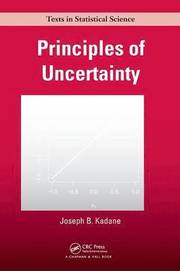
Principles of uncertainty by Joseph (“Jay”) Kadane (Carnegie Mellon University, Pittsburgh) is a profound and mesmerising book on the foundations and principles of subjectivist or behaviouristic Bayesian analysis. Jay Kadane wrote Principles of uncertainty over a period of several years and, more or less in his own words, it represents the legacy he wants to leave for the future. The book starts with a large section on Jay’s definition of a probability model, with rigorous mathematical derivations all the way to Lebesgue measure (or more exactly the McShane-Stieltjes measure). This section contains many side derivations that pertain to mathematical analysis, in order to explain the subtleties of infinite countable and uncountable sets, and the distinction between finitely additive and countably additive (probability) measures. Unsurprisingly, the role of utility is emphasized in this book that keeps stressing the personalistic entry to Bayesian statistics. Principles of uncertainty also contains a formal development on the validity of Markov chain Monte Carlo methods that is superb and missing in most equivalent textbooks. Overall, the book is a pleasure to read. And highly recommended for teaching as it can be used at many different levels. Continue reading