Archive for brain model

Nature tidbits [06 Nov 2025]

Posted in Books, Kids, pictures, Travel with tags , , , , , , , , , , , , , , , , , , , , , , , , , , , , , , , , , , , , , , , , , , on January 3, 2026 by xi'an

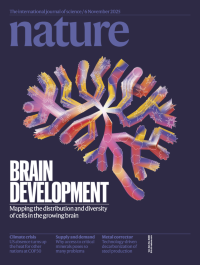
In this issue of Nature (I read on my way to Warwick), a pre-COP30 tribune, to be opposed to later issues!, with a positive take on the impact of the Trump Administration ignoring the conference, with the advances made by China and India (with a surprising 50% of “installed electricity generation capacity coming from non-fossil sources”, if more critical on Brazil’s efforts than the subsequent tribune by the Brazilian undersecretary for ecological transformation for environment, plus a tribune on the ambiguous terms used by countries to secure access to “critical” minerals, in tune with the on-going muscle-flexing attitudes of China and the US. Although the comment is more focussing on the universal access to minerals than to the protection of the workers extracting it and to the environmental impact of it. Followed though by another comment on the climate impact(s) on mining as (no longer) extreme weather events hinder mining all over the (mining) world.

A reflection on China’s 5y plan for science and its reaching a $500 billion annual investment in R&D, predicting (with a large confidence margin) that it will become the #1 power in sciences and technology in the coming decade. I am actually surprised that China has not yet achieved this goal for semi-conductors. And a tribune on the mixed signal of Takaichi Sanae becoming Japan’s first female prime minister, for science as a whole and for gender equity. (My take being that her having UK’s first female prime minister, Margaret Thatcher, as a role-model is not particularly promising. Just like the projection of Marine Le Pen on the verge of becoming France’s first female president does not carry any optimistic message!)

A light entry on a chemical analysis of the specifics of koti luwak (or civet coffee) that does not tell much, beside civet  digestion  adding caprylic and capric acids making beans lower in proteïns and higher in fat. Not yet reaching the goal of “leaving the animals out” from producing this luxury coffee ($75 a cup!).

An article on the shrinking number of US PhD admissions (in some colleges) conflicting with another article in a later issue of a stable influx. And a rather shallow article on the creativity or lack thereof of AI, along with the high sycophancy of LLMs,  to be opposed to a thoughtful reflection on how AI is radically changing the PhD experience and focus, if almost shelving statistics as a thing from the past! But insisting on graduates keeping their ability to check for the validity of their (AI’s)  statistical conclusions!! And another entry on the systematic dismantling of US federal scientific agencies like EPA, CDC, NASA, NOOA, NIH, &tc., by Trump -2.0, which beyond terminating staff contracts in huge proportions is culling the independence of these agencies. With generational impacts on science, training, and evidence-based policies.

A Where I work column featuring a pangolin treated by a Singapore vet, Charlene Yeong. (Unfortunately said pangolin was euthanised after the surgical intervention.) And a book review on the background and motivations of Francis Crick,  just prior to his collaborator James Watson passing away. As noted by the author, Cobb, as MRC staff and later non-resident fellow of the Salk Institute for Biological Studies in San Diego,  “Crick never had to teach or grapple with university administration: he applied for a grant only once in his life.” And concludes that he was not a saint or a hero but “an extraordinarily clever man with limits to his interests and perception”.

brain overload

Posted in Books, pictures with tags , , , on May 2, 2022 by xi'an

ABC on brain networks

Posted in Books, pictures, Statistics, University life with tags , , , , , , , , , , , , , on April 16, 2021 by xi'an

Research Gate sent me an automated email pointing out a recent paper citing some of our ABC papers. The paper is written by Timothy West et al., neuroscientists in the UK, comparing models of Parkinsonian circuit dynamics. Using SMC-ABC. One novelty is the update of the tolerance by a fixed difference, unless the acceptance rate is too low, in which case the tolerance is reinitialised to a starting value.

“(…) the proposal density P(θ|D⁰) is formed from the accepted parameters sets. We use a density approximation to the marginals and a copula for the joint (…) [i.e.] a nonparametric estimation of the marginal densities overeach parameter [and] the t-copula(…) Data are transformed to the copula scale (unit-square) using the kernel density estimator of the cumulative distribution function of each parameter and then transformed to the joint space with the t-copula.”

The construct of the proposal is quite involved, as described in the above quote. The model choice approach is standard (à la Grelaud et al.) but uses the median distance as a tolerance.

“(…) test whether the ABC estimator will: a) yield parameter estimates that are unique to the data from which they have been optimized; and b) yield consistent estimation of parameters across multiple instances (…) test the face validity of the model comparison framework (…) [and] demonstrate the scalability of the optimization and model comparison framework.”

The paper runs a fairly extensive test of the above features, concluding that “the ABC optimized posteriors are consistent across multiple initializations and that the output is determined by differences in the underlying model generating the given data.” Concerning model comparison, the authors mix the ABC Bayes factor with a post-hoc analysis of divergence to discriminate against overfitting. And mention the potential impact of the summary statistics in the conclusion section, albeit briefly, and the remark that the statistics were “sufficient to recover known parameters” is not supporting their use for model comparison. The additional criticism of sampling strategies for approximating Bayes factors is somewhat irrelevant, the main issue with ABC model choice being a change of magnitude in the evidence.

“ABC has established itself as a key tool for parameter estimation in systems biology (…) but is yet to see wide adoption in systems neuroscience. It is known that ABC will not perform well under certain conditions (Sunnåker et al., 2013). Specifically, it has been shown that the
simplest form of ABC algorithm based upon an rejection-sampling approach is inefficient in the case where the prior densities lie far from the true posterior (…) This motivates the use of neurobiologically grounded models over phenomenological models where often the ranges of potential parameter values are unknown.”

Nature snippets

Posted in Books with tags , , , , , on July 8, 2018 by xi'an

Besides this remarkable picture of a fox and an eagle fighting for a rabbit, posted in Nature of 7 June, I noticed [in Nature 24 May] an editorial by Richard McEalreath, author of the remarkable Statistical Rethinking, about a paper by González-Forero & Gardner developing a model for brain vs body growth, incorporating social and ecological challenges. The goal was to fit the actual growth in body mass and brain mass. As in the one below.Without reading the supplementary material, I cannot tell how much statistics was involved in preventing the “best fit” to turn to overfitting. But Richard McEalreath points out that this modelling goes away and presumably beyond the “purely statistical”, including regression approaches, without elaborating more on the methodological aspects.

at the brain institute

Posted in Kids, pictures, Travel, University life with tags , , , , , , , on January 24, 2017 by xi'an

brainsFor a rather convoluted reason, I happened to visit the Brain and Spine Institute (ICM, Institut du Cerveau et de la Moelle Épinière) yesterday, in Paris, within the Pitié-Salpétrière Hospital. And saw this row of brains, printed by 3D printers, rather than standing in jars. (Like Abe Normal’s.) Which produced brain shadows, not commonly seen otherwise!