Archive for antiquity

Thucydides 2.0

Posted in Statistics with tags , , , , , , , , , , , , , , on May 24, 2026 by xi'an

Last weekend, I was listening to one of my favourite (France Inter) radio shows, Quand les dieux rôdaient sur la Terre (when gods roamed the Earth), and the story was about the siege of the tiny island of Melos by the Athenians and the subsequent massacre, based on the report given in Thucydides’ History of the Peloponnesian War and in particular the Melian Dialogue. I was unaware of this episode, but the modern tone of the dialogue excerpts was striking and made me think they equally applied to modern leaders… To wit,

“The strong do what they can, and the weak suffer what they must.” — Melian Dialogue, Book V

“Most people, in fact, will not take the trouble in finding out the truth, but are much more inclined to accept the first story they hear.” — Book I, §20

“Men naturally despise those who court them, but respect those who do not give way to them.” — Book III, Cleon’s speech

“It is a common mistake in going to war to begin at the wrong end — to act first, and wait for disaster to find out what to do.” — Book I, §78

“Words had to change their ordinary meaning and to take that which was now given them. Reckless audacity came to be considered the courage of a loyal ally; prudent hesitation, specious cowardice.” — Book III, §8
riddles on Egyptian fractions and Bernoulli factories

Posted in Books, Kids, R with tags , , , , , , , , , , , , , on June 11, 2019 by xi'an

Two fairy different riddles on the weekend Riddler. The first one is (in fine) about Egyptian fractions: I understand the first one as

Find the Egyptian fraction decomposition of 2 into 11 distinct unit fractions that maximises the smallest fraction.

And which I cannot solve despite perusing this amazing webpage on Egyptian fractions and making some attempts at brute force  random exploration. Using Fibonacci’s greedy algorithm. I managed to find such decompositions

2 = 1 +1/2 +1/6 +1/12 +1/16 +1/20 +1/24 +1/30 +1/42 +1/48 +1/56

after seeing in this short note

2 = 1 +1/3 +1/5 +1/7 +1/9 +1/42 +1/15 +1/18 +1/30 +1/45 +1/90

And then Robin came with the following:

2 = 1 +1/4 +1/5 +1/8 +1/10 +1/12 +1/15 +1/20 +1/21 +1/24 +1/28

which may prove to be the winner! But there is even better:

2 = 1 +1/5 +1/6 +1/8 +1/9 +1/10 +1/12 +1/15 +1/18 +1/20 +1/24

The second riddle is a more straightforward Bernoulli factory problem:

Given a coin with a free-to-choose probability p of head, design an experiment with a fixed number k of draws that returns three outcomes with equal probabilities.

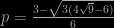
For which I tried a brute-force search of all possible 3-partitions of the 2-to-the-k events for a range of values of p from .01 to .5 and for k equal to 3,4,… But never getting an exact balance between the three groups. Reading later the solution on the Riddler, I saw that there was an exact solution for 4 draws when

p=\frac{3-\sqrt{3(4\sqrt{9}-6)}}{6}

Augmenting the precision of my solver (by multiplying all terms by 100), I indeed found a difference of

> solver((3-sqrt(3*(4*sqrt(6)-9)))/6,ba=1e5)[1]
[1] 8.940697e-08

which means an error of 9 x 100⁻⁴ x 10⁻⁸, ie roughly 10⁻¹⁵.

vacanze romane [jatp]

Posted in Statistics with tags , , , , , , , , , , on May 7, 2019 by xi'an