Archive for recycling

Nature tidbits [06 Feb 2025]

Posted in Statistics with tags , , , , , , , , , , , , , , , , , , , , , , , , , , , , , , , , , , , , , on March 10, 2025 by xi'an

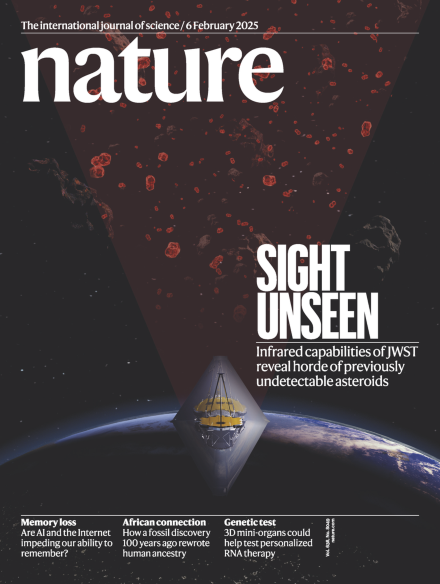
Entries about the scary rise in H5N1 risks of a human transmission, compounded by Trump’s America leaving WHO, hence the US connection with global monitoring and its substantial funding of the organization. Advising against drinking raw milk as a primary precaution. Even camembert?!

A (naïve, imho) call by the presidente of the Union of Concerned Scientists to boost scientific integrity to protect (US) federal research despite the chainsaw massacre unfolding daily in (US) federal agencies. And the disregard of said massacrers for accountability and legal boundaries. And unions, definitely unions.

Also entries (and two Nature collections) on the one hundredth anniversary of the Taung Child fossil uncovering, as the first Australophitecus africanus  that opened the way for the theory that Africa was the birthplace of humanity, along with other extended books reviews. On quantum theory (it’s complicated!, according to Sean Carroll) and Kepler mission (by Jason Steffen). And a show at Cité des Sciences in La Villette about silence that I would love to attend.

A quick assessment of deepseek against its competitors. Mostly praising its open code. And another one on 23andMe losses and trouble,  reflecting the one-shot strategy of the company that cannot sell its analysis more than once (despite repeatedly trying, as I can confirm from their frequent emails). And opening concerns about their data or rather our data. Since there is very little protection in the US for this kind of data, considered out of healthcare.

New challenges of large carnivores in Western Europe, with a rise of wolverines, success story for the Iberian lynx, talks of reintroducing wolves to Scotland (to cull red deer like those who roam Buachaille Mor), degrading setting in France with looser rules for shooting wolves.

Microplastics in the brain, unsurprisingly increasing the chances of clots and surprisingly easily moving into blood vessels and the brain. And, speakiMicroplastics in the brainng of plastic, recycling, at last? Warwick Manufacturing Group (WMG) mentioned as evaluating the life-cycle analysis of a new approach with superheated water. Exposing the elephant in the room, namely that there is very little true recycling going on and that part of the recycled plastic ends up as fuel, hence contributing to pollution. Costs and impact of turning used products into new material are mentioned (and staggering albeit not compared with the initial costs and impact.

And I remain perplexed by the Two-Eyed Seeing Indigenous perspective for neuroscience article. As I do not see the scientific component, besides directions to work with local communities.

innumerazione

Posted in Kids, Statistics, Travel with tags , , , , , on September 5, 2021 by xi'an

While vacationing in Corsica, I spotted this poster all over town (Bastia). About the weight of recycled garbage in Corsica. Its congratulation smelled somewhat fishy and trying to argue the point with my family I looked at what it meant in meaningful units….

Since the weight of 8 Eiffel Towers is about 80,000 tons and there are about 340,000 people residing in Corsica, this means 235kg are recycled by an average Corsican (if the figure does not include agriculture, industry, and service recycling). Which sounds close to the national figures, when considering the average 580kg of personal garbage produced by the average French. However, this statistic does not account for the likely impact of tourists (like us) on the figures. Considering that there are about 3 million tourists visiting Corsica every year, with [the conservative figure of] an average stay of one week, assuming that they recycle as well, the figure per inhabitant gets down. (This impact can also be spotted in the raw [!] figures per month, which are triple in August, when the majority of tourists is visiting, than in March.) Hence the figure is not so conclusive…

waste tide

Posted in Books, pictures, Travel with tags , , , , , , , , , , on April 11, 2021 by xi'an

I presumably bought this book upon a suggestion made by the Amazon AI. It sounded quite original and interesting. And translated by Ken Liu. I had not seen the above cover, but it would have only helped. (And reminded me of the daunting and bittersweet Tales from the Loop.)

“None of this, of course, existed in the digital world. In their place were highly abstract algorithms and programs that turned the complicated messy world into a set of mathematical models and topological spaces. Like a real spiderweb, the web would be deformed by any insect that got caught into it, and the rate at which such deformation evolved exceeded the rate at which information might be transmitted under the restricted-bitrate regulations. In this world, the shortest path between two points was no longer the straight line.”

Waste Tide is immensely puzzling and definitely interesting. A Chinese form of Neuromancer…. With further links to the Windup Girl. The location of the novel is a near-future island in Guiyu, China. Where the World electric waste ends up, to be processed and recycled by “waste people”. Who are despised by the original inhabitants of the island. And exploited by clans and American companies. Several of the main characters find themselves torn between several cultures, but these characters often sound a bit too caricaturesque. Just like the take-over of a “waste girl” by a residual AI is somewhat clumsy. Far from the constructs of Neuromancer or Windup Girl.

Another interesting side of the book is the translation by Ken Liu, who also translated The Three Body Problem. As well as published short stories of his own. The preface warns about the multiple languages co-existing in China, beyond the most well-known Cantonese and Mandarin and the book includes footnotes about the proper pronunciation of some words.

garbage in the air

Posted in pictures, Travel, Wines with tags , , , , , , , , , , on November 6, 2019 by xi'an

As I am flying today to Seoul, for the Fall meeting of the Korean Statistical Society, a somewhat interesting paper in the New York Times about switching to alternatives for airline catering (if not air travel), starting with the figure that a passenger generates on average 1.5kg of waste per flight. And pointing out the conflicting issues in recycling food waste in most countries as they see it as imported waste and potential imported pathogens.and biohazards… While getting rids of plastic items is a tiny step in the right direction, especially because airlines do not sort between different kinds of garbage, a major step would be to avoid replacing them by another disposable item, especially heavier ones. From getting rid of providing food and drink (except water) on short and medium-haul flights to aim at healthy foods that do not require packaging or utensils. Like fruits. And asking passengers to carry their own garbage when leaving the plane could also enhance the realisation of the amount of garbage they thus produced. (On a recent early morning flight between Paris and Birmingham, the plane supposedly could not leave until the late delivery truck had brought croissants and drinks, as if passengers could not have abstained for the 55mn the flight lasted, especially when most of them were sleeping…) Nowadays. I usually travel with a water bottle that I fill before boarding after security and often skip meals on flights, but it invariably proves difficult to ask flight attendants to use my own reusable cup rather than a single-use plastic cup.

unbiased product of expectations

Posted in Books, Statistics, University life with tags , , , , , , , , on August 5, 2019 by xi'an

m_biomet_106_2coverWhile I was not involved in any way, or even aware of this research, Anthony Lee, Simone Tiberi, and Giacomo Zanella have an incoming paper in Biometrika, and which was partly written while all three authors were at the University of Warwick. The purpose is to design an efficient manner to approximate the product of n unidimensional expectations (or integrals) all computed against the same reference density. Which is not a real constraint. A neat remark that motivates the method in the paper is that an improved estimator can be connected with the permanent of the n x N matrix A made of the values of the n functions computed at N different simulations from the reference density. And involves N!/ (N-n)! terms rather than N to the power n. Since it is NP-hard to compute, a manageable alternative uses random draws from constrained permutations that are reasonably easy to simulate. Especially since, given that the estimator recycles most of the particles, it requires a much smaller version of N. Essentially N=O(n) with this scenario, instead of O(n²) with the basic Monte Carlo solution, towards a similar variance.

This framework offers many applications in latent variable models, including pseudo-marginal MCMC, of course, but also for ABC since the ABC posterior based on getting each simulated observation close enough from the corresponding actual observation fits this pattern (albeit the dependence on the chosen ordering of the data is an issue that can make the example somewhat artificial).