Archive for Huber loss

Nature tidbits

Posted in Books, pictures, Statistics, University life with tags , , , , , , , , , , , , , , , , on September 2, 2024 by xi'an

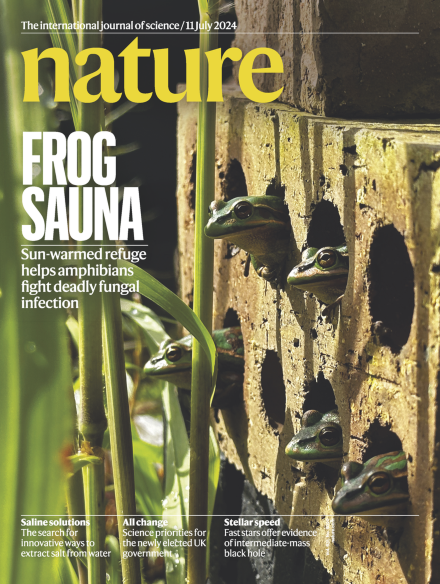
Going quickly through the four issues of Nature I found in my mailbox when returning from the Pacific Northwest, beyond the great picture of these frogs warming up, and fighting fungal infection, in the 11 July edition, a few (Sunday morn breakfast) quick reads from the 4 July 2024 edition:

  • a “technology and tools” long article on picking the “right” loss function when constructing an algorithmic predictor or another ML tool, although the author remains vague about the “rightness” part (with an incorrect entry for Huber loss). The message is however clearly that tuning the loss function to the problem one wants to address is (obviously) key. With additional advices about properly handling outliers, avoiding overfitting, and correctly modelling noise. In short, run a proper statistical analysis!
  • a call for neuroscientists not to be afraid of studying religions, which should sound like an obviousness, but believers and religious leaders are often so touchy about their faith that running representative scientific studies of the “brain processes associated with religiosity and spirituality” may prove inaccessible. I also find the statement “researchers might be able to get a better handle on what (if any) alterations happen in people’s brains in the rare instances when religious belief turns to radicalized action or sectarian hatred” closer to Brave New World or Clockwork Orange than to the purpose of Nature!
  • the warmest summer ever, ever, ever…
  • a scary story from South Korea where an academic got sentenced to two years in prison for sharing data with Chinese collaborators on “national core technology”, a case reminiscent of similar ones earlier in the US. And where the academic researcher is again seen as the sole culprit instead of their university or the government sharing the responsibility. In France, the imminent threat to turn mathematics and statistics labs into restrictive regime zones (ZRR), with much heavier constraints on visitors and students, and on publication contents, carried by the researchers themselves, pertains from the same tendency. (A personal illustration of the induced administrative absurdities: my datascience lab being next to a biomedical ZRR lab, I am not allowed to use the lift shared by both units, but can nonetheless reach the same spot using the nearby stairs.)

Familial inference

Posted in Statistics, University life with tags , , , , , , , , , on October 3, 2023 by xi'an

An ISBA-BNP webinar on Wednesday, 4 October, at 17:00 UTC by my friend Steve McEachern:

Familial inference: Tests for hypotheses on a family of centers

Many scientific disciplines face a replicability crisis. While these crises have many drivers, we focus on one. Statistical hypotheses are translations of scientific hypotheses into statements about one or more distributions. The most basic tests focus on the centers of the distributions. Such tests implicitly assume a specific center, e.g., the mean or the median. Yet, scientific hypotheses do not always specify a particular center. This ambiguity leaves a gap between scientific theory and statistical practice that can lead to rejection of a true null. The gap is compounded when we consider deficiencies in the formal statistical model. Rather than testing a single center, we propose testing a family of plausible centers, such as those induced by the Huber loss function (the Huber family). Each center in the family generates a point null hypothesis and the resulting family of hypotheses constitutes a familial null hypothesis. A Bayesian nonparametric procedure is devised to test the familial null. Implementation for the Huber family is facilitated by a novel pathwise optimization routine. Along the way, we visit the question of what it means to be the center of a distribution. The favorable properties of the new test are demonstrated theoretically and in case studies.
This is joint work with Ryan Thompson (University of New South Wales), Catherine Forbes (Monash University), and Mario Peruggia (The Ohio State University).