Archive for sourdough

virtual yeast and real migrants [Nature, 2 July]

Posted in Books, Statistics, Travel, University life with tags , , , , , , , , , , , , , , , , , , , , on November 14, 2026 by xi'an

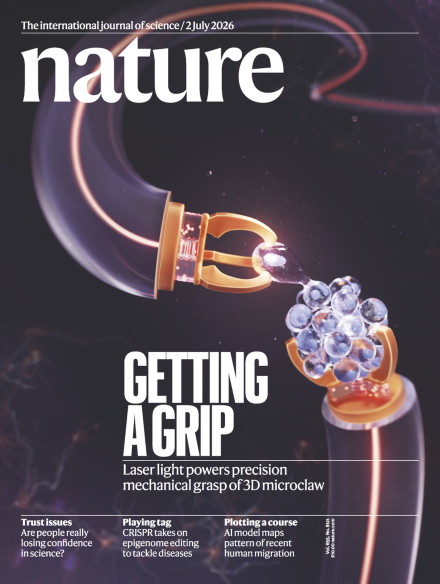
The 2 July issue of Nature—that stayed under a pile of unread journals after my return from Japan—came with (a nice cover about a 38 micrometer claw! and) an article I found quite exciting from a statistical perspective, namely a “deep learning of human migration”, a reconstruction of global migrations in the past decades. It estimates yearly migration flows between 230 countries and territories from 1990 to now, using an ensemble of deep recurrent neural networks fed with 18 geographic, economic, cultural and political covariates (and INSEE data). The headline figure is that global migration went from about 13 million people a year in 2000 to around 35 million in 2023. But the news & views comment questions the ultimate utility of the outcome in identifying new trends and keeping track of (rapidly changing) migration channels. On top of this article:

a feature, backed by an Editorial, goes against the grain of the “trust in science is collapsing” narrative. A large survey, nearly 72,000 people in 68 countries in 2022–23, gives an average trust score of 3.6 out of 5. The cracks are located rather than general. In Britain, trusting science “a lot” fell from 63% in 2020 to 34%, but in the US, confidence in scientists even among Republican-leaning respondents only fell from 85% in 2020 to 65% in 2025, while Democrats barely moved. I liked the point that some studies find that admitting uncertainty makes scientific information look more trustworthy than overconfident statements do. Much less that YouTube and similar platforms were the main source of science information. In the same issue, a World view on scientists acknowledging their own political biases, and a comment with six ways to bring the public into science and policy.)

Then another news piece on “Is AI ruining our skills?”. Unsurprisingly, early evidence says yes. with 70% of US nurses and 77% of US physicians worried about losing skills through over-reliance on AI. One researcher puts it nicely: users perform well because they are “borrowing skills from the AI” without acquiring them. The GPS comparison is made too, and I can vouch for that one personally. Whether students who never derived a Gibbs sampler by hand will ever realise when it fails is a question solved at exam time…

The books & arts section reviews The Political Economy of Rwanda’s Rise by P Behuria  (open access on Cambridge Core). Covering Rwanda’s attempt to rebuild its economy after the 1994 genocide into one of the fastest-growing in Africa as a regional services hub. But the authoritarian nature of Kagane’s regime and its involvement in rebel groups in Eastern Congo may put the brake on this development…

And to conclude on a lighter note, a perspective “Towards the construction of a virtual yeast”. It sounds like a digital twin of S. cerevisiae, build from eight functional modules, each with a dedicated AI tool, and a large language model to coordinate them, with active experiments closing the loop. I wonder whether this virtual yeast could help in my prospective sourdough project, but this will need wait another few years!

a journal of the chaos⁺⁺⁺ year

Posted in Books, Kids, Mountains, pictures, Travel, Wines with tags , , , , , , , , , , , , , , , , , , , , , , on February 25, 2025 by xi'an

Read a second volume of Caimh McDonnell’s first Dublin trilogy, The Day That Never Comes, which I found a huge disappointment, from mixing too many stories and situations to the slow pace of the scenario, to the annoying childishness of the main characters, to the tired jokes and idiosyncrasies, to the once again unrealistic conclusion. I am not contemplating going through the following tomes. I also read over a weekend the last volume of Pascale Quiviger’s Le Royaume de Pierre d’Angle, Courage, which concludes this (YA?) fantasy novel. A little disappointed by this very long volume, even more than little… Part of the story is very secondary, even useless, and we quickly get tired of the fights between Jacquard and Victoire, as well as of the mistreatment of the entire castle staff by both of them. The lack of realism of the Pierre d’Angle universe is even more glaring in this volume, because of its inability both to provide the resources of a court like Louis XIV’s and to hide rebel orders. The resolution of the Catastrophe is even more disappointing. Both simplistic and incomplete, with aspects remindful of Italo Calvino’s novels, but which don’t stick.

Cooked a huge cabbage curry for my week in Les Houches, with chickpeas whose water (aquafaba) I recycled into the base of a vegan chocolate mousse as earlier visitors had left a box of powdered cocoa in the flat. And cooked morning crêpes there  (with a vengeance!) when the local bakery did not accept credit card payments for a baguette! Also went to a farmers’ market near the workshop hotel to buy sourdough, only to find that the dozens of loaves in the hall were all reserved but for one. But came back with a wild thyme crêpe offered by the baker.

Watched The boy and the heron, a Miyazaki anime on a fantastic quest of an orphaned boy to find a place in his recompose family. The drawings are beautiful but I alas find the story rather simplistic, with the boy’s attitude difficult to analyse and no critical position on the ongoing war (despite the boy’s father’s factory producing domes for Zero fighters).